Tuesday, 8 March 2022

All hail the monstrous regiment of women....


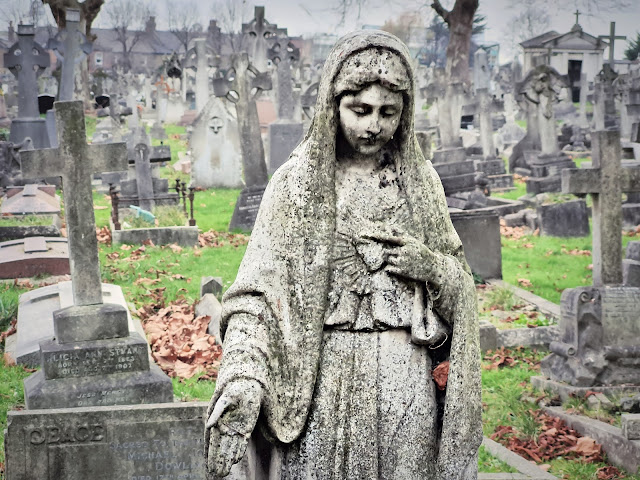
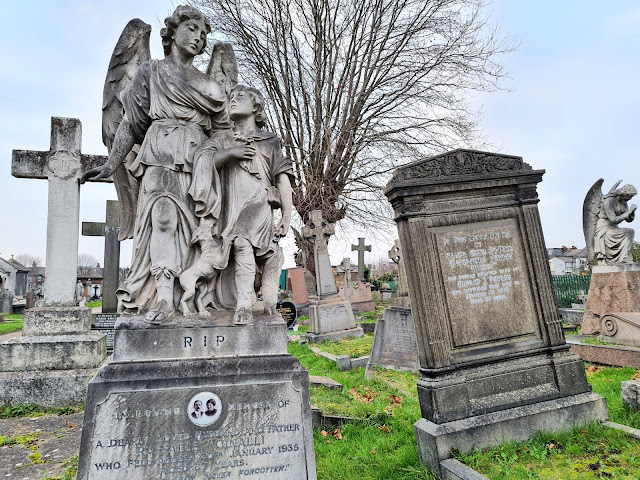
For International Women’s Day the London Dead would like to share some of its favourite memorials in London cemeteries and remember the intriguing women they commemorate. Cemeteries were (are) no less patriarchal than the rest of society so women long received unequal treatment and almost always second billing to their husbands. Women were viewed as nothing more than an adjunct to the significant male in their lives and recorded on tombstones as ‘daughter or wife of…’ (or even worse ‘relict of…’). But of course, many women were much more interesting than the boring old fucks they were married to; this is a selection of women who steadfastly refused to play second fiddle.   

Anne Maria Lucena (1834-1908), Lavender Hill Cemetery, Enfield

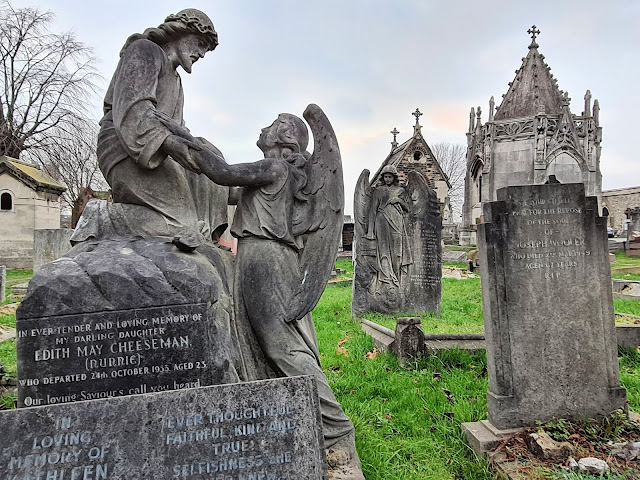
The memorial shows solicitor Stephen Lancaster Lucena’s second family in a sentimental grouping with the two children Stephen and Annie Elizabeth being read to by their mother Anne Marie, quite probably from the bible or some other religious book as the little girl is clearly praying. Even the dog seems attentive to the word of God. The domestic group was originally watched over by a pair of guardian angels but only one is now in situ, the other, toppled from its base, now lies headless and wingless behind the monument, the head is completely missing but the broken wings are tucked into a niche on the main memorial for want of any better place to put them.  The piety of the sculptured group conceals a series of late Victorian and early Edwardian scandals; both of the children were conceived outside of wedlock, their mother a household servant in their father’s house and in later life the praying little girl, Annie Elizabeth, went through a spectacularly messy divorce from an army major which resulted in the murder of her mother and the suicide of her ex-husband.

Anne Maria Benn met her future husband when she was 27 and working with her mother Hannah as domestic servants in the 56-year-old lawyer’s house, Rose Cottage, in Enfield. She became pregnant by her employer and went to have two children with him. He married her in 1874, three years after his first wife died and just two years before he died himself. Anne Maria put her husbands modest fortune to good use and turned herself into a very rich woman by property speculation. Her wealth failed to protect her from her psychologically damaged and brutal son-in-law who ordered her in 1908. Full story here.
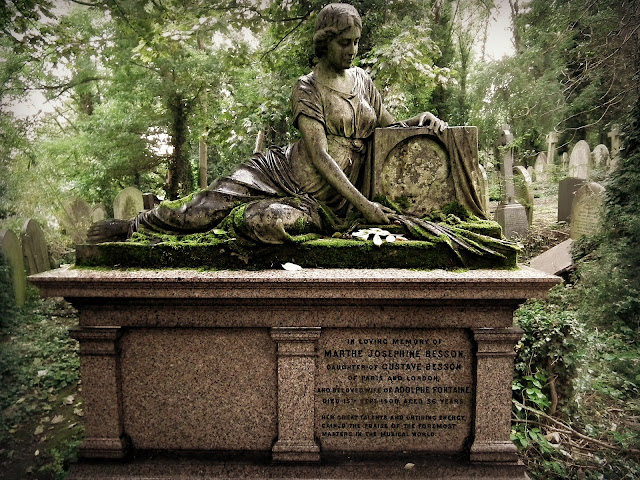
Marthe Josephine Besson (1852-1908), Highgate East Cemetery

Up a steep and neglected muddy side path in Highgate East Cemetery, hidden amongst the undergrowth and surrounded by toppled and leaning gravestones, you will find this striking monument to a Victorian businesswoman. The inscription reads: 

In loving memory of
Marthe Josephine Besson,
daughter of Gustave Besson
of Paris and London
and beloved wife of Adolphe Fontaine.
Died 15th Sept 1908, aged 56 years.
Her great talents and untiring energy gained the praise of the foremost masters in the musical world.

It looks like a touching tribute from a grieving husband and one could lazily assume that Adolphe and Marthe were mutually devoted and lived long and contentedly in conjugal bliss. But one would be wrong. 12 years earlier Adolphe was trailing through Europe after Marthe and her Spanish lover accusing her of stealing his fortune, trying to have her arrested by Scotland Yard and generating a scandal that he must still have been trying to live down when he instructed A. MacDonald & Co. Ltd of Euston Road to produce his wife’s funeral monument.

Marthe certainly did not love Adolphe and would have been furious to see his name on her spectacular memorial. An astute business woman whose life was blighted by tragedy, Marthe was a strong willed woman who knew her own heart. Full story here and further details here.
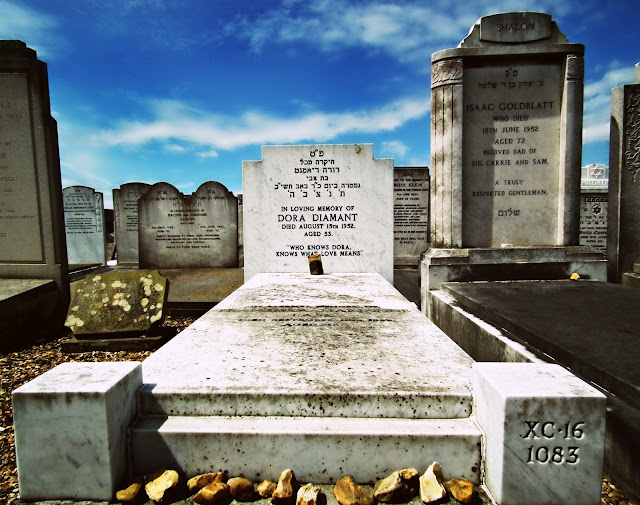

 Dora Diamant (1898-1952) United Synagogue Cemetery, Marlow Road, East Ham

In the bed directly opposite me a woman lies dying. An older woman. She’s whimpering incessantly, trying to say something.  The nurses are trying to understand what she says. Earlier on she cried. She lay quite still and the tears flowed from her closed eyes down her face. A beautiful woman, fairly plump, cheeks a little pink, maybe she has a fever. What does she think? Does she know she is dying? She seems to be conscious. Then she certainly knows it. It is simply not something one cannot overlook. I was not as far gone a few weeks ago, but still I knew exactly how things looked....She is an Englishwoman so at least she is dying in her homeland. .......(Later, when the nurses had moved screens around the dying woman’s bed) I think it is the end over there. It is difficult to think about anything else. Now and then one hears laughter from the other end of the ward. On the whole most are quiet, not depressed, although they too think of nothing else it seems.

Dora Diamant, Plaistow Hospital April 1951

At 53 Dora Diamant was hardly old but she knew she was dying. She had been diagnosed with chronic nephritis, a condition which eventually causes kidney failure and for which there was no known cure. The disease could have killed her at any time; the only suggestion her doctors had to prolong her life was bed rest and a strict diet with restricted salt and protein. Even then they couldn’t tell her if she had years, months or just weeks to live. She was almost frantic with worry about her seventeen year old daughter, a beautiful but unworldly child who had spent most of her sheltered childhood in hospitals and boarding schools and was so shy that she could barely bring herself to speak to strangers. How would she cope with life without her mother to look after her?  Her other preoccupation were her memories of her first lover, Franz Kafka. Death would erase them unless she committed them to paper.  On March 4 1951 in black ink , she wrote across the front cover of a bright red Silvine school exercise book ‘To be given to Max Brod’. On the inside cover she wrote her address ‘Ward Pasteur 1, Plaistow Hospital, E15’ (Dora lived in Finchley and so can be excused not knowing Plaistow Hospital was in E13 not E15).  In the blank pages of the exercise book she took herself back to the summer of 1923 and the seaside town of Graal-Müritz on the Baltic coast, the place where as a 25 year old volunteer at the Berlin Jewish People’s holiday camp for refugee children, she had met and fallen in love with Kafka. 

Full story here.
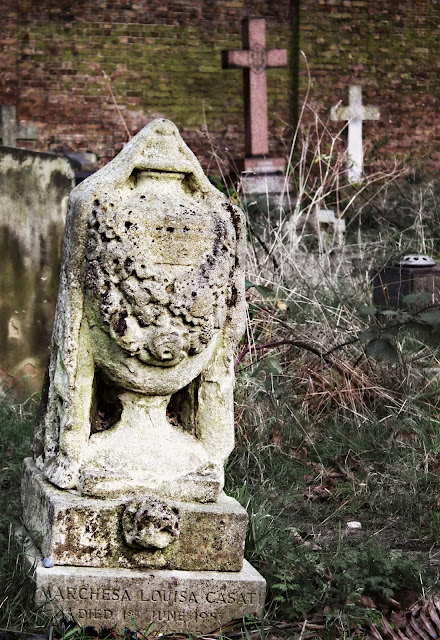

Marchesa Luisa Casati (1881-1957), Brompton Cemetery

“Quite suddenly and simply by chance, I once met a bizarre lady while taking tea with some friends in London. She arrived wearing black velvet from head to foot, her mouth painted blood red, and carrying a very tall umbrella with a decorated handle. And, you must understand, this ensemble was being worn in the middle of the day. This picturesque ruin of a woman was very tall and thin, and gave the impression of formidable strength. It was then I was introduced to the Marchesa Luisa Casati for the first and last time. She had made her entrance into that room looking wonderful and saying very little. She wasn’t beautiful—she was spectacular. Here was a woman possessing a presence one would never forget.”

Quentin Crisp

Full story here
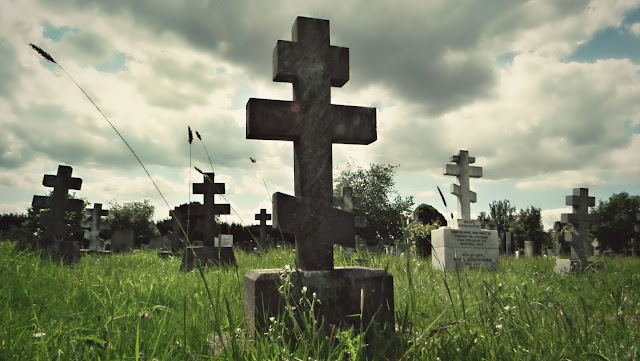

Moura Budberg (1892-1974) Chiswick New Cemetery

In her final years Moura Budberg lived in a ‘large rambling flat’ in the Cromwell Road according to Michael Blakemore, who visited her at the request of Sir Laurence Olivier, ‘attended by a female servant, also Russian…and equally cranky… Moura had on a long dress, by no means new, but appropriate to a countess, and her grey hair, its colour improved by the application of some silvery liquid was swept on top of her head. A tiny metallic trickle ran down the side of her face.’ According to other sources she was swollen and arthritic, kept a half bottle of vodka in her handbag, passed her time making small bets on horse races at Ladbrokes or watching Pinky and Perky on television and, as she was perpetually short of money, shoplifting (for which she was arrested at least once). The former beauty still craved company and in his memoirs, Alan Ross recalls that her ‘entertaining, helped along by various Russian acolytes, was now much reduced but invitations were peremptory. Any excuses… were brushed aside as if of no account. “Just come in for a little moment,” she would wheedle in her husky voice, which remained distinctive and seductive long after all other physical charms had fled and she had become heavily square in shape.’ Another acquaintance, William Shier, tells us that two or three years before she died, she was beginning to sort ‘through piles of material from cardboard boxes that littered the living and dining rooms of her house in Cromwell Road after she had given in to the pleas of her friends to write her memoirs.’  The much-requested memoir was never written, ‘the work seemed sometimes to bore and exhaust her and she would telephone urging me to come over for tea and vodka.’ In 1974 Moura moved to Italy to live in the sun, with her son, but died a few months later. Her body was shipped back to England and after a funeral ceremony at the Cathedral of the Russian Orthodox Church in Exile at Emperors Gate (just off the Cromwell Road, close to Moura’s old flat) she was buried at the uninspiring Chiswick New Cemetery in a small patch of other Orthodox burials. 

Full story here.

Joyce McQueen (1934-2010) Manor Park Cemetery

The night before Joyce McQueen was due to be cremated at Manor Park Cemetery her husband Ronald and the couple’s children had to decide whether to postpone the funeral to give them time to organise a double interment. Joyce and Ronald’s youngest son Lee (better known to the world at large as Alexander McQueen, haute couturist) had been found dead at his home in Mayfair after apparently hanging himself in a fit of depression brought on by his mother’s death. They probably had no real choice but to go ahead with Joyce’s funeral as planned; if Alexander had committed suicide they may have had to wait some time for his body to be released by the coroner.

Full story here.
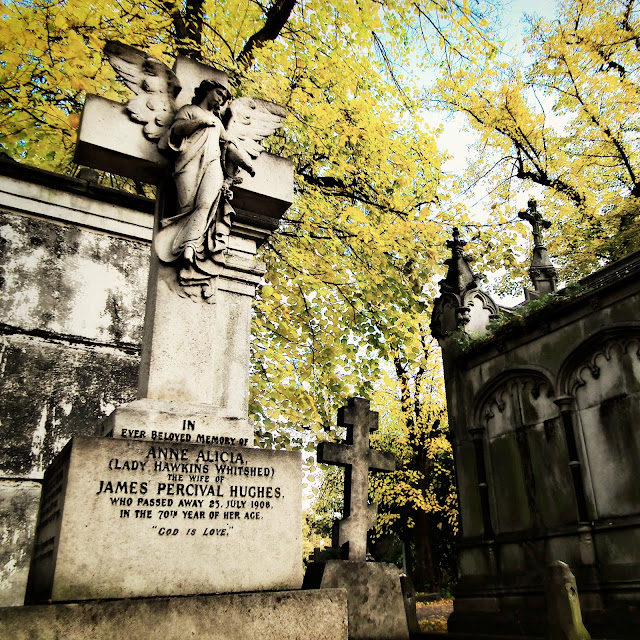


Elizabeth Alice Frances Hawkins-Whitshed (1860-1934) Brompton Cemetery

Although we know, courtesy of the newspapers, exactly what the newly married Mrs Elizabeth Burnaby was wearing when she set off on honeymoon (‘The bride’s travelling dress was stone-coloured cashmere, trimmed with satin to match, a white chip bonnet, and long white feather’), the only thing we know about the honeymoon itself is that Lizzie came back pregnant and that she and her husband were barely on speaking terms. They lived in London, together, until the birth of their only child, a boy, but before they could celebrate their first wedding anniversary Lizzie had moved to Switzerland ‘for the sake of her health.’ The presumptive consumptive startled everyone by taking up mountain climbing, something almost unheard for a woman in the dying years of the Victorian age. The cosseted ward of the Chancellor discovered unimagined freedom in the mountains, including the hitherto novel experience of putting “on my own boots, and I was none too sure on which foot should go which boot. It is difficult for me to realize now that for several years longer it did not occur to me that I could do without a maid … I owe a supreme debt of gratitude to the mountains for knocking from me the shackles of conventionality, but I had to struggle hard for my freedom. My mother faced the music on my behalf when my grand-aunt, Lady Bentinck, sent out a frantic S.O.S. ‘Stop her climbing mountains! She is scandalizing all London and looks like a Red Indian.’”  As well as being sunburnt Lizzie climbed in pragmatic short skirts which barely came down to her knees, to her scandalised contemporaries, practically naked in other words.

Full story here.
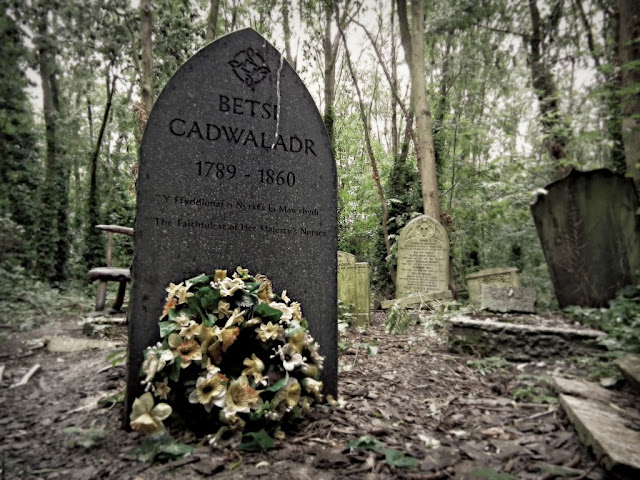

Betsi Cadwaladyr 1789 - 1860, Abney Park Cemetery

The penniless and obscure Betsi Cadwaladr was buried in 1860 in Abney Park Cemetery, either laid above, below, or sandwiched between, three complete strangers in a pauper’s grave dug deep enough to take four cheap coffins. There were probably not many mourners at her funeral and no marker or memorial was erected over the burial spot.  The headstone now over her grave is new, put up in 2012 by the Royal College of Nursing and a Welsh Health Board that had adopted her name and proclaimed Betsi  a Welsh national heroine. Not everyone was pleased to see the obscure Betsi Cadwaladr, or Elizabeth Davies as she was also known, launched into posthumous celebrity. In Wales there were dark mutterings accusing the former nurse of having worked as a prostitute in the Liverpool Docks; in January 2012 the Welsh Daily Post felt obliged to defend her honour against her detractors and calumniators, retorting that there was no evidence that she had ever sold herself on the streets of Merseyside.

Full story here


Friday, 4 March 2022

The arrival of spring?: St Mary's Catholic Cemetery, Kensal Green


The weather was beautiful last weekend in London; clear air, cloudless blue skies and winter sunshine. Just a week before storm Eunice had been knocking over trees and ripping tiles from roofs and then we had had a couple of days of rain. Some areas of the catholic cemetery at Kensal Green were completely waterlogged; some graves were only accessible by skiff as you can see in the photo below.  Not for the first time it seems; this is from the Willesden Chronicle of Friday 03 May 1895.

Kensal Green Catholic Cemetery — A contemporary states that a number newly made graves in this part of the great cemetery at Kensal Green were suddenly flooded in the heavy storm on Saturday. As many as eight bodies had to be left in the church through the night and much distress was occasioned among mourners who had to leave the cemetery without the completion of the funerals.


I came across an interesting account of a visit to St Mary’s in the Saturday Supplement to the Daily Herald of 16 October 1915. The left leaning Herald was published in London between 1912 and 1964 (though printed in Manchester from 1930) and was a staunch supporter of the labour movement and the Labour Party. It was a broadsheet newspaper and relaunched as the Sun in 1964 (it only became a tabloid in 1969 when taken over by Rupert Murdoch). The article, entitled ‘At Kensal Green’ was by James W. Butler; I can find out nothing about him at all. His language seems rather high flown for a journalist.  

The dull canopied skies were lowering darkly upon the graves in St. Mary’s Cemetery, Kensal Green. October, with her grey, cold robes, chilled the blood in the veins. Leaves, dead and dying, with the dappled russet-gold of Nature’s mourning, strew the pathways and litter the decaying grass, or flitter for an instant on a headstone. Symbolical are they of the life that was in the spring; and the death near at hand.

In an almost obscure position, a few feet from the footpath, lies the plain white sarcophagus that covers the remains of the great Victorian poet, Francis Thompson, “a true poet, one of small band,” to quote George Meredith’s tribute, which was enclosed in the coffin, together with roses from Meredith’s Garden. No grandiloquent epitaph adorns the simply carved stone. Just as he who lies underneath would have wished it; “Meet me in the nurseries of Heaven.” 

The sound of feet crunching the small stones into the ground catches my ear. Glancing round, I see approaching along the narrow winding path a pathetic little procession. A woman, really a girl, shabbily clad, obviously of the costermonger type, is sobbing herself almost to distraction. She is being held up by an anaemic-looking young fellow, wearing corduroy trousers, a cheap black cap, a cheaper black strip of cotton stuff knotted round his throat, and a tattered serge coat through which brazenly peep parts of his shirt. Close behind follow three puny slum children; tragedy written plainly on their ferret-like faces. They, too, wear black kerchiefs round their necks—their only sign of mourning; whilst several relations and friends straggle in the rear. Poverty is strongly portrayed, and throws its shadows across their faces and manifests itself in their scanty attire.

Arrived at the graveside, tears and emotion were strongly universal. The poor young mother’s lamentations rent the chill air. She is frantic, and it takes the united efforts of her friends to prevent her from throwing herself into the grave. The priest sprinkles the cheap white coffin with holy water. Two penny bunches of white chrysanthemums are reverently dropped on to the lid as the tiny box is lowered into the hole, and with the rites finished by the clergyman and his two surpliced servers proceed towards the church to meet another funeral.


The small band of meanly-dressed mourners return to their one-horse coach. Eight try and crowd in; some have to walk back to Leather-lane. The ill-kempt children are waiting their turn. Quietly a two-shilling piece finds itself into one of the grimy little hands. But the movement has not escaped a lynx-eyed youth with a short leg.

“What’s the bloke giv’n yer? He greedily asks, leaning over the child and grasping her hand. He opens the fingers deftly and sees the spoils. Quickly he brings from his vest pocket a copper coin with which he rapidly rings the changes. other members are too grief-stricken to notice what has occurred…


With purple stole and black biretta the priest is waiting near the small mausoleums and chapels, containing the remains of foreign princes, counts, and members of the Roman Catholic aristocracy. In the distance and coming up the small roadway from the main gate is a gorgeous funeral cortege. Four prancing Flemish horses draw a hearse surmounted with a tray of black nodding feathers. Bay horses, the insignia of gentility, are doing their best in the coaches to add dignity and grandeur to the occasion. Costly wreaths almost hide the beautifully-polished oak shell, and decorate the carriage lamps of every vehicle.


It is a lavish display of studied position and wealth. But the dead child is not disturbed. mourners bent double with grief alight from the coaches. They hold their heads aloft, with chins pointed towards Heaven. It is the demeanour of the dignity of grief. Children are conspicuous by their absence. It is the custom; it is proper; it is etiquette. The priest again leads the way to the grave — in another part of the burial ground.

“… My soul hath relied upon His word: my soul hath hoped in the Lord…” The noble antiphons of the dead are recited. A few slight sobs are heard as the coffin is lowered into its last resting-place; but faces are under control. There is no unseemly demonstration of weeping. With stately mien the mourners return to the luxurious coaches, upholstered with comfortable seats.


"Meet me in the nurseries of Heaven.” Thompson, a fervent lover of children. “The Heart of Childhood, so divine for me.” He loved the small wan flowers of life; the children of the poor; of the streets. He wrote of them even to the last.

The mists were creeping’ into Harrow-road as I boarded a tram for Westbourne Park Station. Some distance further along the sidewalk toiled the lame young fellow with two companions. They were walking into the doors of a coffee-shop when the tram drew abreast. Then, indeed, I felt almost glad that the two shillings had changed hands.


Sunday, 27 February 2022

‘Is there anybody there?’ said the Traveller; St Mary's Catholic Cemetery, Kensal Green


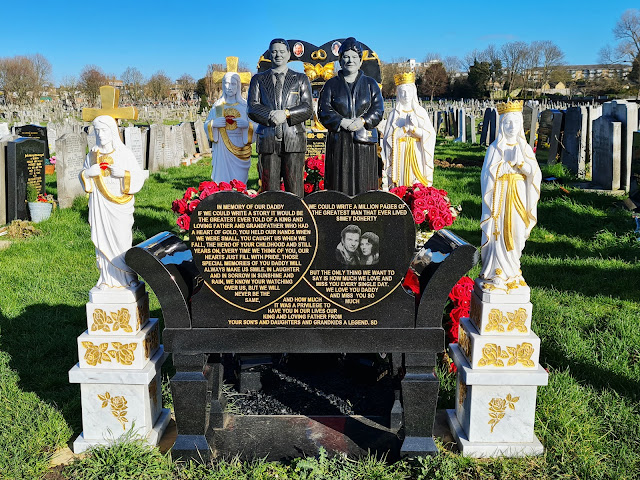
BIG FAT GYPSY FUNERAL Hundreds of Travellers from across UK descend on Surrey for funeral of Big Fat Gypsy Wedding star Paddy Doherty’s dad, hailed the ‘father of all Travellers’

Mourners joined the Big Fat Gypsy Wedding and Celebrity Big Brother star to say goodbye to Simon Doherty, remembered as the "father of all Travellers". More than a dozen silver Rolls Royces, each bearing the Irish tricolour, lined up outside St Michael's Church in Ashtead, Surrey. Mr Doherty's coffin was emblazoned with the colours of the Irish flag and the message: "Simon Doherty - blacksmith, King of all Doherty's".

Paddy said: "He was like Mafia in his own way, not in a bad way - any trouble they would go to him. He was like the godfather - what he said was law. He said I want no one crying at my funeral, I want them happy, singing and get them drunk." The 58-year-old former bare knuckle fighter sat with his hand resting on his father's coffin throughout the service.

Floral tributes were laid on the altar in the shape of an Irish shamrock, bottles of whisky, pint of Guinness and a Rolls Royce. Irish dancers performed and a video footage of Mr Doherty senior in a horse race was played at the service. Paddy added: "He wasn't an average man - he was outstanding, a great man. Everything had to be five stars for him, he lived the best and was the best. My poor mother - her heart is devastated, her heart is broken. I'm so grateful how many people have turned out - we just want everything to go well, everything has to be tremendous and over the top."

The Sun 17 April 2017


Sunday, 20 February 2022

The recluse of Welbeck; William John Cavendish-Scott-Bentinck (1800-1879) the 5th Duke of Portland, Kensal Green Cemetery


I have always thought of myself as a Northerner because I was born and bred in Yorkshire but in truth my birthplace is a stone’s throw away from the Nottinghamshire border and only a mile or two of fields saved me from the fate of being a Midlander. As far as I am aware, I have no blood relatives or ancestors buried in any London cemetery; however I do have a personal connection to an easily overlooked vault close to the Anglican Chapel in Kensal Green. This vault, with its massive granite capstone, houses the mortal remains of William John Cavendish-Scott-Bentinck, the Marquess of Titchford and, from 1854, the 5th Duke of Portland. The duke is famous for being somewhat eccentric and for the unusual nature of his additions to the ancestral home at Welbeck Abbey in Nottinghamshire. My tenuous connection with the duke is that my great-grandfather cleaned the chimneys at Welbeck Abbey and my grandmother worked in the kitchens; I am descended from the serfs on the estate.

The Dukeries, the area of North Nottinghamshire where the estates of the Dukes of Newcastle, Norfolk, Kingston and Portland are to be found, is just 10 miles from where I grew up. I heard stories of Welbeck Abbey, its eccentric Duke and of the tunnels and underground rooms he built beneath the main house from my father. Whilst he was, to all appearances, a sober man and certainly not one given to flights of fancy, I eventually came to realise that my father was a mine of disinformation. Whilst often containing a kernel of the truth his stories were prone to exaggeration; on trips to Clumber Park, once the estate of the Dukes of Newcastle, my father told me that the main house had been sold by an impoverished Duke before the war and then carefully demolished, all the bricks and building stones meticulously numbered and then packed and shipped off, along with all its furniture and artworks, to America where the mansion had been rebuilt for a millionaire, lovingly recreated exactly as it was, down to the carpets and curtains, the dinner service and the books in the library, in sunny California.  It was true that the house had been demolished in 1938 but the rest turned out to be total bullshit.  As a child I loved my dad’s stories about Clumber Park and neighbouring Welbeck Abbey; he told us that the Duke of Portland had built an underground home beneath the mansion, with a subterranean library, stables and a tunnel from the house to Worksop Station that was big enough to take a horse and carriage. The greatest wonder of the underground house he said, was a ballroom with a glass ceiling that had been built beneath the ornamental lake and where, if you looked up, you could see the carp swimming in the clear green waters above your head. It was only later that I learned to be sceptical about the details in these accounts. My grandmother later confirmed that she had worked for a while in the kitchens at Welbeck but the only detail I can remember her telling me is a story about accidentally shutting the oven door on a kitchen cat that had been napping inside, and the unholy noise it made when she lit the fire beneath the oven. I would love to be able to quiz her now about every last detail she remembers of the place (and everything else from her life) but she died in 1985.


The Duke of Portland expired at his town mansion, Harcourt House, 19, Cavendish-square, at half -past five on Saturday morning, after an illness of but brief duration. The health of the Duke had, indeed, for some time past been a cause of anxiety to his friends, owing to his advanced age, but it was not until the early part of the past week that his illness assumed such a serious aspect as to alarm his family, and on Friday he was seen to be sinking fast. During the night he got worse, and before day dawn on Saturday morning he had breathed his last.

London Evening Standard - Monday 08 December 1879

William John Cavendish-Scott-Bentinck was born in London 1800 and baptised at St George’s in Hanover Square. From childhood he was always rather dreamy and delicate and his parents took the decision to educate him at home rather than subject him to the rough and tumble of Westminster School, his father’s alma mater. Despite this he had a five year army career from the age of 18 though he did move regiment rather regularly, starting off in the Foot Guards before moving to the Light Dragoons and finishing off as a captain in the Life Guards. He saw no active service and suffered from ‘lethargy’ caused by his delicate health throughout his short career. In 1824 he changed regiments once again, moving to the Royal West India Rangers as a Captain; an unusual move since the regiment had been disbanded five years earlier. He happily stayed on in the non-existent army unit for another 10 years, drawing half pay and not having to be bothered with any tiresome duties. His family encouraged him to go into politics and he was duly elected as the Conservative Member of Parliament for Kings Lynn in 1824, a position he promptly resigned from two years later on the grounds of ill health. To escape further family attempts to find him a useful career he fled to the continent until he his father died in 1854 and he became the 5th Duke of Portland.  His position finally allowed the highly introverted middle-aged man to become what he had probably wanted to be all along – a recluse.


The Sheffield Daily Telegraph of Tuesday 09 December 1879 carried a rather good obituary of the 5th Duke.  The version below is abridged!:

THE LATE DUKE OF PORTLAND. The "Recluse of Welbeck" is dead. He will be missed, but not by many; for not many saw or had intercourse with him; but by those who do miss him, he will be missed greatly. There was, perhaps, no man of whom so little was known and so much was said, as his Grace the Duke of Portland. The art of minding one's own business and not caring about the business of anyone else, was by him cultivated keenly, and brought to perfection. He was in the world, but not of it, in the ordinary sense of that term, and popular imagination had surrounded him with a brilliant nimbus of romance. And yet he was intensely practical and matter-of-fact. In all he did—and he did much—there was a method, as sane as that of the philosophic Dane. The Most Noble William John Cavendish Scott Bentinck, fifth Duke Portland, in the county of Dorset, of Titchfield, in the county of Southampton, Earl of Portland, Viscount Woodstock, of Woodstock, in the county of Oxon, Baron of Cirencester, in the county of Gloucester, one of the co heirs of the ancient Barony of Ogle, and a family trustee of the British Museum, was born in London on the 18th of September, 1800. He the second and last surviving son of William Henry Cavendish, fourth duke, by Henrietta, eldest daughter and coheiress with her sister, Viscountess Canning, of the late General John Scott, of Balcomie, in the county of Fife.

Every year since the Duke Portland inherited his estate, he has spent a princely fortune in carrying out alterations in building and in pulling down again. For cost the Duke’s building achievements are without precedent in the history of the country. Welbeck Abbey is at the present day a wonderful place, and has no equal. There are passages underground for miles, buildings under the sods of magnificent proportions, and a ball-room that surpasses the hall of the cutlers in dimensions and puts the Albert Hall to the blush. The most striking feature of the Abbey is the large Gothic Hall, which was restored by the Countess of Oxford in 1751. The fan like tracery of the calling, the elaborate designs, and the splendid decorations are a feast to the eyes.  All the rooms are furnished with princely luxuriance, and they are very numerous. Like the famous Worcester, the Duke of Portland was of an inventive turn of mind. He believed in labour-saving contrivances, and wherever he could he applied them. The necessity for waiters was minimised even in his great dining room. An hydraulic shaft connected the dining room with the kitchen, and by means of it a small waggon was lowered to the underground passages. The rails upon which the waggons run—like miniature tram rails—terminated in a cupboard, and in this cupboard, which was also a stove, food could be kept hot till needed for the table. The hundreds of valuable and high-class pictures hung in the various rooms showed his Grace's mind was highly cultivated and artistic. Indeed, the earlier part of his life was devoted to the cultivation of art.

The underground picture gallery

But the outside of the abbey, the grounds, the "works" as they are called, are the most striking proofs of the strangeness of the Duke’s ways, and thoughts, and doings. The grounds seem to be literally undermined. Extending in all directions from the abbey are burrows or passages. There are burrows to the right of the abbey, burrows to the left, burrows to the north, and burrows to the south, burrows to the east, and burrows to the west.  Not mere borings or excavations, but lofty, spacious passages, brilliantly lighted by costly apparatus for letting in sun-light, and where sun-light cannot be admitted, by lights from gas. By an underground passage we come to the celebrated riding school, the like of which is not to be found in Europe, or in the world. It is entered by a trap door, opened by means of a curiously-designed crank in the passage. In the days of the Duke of Newcastle it was used as a riding school, now it is magnificent museum of art over I50 feet in length. Hundreds of pictures are arranged— not hung—round the gallery, and piled in stacks on the floor are thousands of volumes of books, some modern, and many old, rare, and valuable. The floor of this gallery is of oak, and the ceiling is made to represent brilliant midsummer sky. Mirrors in profusion are placed about, and light is shed from four chandeliers suspended from the roof, and each weighing a ton. This apartment is lighted by over two thousand gas lights, and when all are illuminated the effect must be brilliant. There are many miles of passages under the grounds. One extends from the Abbey half the way to Worksop; another was only used by the Duke, and the stranger found in it was deemed guilty of an offence approaching high treason. The passages are all broad enough for three people to walk abreast in them, and pleasant to walk in. The library, like the picture gallery, is underground, and is the work of many years. It is divided into five large rooms, and so arranged as to form, when desirable, one very large room. This library is 238 feet long. Another immense and superbly-constructed room has been erected underground. At one end it is approached by spiral staircase, and the other by subterranean passages. Church or ball-room? It would do admirably for both. Some say it is intended for the first and some say for the second. It was begun five years ago, and left in an incomplete state. There are many of these rooms at Welbeck. They are free from draughts, admirably lighted, magnificently decorated, and all very costly. Comparatively few outbuildings are to be seen at this home of errate fancy. The most remarkable of those which can be seen is undoubtedly the new riding school, a building of gigantic proportions and of extraordinary beauty. The walls are of solid stone and the roof of wood, iron, and glass is nearly four hundred feet in length and one hundred feet wide, and divided into a great centre and two isles. The central department is decorated with frieze painted brass work representing birds, beasts, and foliage, and of perfect workmanship and elegant design. It is fifty feet high, and lighted by 8000 gas jets. Here the Duke took pleasure in seeing his horses exercised. 

The kilometre-long plant corridor which runs between the main house and the riding school

The "works" are marvels. He employed constantly upon them over 2.000 workmen. In fact, Welbeck was like an industrial village. There were wood yards, machine shops, factories, end even gas works, all within the grounds. He was ever building and pulling down again. A writer in ‘the World’ a year ago said of him that he had refined taste and skill in architecture. The Duke of Portland was a builder-up of good work and a puller-down of bad. There are many stories of his impatience of ugliness, and tenderness to its authors. An architect at one time employed by him built a gateway, which when completed became abhorrent to him; yet so considerate was he of the artist's feelings that he could not find it in his heart to remonstrate with him. So be tried another way. One night he waited till the architect had driven off it his dogcart, and then set all his men to work at overtime and double pay to pull down the hated edifice. By morning not a vestige remained, and the architect on his arrival rubbed his eyes in amazement; and neither he nor the Duke ever took the slightest notice of its disappearance. There was, too, a memorial bridge erected in the memory of Lord George Bentinck, near the spot where he breathed his last, close to the wood and opposite village of Norton. Short work was made of this bridge, as of numerous other odds and ends of architecture on the domain, and the present reign of perfection was inaugurated. 

The Illustrated London News from 1881

The late Duke was always what the world calls eccentric He visited not at all, and encouraged no visitors. He hated ceremony and the penalty of dismissal was said to be the result of a workman lifting his hat or specially noticing him as he walked about the grounds. A man who wanted work always obtain it at the Dukeries, but his Grace had a contempt for idlers. It was said that if he found a man ‘dawdling’, that man was sent instantly about his business. He was what people call a "good friend and a bitter enemy." He never forgave an affront, and could wait for years to repay it as some of the workpeople found to their cost. He detested "limbered tongue" people, if he found that any of the workpeople had been revealing secrets to the world he would dispense with their services. The Duke was enormously wealthy. It was currently stated that he had coming "a thousand pounds per day and two for Sunday." According to a contemporary his rent roil was something like £400,000 per annum. He had estates in Middlesex, Ayrshire, Northumberland, Derbyshire, Norfolk, and Lincolnshire.

There was no peace for the Duke even after his death – in 1897 began the long running Druce case when Anna Maria Druce claimed that his grace had lived a double life, pretending to be her father-in-law, Thomas Charles Druce a successful London upholsterer. Druce had been buried at Highgate in 1864. As the 5th Duke had never married and had no children the Druce case was essentially that Anna Maria’s husband was the rightful heir and the Druces should inherit the entire Portland estate. The case was only settled in 1907 when Druce’s body was exhumed at Highgate see here for the full story.

Monday, 31 January 2022

180 years of Kensal Green Cemetery - 1841 & 2022

A couple of weeks ago I had a work meeting in Ilbert Street, W10. The appointment was at 10am and Ilbert Street is just around the corner from Kensal Green cemetery, a ten-minute walk at most. So I made sure that I arrived an hour early in West London and was waiting at the cemetery gates when they opened at 9am. It was a glorious morning when I first arrived, cold and crisp but with the sun shining. Within ten minutes it had clouded over and started to drizzle but the light was still good and I managed to get a few decent pictures as I strolled through the cemetery from the crematorium end to the main Harrow Road entrance.


I’ve been reading Chapter 86, ‘London Burials’ in Volume 4 of Charles Knight’s 1841 magnum opus ‘London’. The chapter is the work of John Saunders, a now forgotten novelist and dramatist who was born in 1810 and died in 1895. His work, which was once admired by Bulwer Lytton, Leigh Hunt and Charles Dickens, is now long out of print and completely unread. As you would expect Saunders devotes a few pages to relating the horrors of burials in the city churchyards but then moves on to a description of the new cemeteries, the magnificent 7 all having opened in the previous decade. He devotes most space to an account of a visit to Kensal Green, just eight years after it had opened. The frontispiece to the chapter shows a view of the cemetery – in the foreground a widow and her children tend a grave while another young mother, bonneted and shawled leads two crinolined little girls across an open lawn. At the rear of the lawn is Central Avenue with the tombs of Andrew Ducrow and John St. John Long. With no trees taller than the biggest memorials the Anglican Chapel and the north colonnade are clearly visible in the distance, bookending the view.  


Saunders opens his account of the cemetery by saying that he arrived there following a pleasant three mile amble along the Harrow Road.  Even as late as 1841 London’s urban sprawl more or less stopped in the North-West at Paddington and a pedestrian strolling along the Harrow Road, once they were past the Lock Hospital and Paddington workhouse, had open fields to the north of them and the gracious villas of Westbourne Green on the south side of the road until they reached Kensal New Town. The railway and the canal to the south of Harrow Road had taken all the heavy traffic off the road and the walk to the cemetery would have been a pleasant rural ramble. Not now of course, the Harrow Road is the route of the A404 and you will choke on exhaust fumes and find yourself half deafened with traffic noise if you take this route; the canal is a much better option these days.
“After a pleasant walk of between two and three miles along the Harrow road, the handsome, substantial looking Doric gateway meets the eye on the left, standing a little back; we pass through and the grounds of Kensal Green Cemetery are before us, These are extensive, comprising about forty six acres and are surrounded with a lofty wall on either side of the gateway, now almost covered by a rich belt of young forest trees, evergreens and shrubs; whilst the opposite boundary is left partially open to the eye, so as to admit of fine prospects from different parts over the country round Shepherd's Bush, Hammersmith, Notting Hill and Bayswater.” When Saunders talks about the country he really did mean country; south of the cemetery was open fields until you reached Notting Hill or Shepherds Bush. He underestimated the size of the cemetery – originally the grounds occupied 55 acres of land, 39 reserved for Anglican burials and the rest for non-conformists. Spare ground to the west of the cemetery was later absorbed into the cemetery and developed into the crematorium and gardens of remembrance in the 1930’s; the total area of the cemetery is now around 72 acres.   


Saunders described what would have been a very different looking cemetery, a much neater and well-manicured one, not the half wild place we know and love today:   

In the interior the grounds are divided by broad winding and straight walks, the rest being laid out in grassy lawns, relieved by parterres of flowers, clumps of trees and shrubs and, above all, by the glitteringly white monuments of every possible outline, style and size from the simple flat stone, up to places large enough for their owners to reside in whilst living. The chief buildings are the two chapels and the colonnade. The chapel for the Dissenters on the left in the unconsecrated ground, divided from the consecrated by a clearly marked boundary, is with the exception of its front, where the Doric pillars give something like dignity of expression, markedly plain; the chapel for the use of members of the Church of England on the right is, on the contrary, both noble and handsome and the interior with its solemn gloom and single painted glass window rich, though simple.


180 years it was the monuments of Andrew Ducrow and John St. John Long which grabbed the attention on Central Avenue, Mulready and Gibson had yet to appear;

The tombs of the greatest pretension at Kensal Green are mostly ranged at the sides of the central walk leading to and from the chapel. Here are Dr Valpy's in the form of a Roman temple, the Rashleigh family's, of Mendabilly, consisting merely of flat and head stones, but of such gigantic size and rude structure that one involuntarily thinks of primeval ages, and men like gods; whilst opposite each other at the junction of four principal walks, the most conspicuous objects in the most conspicuous part of the cemetery, stand St John Long's with a figure of the goddess of health raised on high within an open Grecian temple, and the prince of horsemen's Ducrow's, in the shape of a large Egyptian building, with bronze sphynxes each side of the door and surrounded by a garden with flowering evergreens, standard roses, and sweet smelling stocks with gravelled walks and bronze railings.


Saunders is impressed by how many burials have taken place at Kensal Green since it opened but 6000 doesn’t seem a lot in 8 years. The Directors of the General Cemetery Company would almost certainly have liked to see it a little busier!

Upwards of six thousand persons have been interred here since the opening; a circumstance that in itself shows how great was the want of such a place. Not one of its least advantages is that every private grave is secured from disturbance, forming indeed a freehold which may be bequeathed by its owner. The system of mapping out the ground is ingenious and satisfactory. The whole is divided into squares of 150 feet by 100, for each of which a leaf of a very large, massive looking, and iron bound volume is set apart; here every grave in the square is numbered and the occupied ones marked. This book, and printed plans of the squares, are always accessible to the parties concerned, so that mistakes and deceptions are alike guarded against. There are some points in which improvement may be made. When the cemetery companies obtained their respective acts of parliament, the dangers of burying near the surface, and of burying several bodies in the same grave, one above another, were not so well known as they have been since the publication of the Report of the Committee. Now however, it appears many of the best informed men consider there should be no grave within five feet of the surface, whilst at Kensal Green, and no doubt at the other cemeteries, they bury within four feet.


The Blondin memorial for the man who couldn't resist a tightrope stretched across Niagara Falls


Monday, 10 January 2022

The lost gasometers of Kensal Green and some miscellaneous photos of the cemetery


"Why so quiet
Vitruvius Wyatt?"
"Because I'm dead,"
he said.

Wynn Wheldon - Vitruvius Wyatt, a short poem (2016)

The iconic gas holders that overlooked Kensal Green cemetery from the other side of the Grand Union canal were demolished last year. I was looking through old photos of the cemetery to see if I had any unused ones and came across the two you see here, both taken on Christmas Eve, one in 2018 and one in 2019.  Gas holders no 5 and 6 have been part of the scenery of the cemetery for over 130 years (see Guy Vaes photos from the 1960’s here) and it is sad to see them gone to make way for new apartments (which will have a good view of the cemetery, though this is generally not acknowledged to be a selling point for some reason).  Gas holder No 5, the more diminutive of the pair was built in 1877-79 to the design of Vitruvius Wyatt the constructing engineer of the Gaslight and Coke Company. Vitruvius (to christen him with the name of the Roman architect and engineer, his father must have had his life and career plotted out for him before he was even born) is responsible for other famous gas holders at Bromley-by-bow and Beckton, all of them under threat of demolition. He chose not to be interred in Kensal Green when died in 1897 and so was spared the unpleasantness of watching his work dismantled and taken away as scrap iron. Instead, he was buried in Hampstead Cemetery where Wynn Wheldon no doubt spotted his grave and was inspired to write the short poem above, quite possibly knowing nothing more about his subject than his name. Gas holder No 6, the bigger of the two, was built in 1890-92 and designed by George Careless Trewby who was Engineer-in-Chief at the company and Vitruvius’ boss. He was also buried at Hampstead Cemetery.


The Kensal Green gas works were established in 1845 by the Western Gaslight Company who used bituminous coal brought by the canal produce cannel gas on the site. This was used to power gas lighting for affluent householders in St Pancras, Marylebone, Bloomsbury, Hampstead, Paddington and Chelsea. Cannel gas was more expensive to produce than coal gas but it produced a better flame. The news that the still semi-rural site was to be used for a gas works did not go down well with local ratepayers and businesses. The General Cemetery Company was as alarmed as anyone one else with a financial stake in the neighbourhood by ‘the alleged nuisance and serious injury to health and property’ and the impact a gas works could have on the cemetery. Interested parties met at the William the Fourth Tavern on Harrow Road on Thursday 08 October 1846 “to come to such resolutions as might be deemed expedient for averting the threatened evil.” The meeting was chaired by the vicar of St. Johns, the Rev. A. G. Pemberton, who commenced proceedings “by reading letters which he had received from the Rev. Warden of All Souls College, who was a landed proprietor in the neighbourhood, from the Kensal green Cemetery Company, and Mr. Jacobs and other gentlemen” who all vigorously opposed the opening of the new gas works. It all did no good, not even taking the matter to law, the gas works opened in 1847 and only closed in 1975. 


The tomb in the foreground of the top photograph belongs to Charles Babbage (1791-1871), mathematician, philosopher and inventor of the difference engine, generally acknowledged as the first mechanical computer. Babbage’s pickled brain now resides, neatly bisected, one half in the Hunterian Museum of the Royal College of Surgeons in Lincoln’s Inn Fields and the other in the Science Museum in Exhibition Road. I have been meaning to write about him for some time, I really must get my finger out.

The photograph above (like all the others, taken on 24th December in 2018 or 2019, is the tomb of William Mulready, the Irish painter, illuminated by the rays of the setting sun.   Mulready’s "six-poster Lombard Renaissance" monument is made of artificial stone and was designed by Godfrey Sykes who was one of the artists responsible for the decoration of the Victoria and Albert Museum. The monument, which features prominently on the Central Avenue of Kensal Green Cemetery, was exhibited at the 1867 Paris Exposition Universelle, where it won a prize. Mulready reclines, in life size effigy, on plush upholstery protected from the elements by a canopy. The base of the monument has incised representations of some of Mulready’s better known paintings as well as palettes and paint brushes and other symbols of the life of an artist.


The last two pictures are sunset scenes in the cemetery, the one above from 2018 and the one below from 2019. 


Monday, 3 January 2022

I Am Every Dead Thing; St Mary's Catholic Cemetery, Kensal Green


For I am every dead thing,
In whom Love wrought new alchemy…
He ruin'd me, and I am re-begot
Of absence, darkness, death: things which are not.

 John Donne - A Nocturnal upon St. Lucy's Day

Covid has put an end to my traditional Christmas Eve cemetery visit as I’m no longer working in an office and so don’t get let out early for a half day holiday on the 24th.  Instead this year I took the afternoon off on the 21st December, the winter solstice, the shortest day of the year. Before we finally gave in and accepted the Gregorian calendar in 1752 (after almost 200 years of spirited resistance to the Papists) the Winter Solstice used to fall on December 13, St Lucy’s day, ‘the year’s midnight’ as John Donne called it in his gloomy meditation on the 7 hours 49 minutes and 42 seconds of daylight we get in Southern England on the day of the solstice (but let us not complain, it is at least an hour more than they get in Aberdeen and two more than the Norwegians and Swedes get in Oslo and Stockholm). Sunset was at 3.53pm and the management at St.Mary’s Cemetery in Kensal Green wanted us out of there by 3.45. Cemeteries are always busy Christmas week and St. Mary’s was no exception. The older part of the cemetery was deserted apart from the gravediggers, who were hanging around tinkering with their mechanical diggers and reminding anyone in ear shot about the early closing time. At the bottom end of the cemetery where the newer graves are there was a steady stream of visitors, mainly arriving by car, bearing Christmas wreaths and decorations as a seasonal alternative to flowers. Poinsettias and tinsel adorned many graves, some of them very elaborately decorated for the nativity. I felt too self-conscious to take photos of the newer graves but this relatively recent trend of decking out memorials with holly and fairy lights is quite interesting. When you drive past Chingford cemetery at night at this time of year the place glows eerily with solar powered LED string lights. St. Mary’s isn’t visible from the road and the gravediggers make sure everyone is out before sundown but I bet it presents an equally festive appearance in the dark.    


St. Mary’s was in the news recently for being the location of one of the increasingly senseless murders that seem to be becoming a feature of urban life in London. On the afternoon of 22 November 2020 61-year-old Michael Morris-Owens was sitting on bench in the cemetery close to the Chapel. A stranger, 51-year-old Cornelius Tully engaged him in casual conversation. When Morris-Owens refused to shake Tully’s hand, possibly because this was during one of last years lockdowns, the younger man apparently took offence and produced a bayonet which he rammed in Morris-Owens stomach. The wounded man fled with Tully in pursuit, slashing at him from behind and tried to get into his parked car. Tully hacked him down by his vehicle, inflicting over thirty wounds with the bayonet. Other visitors to the cemetery tried to intervene, at first to stop the attack and then to try and save Morris-Owens but he was pronounced dead by paramedics when they arrived at the scene. Tully didn’t try to escape; he waited until armed police arrived and then gave himself in. He appeared at the Old Bailey on 14 September 2021 via video link from a secure mental hospital in Three Bridges to plead guilty to manslaughter on the grounds of diminished responsibility. On November 11 he was sentenced to an indefinite hospital order, meaning that he will only be released if psychiatrists agree that he is no longer a danger to himself or others. After having been murdered there Michael Morris-Owens was buried at St Mary’s on 04 March 2021. 


There was a particularly sad funeral held at the cemetery on Tuesday 08 December 1953. 5-month-old Tomunatanye Davis was buried with just a priest, her mother Veronica, a representative from her mother’s employer, the United Africa Company, and an African nurse from Hammersmith Hospital in attendance. The floral tributes were a sheaf of flowers from the company and a bunch of violets presented by a Girl Guide troop. Tomunatanye had died on 03 December during an operation held at Hammersmith Hospital to separate her from her conjoined twin sister Wariboko. The twins were born in Kano, Nigeria on 25 July 1953 and became an immediate media sensation when they were flown to England to be separated. The operation was carried out by Scottish surgeon Professor Ian Aird who was no doubt hoping to make history by carrying out the first successful surgical separation of conjoined twins. Unfortunately, Tomunatanye died in the operating theatre though Wariboko survived. The funeral of Tomunatanye on the 8th did not stop the Daily Mirror crowing about the operation as a triumph of British imperialism the following day; 

BABIES OF IMPORTANCE   EVERY mother in Britain is keeping her fingers crossed for baby Boko, the survivor of the Siamese twins from Nigeria. She is the most famous baby in the world - the piccaninny who stole the headlines from Winston, Ike and Georgyi.

Boko is noticing people. Hear that, Mum? Boko is sucking her fist, now. Just listen, Dad! This is the battle for recovery that grips all parents. And behind the battle is the other story. Of the twins' journey to London with their mother - paid for by their father's firm. How a Scottish surgeon, giving his services free, separates the twins in a London hospital.

THIS is the " imperialism" we—and Boko's mother—are proud of. Boko is its bonny emblem. And not the only one. For, 2,000 miles away, an important Egyptian baby has been rushed British medical care.

He is Mohammed, son of Major Salem, Egypt's Minister of National Guidance. Salem talks hatred of British "imperialism." But he appealed for help to the British Army in the Suez Canal Zone when his baby developed infantile paralysis. GOOD FOR HIM! A British specialist and nurses raced to Cairo. An iron lung was flown from this country. Now Mohammed, like Boko, is doing better. Bless them both. They stand for so much decency and humanity between nations. Their stories make CHEERFUL reading. Britain has a right to feel happy about them both.

Wariboko and her mother returned to Nigeria just three weeks after the operation.  Veronica Davis went on to have another pair of twins, not conjoined this time, both of whom in infancy. She later died giving birth to a still born baby before Wariboko was old enough to remember her. Wariboko was brought up by a Mr and Mrs Jituboh and became a nurse. She is, as far as I know, still alive, she certainly was in 2015. Professor Ian Aird committed suicide in 1962. 


Another sad funeral was that of artists model Norine Fournier Lattimore, a story widely syndicated in the newspapers and here taken from the Hartlepool Northern Daily Mail of  Friday 10 August 1934; 

ONLY FOUR MOURNERS Funeral of Former Famous Model

Only four mourners, headed bv her father. Mr E. Scholfield, attended the funeral of Dolores the famous model, at Kensal Green Catholic Cemetery, London, to-day. During her stage and studio life Dolores’ friends had been legion. The service at the graveside was conducted by Father Pelors, a French priest. On the coffin was a wreath of lilies from Dolores’ father bearing the inscription. "God rest your soul.— Papa" and a posy of sweet peas. There were two other wreaths at the graveside from friends. The burial was in a public grave. 

Norine Schofield was born in London in 1934 into a theatrical family. She was raised in Islington and a junior Tiller girl before moving to Paris where she joined the company of L'Opéra Comique where she met Sarah Bernhardt, danced with Anna Pavlova and danced before Kaiser Wilhelm who presented her with a gold powder box. She became an artists model for Jacob Epstein and a clothes model for Norman Hartnell. She married three times and at least two men reputedly committed suicide because of her, her first husband Frank Amsden and the artist Frederick Atkinson. Norine protested “I am not a heartless vampire,” after her conduct came under criticism at Atkinson’s inquest. Her life ended in straightened circumstances at the age of 40, her last public appearance in public being "fasting in a barrel" at a fun-fair in Tottenham Court Road, a position she took over from Harold Francis Davidson the disgraced vicar of Stiffkey who had been defrocked because of a scandal involving prostitutes (he was, I feel impelled to point out, an Anglican priest, not a catholic one). She died of cancer in St Mary Abbot's Hospital, Marloes Road, Kensington, on 8 August 1934.