Monday, 31 January 2022

180 years of Kensal Green Cemetery - 1841 & 2022

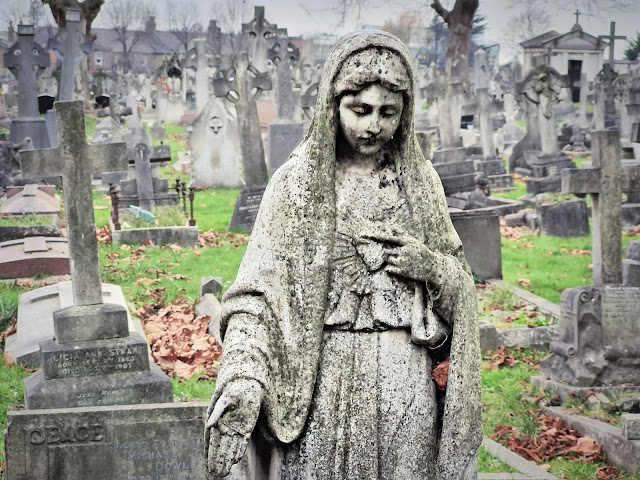
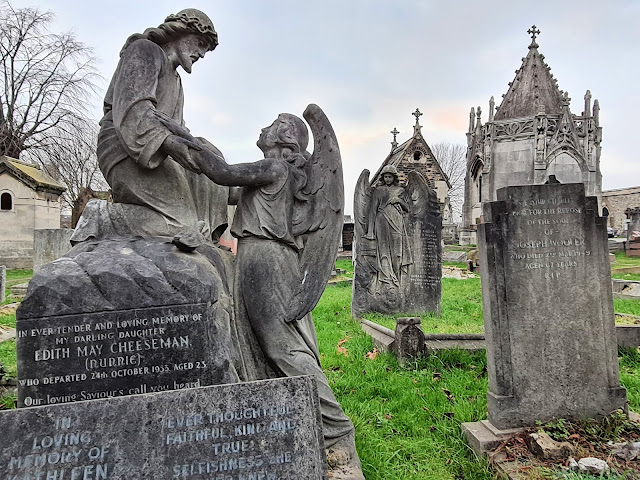
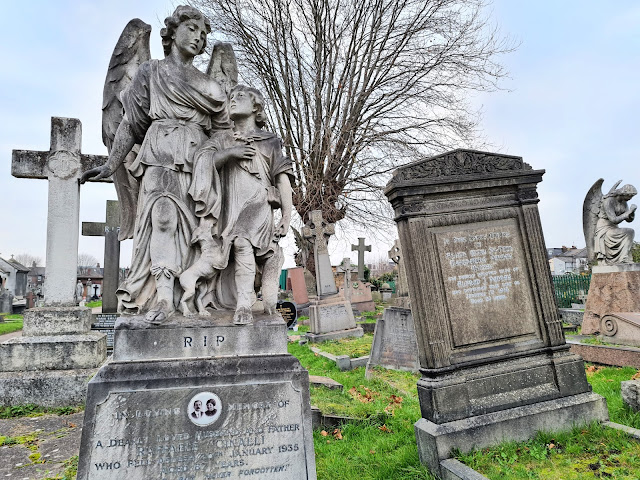
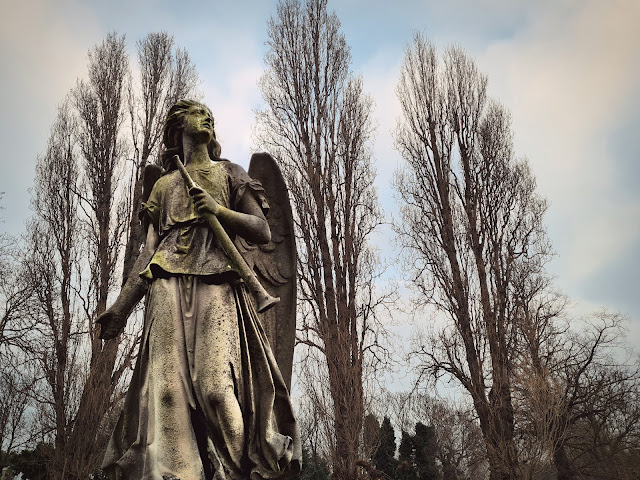
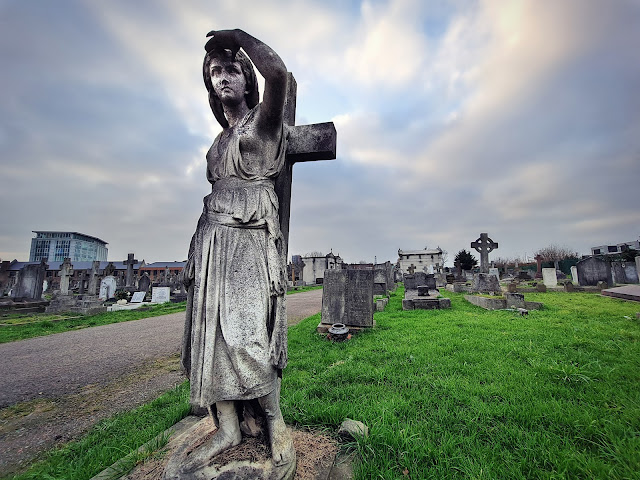
A couple of weeks ago I had a work meeting in Ilbert Street, W10. The appointment was at 10am and Ilbert Street is just around the corner from Kensal Green cemetery, a ten-minute walk at most. So I made sure that I arrived an hour early in West London and was waiting at the cemetery gates when they opened at 9am. It was a glorious morning when I first arrived, cold and crisp but with the sun shining. Within ten minutes it had clouded over and started to drizzle but the light was still good and I managed to get a few decent pictures as I strolled through the cemetery from the crematorium end to the main Harrow Road entrance.


I’ve been reading Chapter 86, ‘London Burials’ in Volume 4 of Charles Knight’s 1841 magnum opus ‘London’. The chapter is the work of John Saunders, a now forgotten novelist and dramatist who was born in 1810 and died in 1895. His work, which was once admired by Bulwer Lytton, Leigh Hunt and Charles Dickens, is now long out of print and completely unread. As you would expect Saunders devotes a few pages to relating the horrors of burials in the city churchyards but then moves on to a description of the new cemeteries, the magnificent 7 all having opened in the previous decade. He devotes most space to an account of a visit to Kensal Green, just eight years after it had opened. The frontispiece to the chapter shows a view of the cemetery – in the foreground a widow and her children tend a grave while another young mother, bonneted and shawled leads two crinolined little girls across an open lawn. At the rear of the lawn is Central Avenue with the tombs of Andrew Ducrow and John St. John Long. With no trees taller than the biggest memorials the Anglican Chapel and the north colonnade are clearly visible in the distance, bookending the view.  


Saunders opens his account of the cemetery by saying that he arrived there following a pleasant three mile amble along the Harrow Road.  Even as late as 1841 London’s urban sprawl more or less stopped in the North-West at Paddington and a pedestrian strolling along the Harrow Road, once they were past the Lock Hospital and Paddington workhouse, had open fields to the north of them and the gracious villas of Westbourne Green on the south side of the road until they reached Kensal New Town. The railway and the canal to the south of Harrow Road had taken all the heavy traffic off the road and the walk to the cemetery would have been a pleasant rural ramble. Not now of course, the Harrow Road is the route of the A404 and you will choke on exhaust fumes and find yourself half deafened with traffic noise if you take this route; the canal is a much better option these days.

“After a pleasant walk of between two and three miles along the Harrow road, the handsome, substantial looking Doric gateway meets the eye on the left, standing a little back; we pass through and the grounds of Kensal Green Cemetery are before us, These are extensive, comprising about forty six acres and are surrounded with a lofty wall on either side of the gateway, now almost covered by a rich belt of young forest trees, evergreens and shrubs; whilst the opposite boundary is left partially open to the eye, so as to admit of fine prospects from different parts over the country round Shepherd's Bush, Hammersmith, Notting Hill and Bayswater.” When Saunders talks about the country he really did mean country; south of the cemetery was open fields until you reached Notting Hill or Shepherds Bush. He underestimated the size of the cemetery – originally the grounds occupied 55 acres of land, 39 reserved for Anglican burials and the rest for non-conformists. Spare ground to the west of the cemetery was later absorbed into the cemetery and developed into the crematorium and gardens of remembrance in the 1930’s; the total area of the cemetery is now around 72 acres.   


Saunders described what would have been a very different looking cemetery, a much neater and well-manicured one, not the half wild place we know and love today:   

In the interior the grounds are divided by broad winding and straight walks, the rest being laid out in grassy lawns, relieved by parterres of flowers, clumps of trees and shrubs and, above all, by the glitteringly white monuments of every possible outline, style and size from the simple flat stone, up to places large enough for their owners to reside in whilst living. The chief buildings are the two chapels and the colonnade. The chapel for the Dissenters on the left in the unconsecrated ground, divided from the consecrated by a clearly marked boundary, is with the exception of its front, where the Doric pillars give something like dignity of expression, markedly plain; the chapel for the use of members of the Church of England on the right is, on the contrary, both noble and handsome and the interior with its solemn gloom and single painted glass window rich, though simple.


180 years it was the monuments of Andrew Ducrow and John St. John Long which grabbed the attention on Central Avenue, Mulready and Gibson had yet to appear;

The tombs of the greatest pretension at Kensal Green are mostly ranged at the sides of the central walk leading to and from the chapel. Here are Dr Valpy's in the form of a Roman temple, the Rashleigh family's, of Mendabilly, consisting merely of flat and head stones, but of such gigantic size and rude structure that one involuntarily thinks of primeval ages, and men like gods; whilst opposite each other at the junction of four principal walks, the most conspicuous objects in the most conspicuous part of the cemetery, stand St John Long's with a figure of the goddess of health raised on high within an open Grecian temple, and the prince of horsemen's Ducrow's, in the shape of a large Egyptian building, with bronze sphynxes each side of the door and surrounded by a garden with flowering evergreens, standard roses, and sweet smelling stocks with gravelled walks and bronze railings.


Saunders is impressed by how many burials have taken place at Kensal Green since it opened but 6000 doesn’t seem a lot in 8 years. The Directors of the General Cemetery Company would almost certainly have liked to see it a little busier!

Upwards of six thousand persons have been interred here since the opening; a circumstance that in itself shows how great was the want of such a place. Not one of its least advantages is that every private grave is secured from disturbance, forming indeed a freehold which may be bequeathed by its owner. The system of mapping out the ground is ingenious and satisfactory. The whole is divided into squares of 150 feet by 100, for each of which a leaf of a very large, massive looking, and iron bound volume is set apart; here every grave in the square is numbered and the occupied ones marked. This book, and printed plans of the squares, are always accessible to the parties concerned, so that mistakes and deceptions are alike guarded against. There are some points in which improvement may be made. When the cemetery companies obtained their respective acts of parliament, the dangers of burying near the surface, and of burying several bodies in the same grave, one above another, were not so well known as they have been since the publication of the Report of the Committee. Now however, it appears many of the best informed men consider there should be no grave within five feet of the surface, whilst at Kensal Green, and no doubt at the other cemeteries, they bury within four feet.


The Blondin memorial for the man who couldn't resist a tightrope stretched across Niagara Falls


Monday, 10 January 2022

The lost gasometers of Kensal Green and some miscellaneous photos of the cemetery


"Why so quiet
Vitruvius Wyatt?"
"Because I'm dead,"
he said.

Wynn Wheldon - Vitruvius Wyatt, a short poem (2016)

The iconic gas holders that overlooked Kensal Green cemetery from the other side of the Grand Union canal were demolished last year. I was looking through old photos of the cemetery to see if I had any unused ones and came across the two you see here, both taken on Christmas Eve, one in 2018 and one in 2019.  Gas holders no 5 and 6 have been part of the scenery of the cemetery for over 130 years (see Guy Vaes photos from the 1960’s here) and it is sad to see them gone to make way for new apartments (which will have a good view of the cemetery, though this is generally not acknowledged to be a selling point for some reason).  Gas holder No 5, the more diminutive of the pair was built in 1877-79 to the design of Vitruvius Wyatt the constructing engineer of the Gaslight and Coke Company. Vitruvius (to christen him with the name of the Roman architect and engineer, his father must have had his life and career plotted out for him before he was even born) is responsible for other famous gas holders at Bromley-by-bow and Beckton, all of them under threat of demolition. He chose not to be interred in Kensal Green when died in 1897 and so was spared the unpleasantness of watching his work dismantled and taken away as scrap iron. Instead, he was buried in Hampstead Cemetery where Wynn Wheldon no doubt spotted his grave and was inspired to write the short poem above, quite possibly knowing nothing more about his subject than his name. Gas holder No 6, the bigger of the two, was built in 1890-92 and designed by George Careless Trewby who was Engineer-in-Chief at the company and Vitruvius’ boss. He was also buried at Hampstead Cemetery.


The Kensal Green gas works were established in 1845 by the Western Gaslight Company who used bituminous coal brought by the canal produce cannel gas on the site. This was used to power gas lighting for affluent householders in St Pancras, Marylebone, Bloomsbury, Hampstead, Paddington and Chelsea. Cannel gas was more expensive to produce than coal gas but it produced a better flame. The news that the still semi-rural site was to be used for a gas works did not go down well with local ratepayers and businesses. The General Cemetery Company was as alarmed as anyone one else with a financial stake in the neighbourhood by ‘the alleged nuisance and serious injury to health and property’ and the impact a gas works could have on the cemetery. Interested parties met at the William the Fourth Tavern on Harrow Road on Thursday 08 October 1846 “to come to such resolutions as might be deemed expedient for averting the threatened evil.” The meeting was chaired by the vicar of St. Johns, the Rev. A. G. Pemberton, who commenced proceedings “by reading letters which he had received from the Rev. Warden of All Souls College, who was a landed proprietor in the neighbourhood, from the Kensal green Cemetery Company, and Mr. Jacobs and other gentlemen” who all vigorously opposed the opening of the new gas works. It all did no good, not even taking the matter to law, the gas works opened in 1847 and only closed in 1975. 


The tomb in the foreground of the top photograph belongs to Charles Babbage (1791-1871), mathematician, philosopher and inventor of the difference engine, generally acknowledged as the first mechanical computer. Babbage’s pickled brain now resides, neatly bisected, one half in the Hunterian Museum of the Royal College of Surgeons in Lincoln’s Inn Fields and the other in the Science Museum in Exhibition Road. I have been meaning to write about him for some time, I really must get my finger out.

The photograph above (like all the others, taken on 24th December in 2018 or 2019, is the tomb of William Mulready, the Irish painter, illuminated by the rays of the setting sun.   Mulready’s "six-poster Lombard Renaissance" monument is made of artificial stone and was designed by Godfrey Sykes who was one of the artists responsible for the decoration of the Victoria and Albert Museum. The monument, which features prominently on the Central Avenue of Kensal Green Cemetery, was exhibited at the 1867 Paris Exposition Universelle, where it won a prize. Mulready reclines, in life size effigy, on plush upholstery protected from the elements by a canopy. The base of the monument has incised representations of some of Mulready’s better known paintings as well as palettes and paint brushes and other symbols of the life of an artist.


The last two pictures are sunset scenes in the cemetery, the one above from 2018 and the one below from 2019. 


Monday, 3 January 2022

I Am Every Dead Thing; St Mary's Catholic Cemetery, Kensal Green


For I am every dead thing,
In whom Love wrought new alchemy…
He ruin'd me, and I am re-begot
Of absence, darkness, death: things which are not.

 John Donne - A Nocturnal upon St. Lucy's Day

Covid has put an end to my traditional Christmas Eve cemetery visit as I’m no longer working in an office and so don’t get let out early for a half day holiday on the 24th.  Instead this year I took the afternoon off on the 21st December, the winter solstice, the shortest day of the year. Before we finally gave in and accepted the Gregorian calendar in 1752 (after almost 200 years of spirited resistance to the Papists) the Winter Solstice used to fall on December 13, St Lucy’s day, ‘the year’s midnight’ as John Donne called it in his gloomy meditation on the 7 hours 49 minutes and 42 seconds of daylight we get in Southern England on the day of the solstice (but let us not complain, it is at least an hour more than they get in Aberdeen and two more than the Norwegians and Swedes get in Oslo and Stockholm). Sunset was at 3.53pm and the management at St.Mary’s Cemetery in Kensal Green wanted us out of there by 3.45. Cemeteries are always busy Christmas week and St. Mary’s was no exception. The older part of the cemetery was deserted apart from the gravediggers, who were hanging around tinkering with their mechanical diggers and reminding anyone in ear shot about the early closing time. At the bottom end of the cemetery where the newer graves are there was a steady stream of visitors, mainly arriving by car, bearing Christmas wreaths and decorations as a seasonal alternative to flowers. Poinsettias and tinsel adorned many graves, some of them very elaborately decorated for the nativity. I felt too self-conscious to take photos of the newer graves but this relatively recent trend of decking out memorials with holly and fairy lights is quite interesting. When you drive past Chingford cemetery at night at this time of year the place glows eerily with solar powered LED string lights. St. Mary’s isn’t visible from the road and the gravediggers make sure everyone is out before sundown but I bet it presents an equally festive appearance in the dark.    


St. Mary’s was in the news recently for being the location of one of the increasingly senseless murders that seem to be becoming a feature of urban life in London. On the afternoon of 22 November 2020 61-year-old Michael Morris-Owens was sitting on bench in the cemetery close to the Chapel. A stranger, 51-year-old Cornelius Tully engaged him in casual conversation. When Morris-Owens refused to shake Tully’s hand, possibly because this was during one of last years lockdowns, the younger man apparently took offence and produced a bayonet which he rammed in Morris-Owens stomach. The wounded man fled with Tully in pursuit, slashing at him from behind and tried to get into his parked car. Tully hacked him down by his vehicle, inflicting over thirty wounds with the bayonet. Other visitors to the cemetery tried to intervene, at first to stop the attack and then to try and save Morris-Owens but he was pronounced dead by paramedics when they arrived at the scene. Tully didn’t try to escape; he waited until armed police arrived and then gave himself in. He appeared at the Old Bailey on 14 September 2021 via video link from a secure mental hospital in Three Bridges to plead guilty to manslaughter on the grounds of diminished responsibility. On November 11 he was sentenced to an indefinite hospital order, meaning that he will only be released if psychiatrists agree that he is no longer a danger to himself or others. After having been murdered there Michael Morris-Owens was buried at St Mary’s on 04 March 2021. 


There was a particularly sad funeral held at the cemetery on Tuesday 08 December 1953. 5-month-old Tomunatanye Davis was buried with just a priest, her mother Veronica, a representative from her mother’s employer, the United Africa Company, and an African nurse from Hammersmith Hospital in attendance. The floral tributes were a sheaf of flowers from the company and a bunch of violets presented by a Girl Guide troop. Tomunatanye had died on 03 December during an operation held at Hammersmith Hospital to separate her from her conjoined twin sister Wariboko. The twins were born in Kano, Nigeria on 25 July 1953 and became an immediate media sensation when they were flown to England to be separated. The operation was carried out by Scottish surgeon Professor Ian Aird who was no doubt hoping to make history by carrying out the first successful surgical separation of conjoined twins. Unfortunately, Tomunatanye died in the operating theatre though Wariboko survived. The funeral of Tomunatanye on the 8th did not stop the Daily Mirror crowing about the operation as a triumph of British imperialism the following day; 

BABIES OF IMPORTANCE   EVERY mother in Britain is keeping her fingers crossed for baby Boko, the survivor of the Siamese twins from Nigeria. She is the most famous baby in the world - the piccaninny who stole the headlines from Winston, Ike and Georgyi.

Boko is noticing people. Hear that, Mum? Boko is sucking her fist, now. Just listen, Dad! This is the battle for recovery that grips all parents. And behind the battle is the other story. Of the twins' journey to London with their mother - paid for by their father's firm. How a Scottish surgeon, giving his services free, separates the twins in a London hospital.

THIS is the " imperialism" we—and Boko's mother—are proud of. Boko is its bonny emblem. And not the only one. For, 2,000 miles away, an important Egyptian baby has been rushed British medical care.

He is Mohammed, son of Major Salem, Egypt's Minister of National Guidance. Salem talks hatred of British "imperialism." But he appealed for help to the British Army in the Suez Canal Zone when his baby developed infantile paralysis. GOOD FOR HIM! A British specialist and nurses raced to Cairo. An iron lung was flown from this country. Now Mohammed, like Boko, is doing better. Bless them both. They stand for so much decency and humanity between nations. Their stories make CHEERFUL reading. Britain has a right to feel happy about them both.

Wariboko and her mother returned to Nigeria just three weeks after the operation.  Veronica Davis went on to have another pair of twins, not conjoined this time, both of whom in infancy. She later died giving birth to a still born baby before Wariboko was old enough to remember her. Wariboko was brought up by a Mr and Mrs Jituboh and became a nurse. She is, as far as I know, still alive, she certainly was in 2015. Professor Ian Aird committed suicide in 1962. 


Another sad funeral was that of artists model Norine Fournier Lattimore, a story widely syndicated in the newspapers and here taken from the Hartlepool Northern Daily Mail of  Friday 10 August 1934; 

ONLY FOUR MOURNERS Funeral of Former Famous Model

Only four mourners, headed bv her father. Mr E. Scholfield, attended the funeral of Dolores the famous model, at Kensal Green Catholic Cemetery, London, to-day. During her stage and studio life Dolores’ friends had been legion. The service at the graveside was conducted by Father Pelors, a French priest. On the coffin was a wreath of lilies from Dolores’ father bearing the inscription. "God rest your soul.— Papa" and a posy of sweet peas. There were two other wreaths at the graveside from friends. The burial was in a public grave. 

Norine Schofield was born in London in 1934 into a theatrical family. She was raised in Islington and a junior Tiller girl before moving to Paris where she joined the company of L'Opéra Comique where she met Sarah Bernhardt, danced with Anna Pavlova and danced before Kaiser Wilhelm who presented her with a gold powder box. She became an artists model for Jacob Epstein and a clothes model for Norman Hartnell. She married three times and at least two men reputedly committed suicide because of her, her first husband Frank Amsden and the artist Frederick Atkinson. Norine protested “I am not a heartless vampire,” after her conduct came under criticism at Atkinson’s inquest. Her life ended in straightened circumstances at the age of 40, her last public appearance in public being "fasting in a barrel" at a fun-fair in Tottenham Court Road, a position she took over from Harold Francis Davidson the disgraced vicar of Stiffkey who had been defrocked because of a scandal involving prostitutes (he was, I feel impelled to point out, an Anglican priest, not a catholic one). She died of cancer in St Mary Abbot's Hospital, Marloes Road, Kensington, on 8 August 1934.


Thursday, 23 December 2021

"Stuffed to the gills with Cockney Mums and Dads": Tower Hamlets Cemetery, Southern Grove, E3


Tower Hamlets Cemetery hit the headlines last summer when a 50-year-old gay man, Ranjith ‘Roy’ Kankanamalage, was found dead with serious head injuries on the morning of 16 August. Whilst not in the same league as Abney Park, the cemetery is a well-known cruising spot and the police are working on the theory that Roy was killed in a homophobic attack. Despite two arrests no one has been charged with the murder. The reasons that make a location a good cruising ground - seclusion, rampant undergrowth, lack of CCTV cameras - also make them dangerous in the event of an attack and hinder investigations into crimes committed there. When Marcus Barnett, the Police Commander of Hackney and Tower Hamlets made a public appeal for information earlier this week there was an air of desperation about it, “I am firmly of the belief that there is somebody, somewhere in London or outside of London now, that was there and knows something or has some information,” he said, “They would've heard of a name. If they have something, however big or small that may be, that would help us move our inquiry forward to find the people or person responsible and to get justice for Roy and his family and friends.” No doubt adding to its frisson, and its dangers, cruising in the cemetery takes place at night – unlike other cemeteries Tower Hamlets never closes its gates and is accessible 24 hours a day. 


The City of London and Tower Hamlets Cemetery Company opened the cemetery in 1841. It was the last of the magnificent seven to open for business and its location, in the poor and overcrowded East End inevitably destined it to have a rather different character from the other joint stock company cemeteries.  None of this would have been evident when the cemetery was consecrated by the Bishop of London on the 4th September. The Morning Post reported that even “though the weather was exceedingly unfavourable, owing to the heavy and unintermitting rains, the attendance” at the consecration “was numerous and respectable” and included the Lord Mayor of London, Sir John Pirie, a shipbroker who also happened to be a major shareholder in the cemetery company (he displayed some reluctance to mix company with his East End customers though, choosing to be buried in West Norwood when he died in 1851).  When the soggy Bishop concluded the ceremony of consecration by pronouncing the apostolic benediction the waterlogged company separated, according to the Morning Post “the largest portion of them adjourning to a neighbouring marquee, in which a cold collation was provided. The number of persons who sat down to the collation were about two hundred, among whom were a great number of fashionably dressed ladies.” The newspaper adds that “the first interment took place on Saturday afternoon, very shortly after the ceremony of consecration had taken place.”


The first entry in the cemetery register

That first burial, which took place close to the main entrance gate, was of 61-year-old Walter Gray of Alfred Street in Bow. His grave was paid for by his widow Sarah; £3 3 shillings for a 6 ½ foot by 2 ½ foot grave plot which according to the burial register was dug to a depth of 9 feet.  The following year a journalist from the British Statesman paid a visit to the “lately-opened place of sepulture …situated a short way beyond the Mile-end gate, on the road leading to Bow” and wrote admiringly of the “spreading field destined for the long repose of its sleepers.”  They singled out the grave of Walter Gray and “admired the carefully tended flowers that grew upon its summit, we saw that sufficient space had been left around it for the occupancy of all the generation. The grave was that of an old man, sixty-one, and the beauty and elegance of the manner in which it is kept, the wallflower blooming in all its prodigality of loveliness,” and noted that “the violet and the pink, the carnation and the rose, vies with each other in proclaiming the attendance which some loving mourner gave to the spot.” They noted the bucolic charms of the former cabbage fields:

The ground commands a bold view of Shooter's and Greenwich hills, which appear as if borne up by the spiral masts of the crowded shipping in the docks, while the tall trees seen from every quarter wave in graceful and silent adoration of the place. The soft and balmy air played gently over our heads, while ever and anon a rich and healthy breeze swept by among the thick clover grass which occupies the unappropriated ground. Here might be seen "A populous solitude of bees and birds;" while now and then a vagrant butterfly pursued its changeful way, as if it was denied all place of rest.


Walter Gray’s widow Sarah never seems to have joined him in his grave but he didn’t stay there alone for ever. In 1863 he was joined by 60-year-old Mary Oliver and then, over the course of the following 12 years by a clutch of children, the offspring of William and Mary Pomphrett of 68 Broad Street in Ratcliff (Stepney); 16-month-old Alfred in 1864, 21-month-old Charles Henry Pomphrett in 1868, 3-year-old Frederick Edward in 1869 and 4-year-old Frederick Alfred in 1875. It is difficult to imagine how 6 coffins managed to fit in a grave that was only 9 feet deep.  As well as overfilling graves the company was accused of allowing the cemetery to become run down, what Ian Nairn described as “man and nature having combined to produce a macabre case of statutory overcrowding…” Correspondence to the editor of Tower Hamlets Independent and East End Local Advertiser in August 1882 described a visit to the cemetery; “I very much regret to state some parts of the cemetery more resemble a wilderness than any place I could suggest. Fragments of tombstones here and there are to be seen strewn about the path. Not only this but the whole paraphernalia of a grave. A little further on. too. numerous dead cats and dogs presented themselves to the visitors notice…” A different correspondent in June the same year took exception to what he considered to be blatant untruths in the Cemetery Clerk’s report to the board. The clerk stated, he said, that a complaint had been received “that there was only three inches of earth between certain coffins in certain graves on a certain day. I myself have seen a child's grave a layer of earth so thin upon a tier of three coffins that I could plainly see the blue and white coffins through it, and it was then ready for the neat tier, though I cannot now particularise the grave.” He goes on to say that the clerk says that there should be a depth of nine or ten inches between coffins in common graves and that he had been backed up by the cemetery foreman and his assistant who both averred that they had never known an instance when this rule was not adhered to. “Now it would well to know how long the foreman and his assistant have held office,” retorted the correspondent “for if they, following their daily calling of digging graves and filling them in, never remember an instance of failure in the depth of earth between the coffins, I, who seldom go to the Cemetery, ‘do know an instance.' As a parent it was my painful duty to bury in the Tower Hamlets Cemetery two full-grown daughters, requiring full-sized graves. They were both buried in one grave, and I, as in duty bound. paid for two graves; but, so far as nine or ten inches, or even three inches of earth between them, the Company or their servants did not give much as ‘dust to dust and ashes to ashes’ between the coffins. So then I paid for two bottoms and only got one, and that one did not hide the coffin underneath.”


On Monday 2ndd June 1890 the Hackney and Kingsland Gazette ran the following story about overcrowding at the cemetery:

The over-crowding of some of the London cemeteries not a new subject by any means, but it has just been revived the instance of the Church of England Burial Reform Association at a meeting held a few evenings ago at the Oxford Hall, in Bethnal Green. Some startling disclosures were made, mainly based upon the Parliamentary return issued last year, from which it appears that 247,000 bodies are buried in 17 acres, of the 85 acres of the Tower Hamlets Cemetery, the first interment in which took place only 50 years ago, and that the average grave is 7 feet by 3 feet, and in each grave 8 adults or 14 children are interred, each coffin being covered and surrounded with one foot of earth, with only average of 4 feet above the topmost coffin. Statistics as to other London cemeteries show that 109,000 bodies are buried at Lambeth, 80,000 at Paddington, 73,000 Norwood, 65,000 at Nunhead, 56,000 at Kensal Green, 76,000 at Highgate, 50,000 at Deptford, 135,000 at Brompton, and lessor numbers in other cemeteries. One of the speakers denounced the pit system of burial, by which not fewer than 70 corpses were piled in one huge grave; and another speaker stated that about eight years ago a committee found that at the Tower Hamlets Cemetery 83 children were buried in a grave or trench 6 feet 6 inches by 2 feet 6 inches. This led to Order in Council limiting the number to be buried in one grave, but there was reason to believe that the regulation was evaded. It is only fair to state that the Secretary of the Tower Hamlets Cemetery Company wrote to the meeting, to the effect that the burial of large number of young children in one grave took place many years ago, but that the Order in Council prohibiting the burial of more than a fixed number in one grave had been strictly complied with.

The cemetery was bought by the Greater London Council in 1966 for £100,000 and finally closed for burials. The total number of interments is now estimated to be around 350,000. 


Tuesday, 30 November 2021

The Mysterious Amos Grave; City of London Cemetery


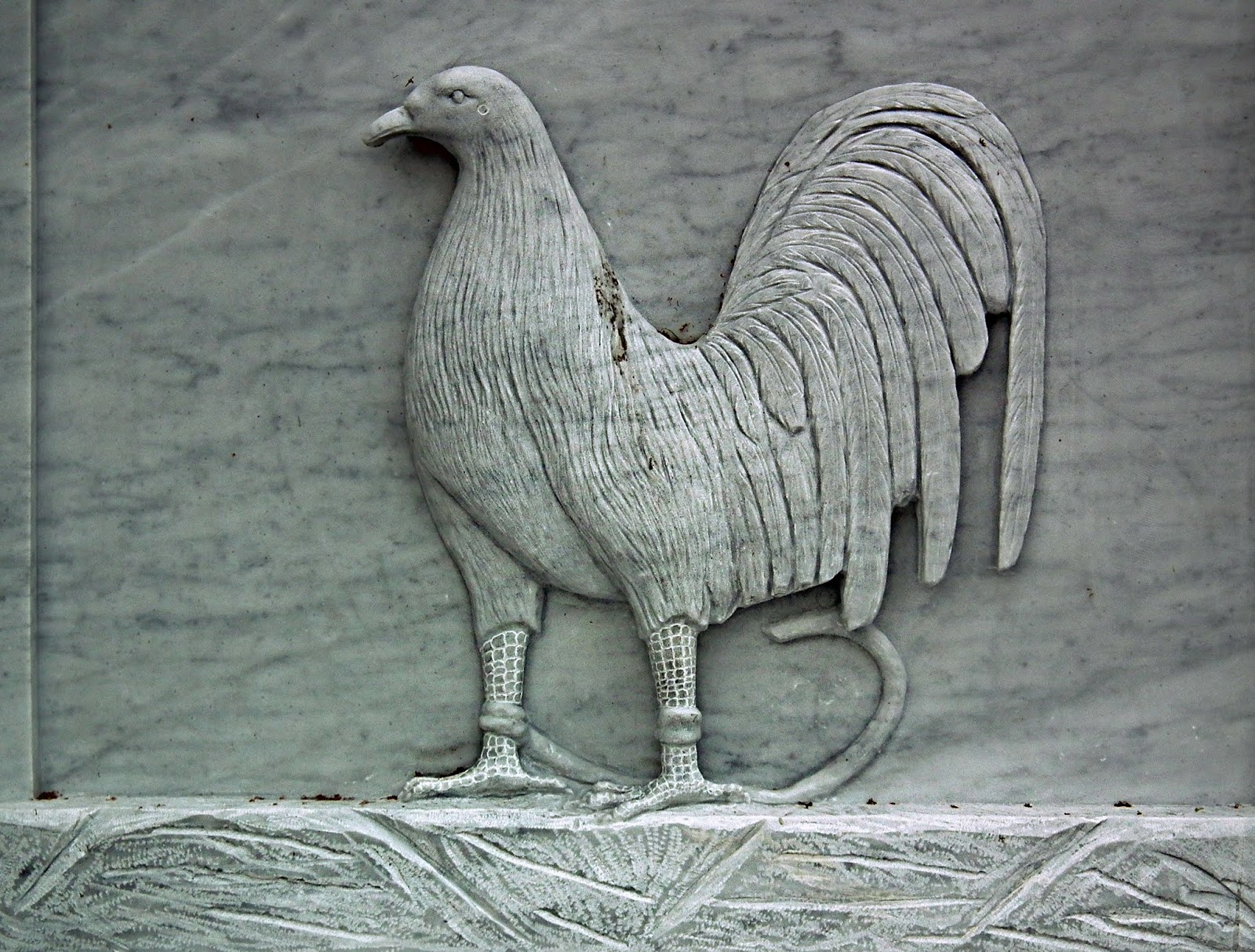
This unusual grave is a complete mystery; I can find out nothing about it. It contains no names other than Amos which I presume is the occupant’s surname but could equally be a first name. There are no dates but the memorial is very recent I think, probably no more than five years old. I first saw it three years ago and the few photos of it on the web are all from the last couple of years. It is on a side path in a section of burials that have taken place since 2000, all of them with large memorials. The others however, expensive as they no doubt were, all look like Chinese headstones, grey granite jobs ordered from a catalogue. The Amos grave is a rare bespoke memorial clearly designed to reflect the tastes and interests of the deceased and produced by a local firm of monumental masons. A lurcher rests at the front of the grave, side panels feature a hare and a jaunting car and the large headstone a cockerel. On the reverse of the headstone are three poems (or excerpts from poems); the middle section is a quotation from ‘Hamlet’ but the other two (‘Lurchers and longdogs were my delight…’ and ‘In the quiet of the night he sits, to all intents asleep’ (about a hare)) seem to be unpublished. The deceased is likely to have lived locally, somewhere in East London or the Essex borders and died recently but even with just a surname to go on it is impossible to say who exactly they were.

I worked in the Royal Docks between 2009 and 2011 and I recall seeing a jaunting car being driven around the streets of Beckton. I wonder….   


Friday, 12 November 2021

Mama, Grandmoo, Visabuela; Dar Durnford Slater (1897-1982) Kensal Green Cemetery


The memorial of Dar Durnford Slater, who was born in 1897 and died in 1982 is rather plain, tastefully lettered to be sure but very unshowy. It is a solidly middle-class tombstone and on it Dar is described as mama, grandmoo and visabuela.  It was a mixture of the unusual first name and the Spanish word for grandmother that attracted my attention and made me wonder if I could find out a little more about who was buried here and whether there was an Iberian or South American connection.  

Dar Durnford Slater was born in Bayswater in July 1897 to George Samuel Ferdinando and his wife Lilian Mabel (nee Duke). She was baptised with the doubly unglamourous forenames Gladys Ethel on 18 July 1898 when the family were living at 29 Grove End Road in St. John’s Wood in what would probably have been a substantial family house (since demolished). Her father’s occupation is variously listed as surveyor and estate agent but whatever he did, he was evidently very successful at it as by 1911 the family were living at Shiprods Manor in the village of Slinfold near Horsham in Sussex. George and Mabel had 5 children living with them in the manor and 6 servants including a cook, a parlourmaid, two housemaids, an under housemaid, a kitchen maid and a 19-year-old chauffeur.  The family name is unusual being a corruption of Ferdinand or possibly Fernandes. Her father appeared as a witness in a libel case in January 1917 brought by a German national, a Mr Maximilian Lindlar, who took the editor and publishers of the journal ‘The Pianomaker’ to court for accusing him of using expressions unfriendly to England and of taking steps, after the Services club had entered into possession of the German Athenaeum club, to oust British officers from the premises. George Ferdinando appeared as a witness to the defence and proudly told the judge that his family settled in England between the sixteenth and seventeenth centuries. The earliest Ferdinando ancestors seem to have been Portuguese Marranos who settled in England in the mid-17th century. This distant relationship seems to have been Dar’s closest connection to Iberia.


After the end of the first world war Gladys Ethel married Alan Farquharson, a man 22 years her senior, probably in Jamaica. The marriage lasted only a short time as Farquharson died in 1922 leaving her a widow at just 25. She married again in 1935, once again in the colonies but this time in India, in Bombay. This time her husband John Durnford Slater, a British army officer, was 12 years younger than her, a callow 26 to her 38.  Her husband became something of a celebrity in World War II when he became the first British commando, appointed as the Lieutenant Colonel of No 3 Commando.  Officering commando units was a more hands-on role than senior army positions usually are and Durnford Slater took part in several raids and did his fair share of strangling German guards with piano wire on moonless nights in Norway. He was awarded the Distinguished Service Order for his part in Operation Archery, a raid on the Lofoten Islands and the port of Vaagso where the attack "lost five out of six officers, & nearly 40% of their effective [strength]" and was in danger of collapsing until he personally stepped into the breach under heavy fire and took control. A photograph of Durnford Slater collecting his DSO from Buckingham Palace appeared in The Tatler in July 1942 and shows him with Dar and his daughter Jennifer. He received a bar to his DSO (effectively meaning he was awarded two DSO’s) for Operation Husky in Italy where he and his men held a bridge against the Germans despite being outgunned and outnumbered. His citation said that he showed a ‘complete disregard for [his own] personal safety’ during the operation, something his men apparently found inspirational. There is a further photograph of him collecting this award in 1944, again with Dar and a slightly older Jennifer.  

After the war Durnford Slater went into the reserves and became a bursar at Bedford School. He died in 1972 in mysterious circumstances at Haywards Heath station according to The People of Sunday 06 February;

Brigadier John Durnford Slater, Britain's first Commando in World War I, was killed yesterday when he fell under the Brighton Belle train at Haywards Heath station, Sussex. Brigadier Slater, 63, who lived in Brighton. was waiting on the platform when the train went through at 60 m.p.h. Awarded the D.S.O. in 1942 for bravery in Norway. He wrote a book, "Commando" about his war exploits.

If there was an inquest (and there surely was) it seems not to have been reported in the papers. If this had been a tragic accident then again you would expect this to have been mentioned in the reports. It is very difficult not to conclude that the war hero committed suicide. Probate records show that he left a very small estate of just £1504. Dar would have been 75 at the time of her husband’s death. If she was living in Brighton with him she must have moved back to London otherwise, why would she be buried in Kensal Green?

The headstone also memorialises Dar’s daughter Jennyfer, a biologist, whose ashes are buried at Old Furzefield Wood (Potters Bar?).


Tuesday, 2 November 2021

"I have no bone to pick with graveyards..."; Kensal Green Cemetery, 02.11.2020


“Personally I have no bone to pick with graveyards, I take the air there willingly, perhaps more willingly than elsewhere, when take the air I must.  The smell of corpses, distinctly perceptible under those of grass and humus mingled, I do not find unpleasant, a trifle on the sweet side perhaps, a trifle heady, but how in­finitely preferable to what the living emit, their feet, teeth, armpits, arses, sticky foreskins and frustrated ovules. And when my father’s remains join in, however modestly, I can almost shed a tear. The living wash in vain, in vain perfume themselves, they stink. Yes, as a place for an outing, when out I must, leave me my graveyards and keep—you—to your public parks and beauty-spots. My sandwich, my banana, taste sweeter when I’m sitting on a tomb, and when the time comes to piss again, as it so often does, I have my pick. Or I wander, hands clasped behind my back, among the slabs, the flat, the leaning and the upright, culling the inscriptions. Of these I never weary, there are always three or four of such drollery that I have to hold on to the cross, or the stele, or the angel, so as not to fall.”

Samuel Beckett ‘First Love’ (1946)

He had a vivid way with words, dearly departed Samuel Beckett, doyen of the shabby, the slovenly and the threadbare; a frowsy tang wafts from the page as you leaf through one of his books. By modern standards I imagine the general population in 1946 did not smell particularly fresh. But however stale and sweaty they were they surely smelled better than the dead? Hot running water, showers, toothpaste, dentistry, deodorant and changing underwear have all become much more common than they were 75 years ago and most of us now are relatively inoffensive, olfactorily speaking. I do think I know what he means about the slightly sweet smell of a corpse though; occasionally I do get a waft of it in cemeteries but having said that I’ve never been sure that I am not imagining it.   


Monument of HRH Princes Sophia, daughter of George III

First thing this morning my phone flashed up a One Drive notification, ‘On this day…’, reminding me that last year, on this day, the second of November, I had been taking photographs in Kensal Green Cemetery. I had spent the weekend in Norwich, a last fling before yet another lockdown which had been announced by Boris Johnson on the Saturday just as we were getting ready to leave our hotel on Tombland (surely the best street name in England?) and go out to find something to eat. Despite the brand new lockdown I had a legitimate, work related, reason to be out and about on Monday. I had to visit a property in North Wembley but once I’d finished Kensal Green was only a minor detour on the way home. It was beautiful, crisp, sunny autumn day and I had the cemetery to myself.  I took my first photo of the day, at the cemetery gate on Harrow Road at 13:19 and my last at 14:37, so I was there for just over an hour.  I took nearly seventy pictures so one a minute almost. These were the best shots on what was a flying visit.   


Tuesday, 19 October 2021

Buried with her baby in her arms and her coffin draped with the Spanish Republican flag: Conchita Supervia (1895-1936) Liberal Jewish Cemetery, Willesden


I first visited the Liberal Jewish Cemetery in Pound Lane in Willesden in the pre-pandemic summer of 2019. I was intrigued by an unusual grave in which a large circular altar-like stone block is supported on the back of four tortoises. Despite a plaque saying the grace had been ‘restored by her admirers in 2006’ I couldn’t read the name and had no idea who was buried here. Meller and Parson’s ‘London Cemeteries’ gave me a bit more detail; in the cemetery “the most unusual memorial dated 1936, comprises four stone tortoises which support a curved sided pedestal confined between two discs, the upper inscribed with the name Conchita Rubenstein who ‘Died with her daughter’.” This was as far as I got with my research; I parked Mrs Rubenstein intending to come back to her when I had more time only to find Sheldon from the Cemetery Club getting in there before me. In his blog post just a few weeks after I visited the cemetery Sheldon revealed that Mrs Rubenstein was in fact Conchita Supervía, a Spanish opera singer born in Barcelona in 1895. Some sources say she made her stage debut at the age of 15 at the Teatro Colón in Buenos Aires and others say that she was only fourteen when Richard Strauss himself chose her to play in Rosenkavalier at the Royal Opera in Rome. She sung all over Europe as well in South America and the United States. She made over 200 recordings and even had a film part as singer Baba L'Etoile in a 1934 British production called Evensong based on the life of Dame Nellie Melba. Some accounts of her life politely say she married twice but none of them mention the name of her first husband by whom she had a son, Jorge.  In 1930 she converted to Judaism, married a Mr Benzion Rubenstein and came to live in London. She died in childbirth at the age of 40.  


The Aberdeen Press and Journal of Tuesday 31 March 1936 gives an account of the distressing circumstances of her death under the headline ‘Famous Prima Donna's Sudden Death’;

Madame Conchita Supervia, the famous Spanish prima donna, died in a London nursing home yesterday. She was the wife of Mr Ben Rubinstein, an English timber broker and fruit farmer. Madame Supervia was expecting a baby, and only on Sunday went into the nursing home "very happy and very well." At 11 a.m. yesterday the baby was still-born. A clot of blood developed, and. despite the efforts of the doctors, Madame Supervia died.


A few days later the Dundee Evening Telegraph gave an account of her funeral:

With the body of her child in her arms, Conchita Supervia, the coloratura contralto, was buried at the Liberal Jewish Cemetery, Willesden, to-day. Her coffin was draped with the new Republican flag of Spain red, purple, and yellow, and rested upon arum lilies sent by her husband and her son from the garden which was such a source of pleasure to her at her home at Rustington, Sussex. The ceremony was according to the Jewish rites, with its centuries' old traditional prayers, but there was no singing. Many of the wreaths on the wet grass by the graveside were without names, and were from admirers who had heard but never forgotten her voice. One of these: typical of others, bore the inscription—"That I may sometimes hear the echo of her voice in the moonbeams." About 200 people were present at the ceremony, and they included Senor Dr Perez D'Ayala. the Spanish Ambassador, and his wife. The mourners included Mr Ben Rubenstein, her husband, and George, her 17- year-old son, together with numerous other relatives and friends. Rev. M Perizweg recited the committal words, first in Hebrew and then in English. As his voice pronounced the words—"May she come to her rest in peace," Mr Rubenstein dropped earth into the grave and the son performed the same symbolic action with the recitation of the prayer of resignation to the will of God. Among the masses of spring flowers was a wreath of tulips, lilies and daffodils from the Spanish Ambassador and his wife. Others who sent flowers included the directors of the Royal Opera House and Violet Lady Melchett, whose wreath bore the inscription— "In loving remembrance of darling Conchita."

Her memorial is designed by Sir Edwin Lutyens who was also responsible for the Phillipson mausoleum in Golders Green.


Monday, 4 October 2021

An Unsuitable Job for a Woman; Hester Hammerton (1711-1746) All Saints, Kingston-Upon-Thames


I came upon an account of the life of Hester Hammerton, the once celebrated female sexton of Kingston-upon-Thames in Kirkby’s Wonderful and Eccentric Museum. For those unfamiliar with this publication it is an early 19th century compendium of the marvellous and the bizarre; it contains biographies of the singular characters of the age (the Chevalier D’Eon and Joseph Merlin for example), accounts of calamities, (shipwrecks, volcanic eruptions, earthquakes etc), details of monstrous births, (four legged cockerals, two headed calves and numerous conjoined twins), prodigious eaters (a polish man who regularly ate 5 pounds of raw beef and 10 tallow candles at one sitting) and stories of miraculous escapes from death (Elizabeth Woodcock of Impington who survived 8 days buried alive in snow). Whilst written to appeal to the sensation seeker it has to be conceded that its articles are generally well informed and that its contributors often took pains to establish their facts.

Kirkby’s tells us that Hester Hammerton was baptised on March 16 1711. Her father Abraham performed the office of sexton of All Saints Church “in which his daughter was accustomed to assist him.” Hester and her brother-in-law Thomas German were both with their father on the 2nd of March 1730, digging a grave for a Mr George Hammond of London. Also present were Richard Milles and Sarah Smith. They were digging too close to one of the main pillars of the Chapel of St Mary; the vicar Dr Rawlinson, explained in a letter to a friend exactly what happened next:

On Monday last, our sexton, with his son and daughter, being employed in digging a grave, part of the ancient chapel of St Mary’s fell in upon them, killed the sexton and one other man, Richard Mills, on the spot, bruised and wounded several others and buried in the grave both the son and daughter for above three hours, during which time many were employed in digging out the rubbish, in order to get at the bodies that were buried. After the removal of the timbers, and several loads of rubbish, they heard very plainly some loud groans and cries in the grave. Soon after, they came to the heads of two persons: the man was speechless and almost dead, having his head closely confined between two stones; the woman was not so much pressed; but being immediately taken care of by Dr. Cranmer, they are both in a fair way of recovery. The Bailiffs and Churchwardens by their great humanity and diligence on this occasion had a great share in preserving the lives of the two persons abovementioned, by the speedy removal of the rubbish and by keeping off the crowd who pressed in upon the labourers in great numbers. The damage besides the lives already lost is computed to amount to above £1000.

The entry from the parish register at All Saints showing the burial of Abraham Hammerton and Richard Milles on the 5th March -'killed by the fall of the church' and Sarah Smith on the 15th.  

Abraham Hammerton and Richard Milles were both killed on the spot but the vicar was writing too soon to know that Sarah Smith would also eventually die of her injuries. Abraham and Richard were both buried on the 5th March, Sarah was not buried until the 15th. Hester and her brother-in-law Thomas both survived and Hester inherited her father’s position as sexton to the parish though luckily her injuries prevented her first job being the melancholy one of digging her own father’s grave. Kirkby’s describes Hester as a ‘strong, lusty woman of a comely countenance.’ It claimed that injuries received in the accident prevented her from ever wearing stays again and says that ‘her usual dress therefore was a man's waistcoat and hat, a long loose gown and a silk handkerchief tied round her neck.’ On Sundays she would bow to convention and ‘dress extremely clean and neat, in a gown of the then fashion, a mob cap with frilled border and ribbon, and a nosegay in her bosom.’  The writer says that Hester ‘was very fond of all kinds of manly diversions, such as cricket, football, bull baiting, also of smoaking and associating with men but nevertheless, she preserved her moral character unimpeached. If any person offered to take liberties with her, she never failed to resent the affront and her fist inflicted merited chastisement on the offender. She possessed great bodily strength and would dig all the graves and ring the great bell herself. She died at Kingston and was buried February 28 1746 in the 35th year of her age.’

Hester's burial recorded in the parish register for 28 February 1746

Hester was instrumental in apprehending Philip Wilkinson and William Sweet, two Londoners who came down to Kingston with the intentions of robbing the communion plate from the church. Hester wandered into church to ring the two o’clock bell and found the two men ripping off the gold lace and fringe of the pulpit hangings. Incensed the doughty Hester grabbed one of the men by the collar and threw him over the reading desk and into the pew below. Whilst she was occupied the other thief crept up on her from behind and hit her over the head with a blunt instrument, stunning her and allowing both robbers to flee the scene. A few days later a boy was caught lurking around the church and suspected of being somehow being involved in the robbery. He denied this but said that if he was released, he would tell the authorities who had robbed the church. His information led to the capture and arrest of Wilkinson and Sweet. The pair were tried at Kingston Assizes on 10th April 1735 and being found guilty of sacrilege, sentenced to death.  The Derby Mercury of 17th April gives this account of their execution;

On Thursday, soon after One o'Clock, Philip Wilkinson and William Sweet, were executed in the Market-Place at Kingston. They said they forgave the Boy and the Woman who were instrumental in their Death; desired the Prayers of the Spectators; and just before they were turn'd off, declar'd, as they were dying Men, that they were innocent of the Fact for which they suffer'd, nor had they been guilty of any Robbery whatsoever; and that they never saw the Boy or Woman before they came to appear against them.

Kirkby’s gives the following postscript to the story;

The bodies of the above two men, after execution, were carried into the Castle Inn yard, and no particular account was given of them afterwards. As christian burial was refused them, on account of the crime of sacrilege, of which they had been convicted it was not till above seventy years afterwards that a discovery was made, which seems to clear up this matter. August 25 1807 - As some workmen were digging a hole in the garden of Mr. John Smallpiece the butcher, near Clattern-bridge (late Mr. Laming's garden) the skeletons of two men lying together were discovered. These were conjectured to be the remains of Wilkinson and Sweet. The garden in which they were found was a bowling green, and belonged to the Castle Inn, at the time when the bodies of those two men were left in the yard, and there is no reason to doubt that, as it was generally supposed, they were buried in that bowling green.