Friday, 16 September 2022

'The temptations of a passion contrary to reason....'; John Child, 2nd Earl Tylney (1712-1784), St Mary the Virgin, Wanstead

The Earl's heart, shipped to England in a jar, still waiting for admittance to the family vault


No one seems to be quite sure where the body of John Child, the 2nd Earl Tylney, lies. He died in Naples on the 17th September 1784 and it would seem logical to have buried him in the English cemetery there which had been interring his compatriots since 1726. But there is no record of his grave there. The year before his own death, he had been with his nephew, Charles, in Rome when he died of malaria. Charles was buried in the eternal city’s English Cemetery and perhaps Tylney’s body was taken to Rome and he was buried there? Again there is no record. He is sometimes said to have been laid to rest at the antico cimitero inglese degli Livorno, the old English burial ground at Leghorn. This would be wonderfully ironic, as he would have been buried just a few yards away from the Scottish novelist Tobias Smollett who died in Tuscany in 1771 and whose grave is at Leghorn.  Smollett, whose undisguised gusto for the seamier side of life earned him the sobriquet the Learned Smelfungus from Laurence Sterne, had, in Roderick Random, caricatured Tylney as Lord Strutwell, an aristocrat who was “notorious for a passion for his own sex”.  Whilst Tylney’s name does appear on a tombstone in the cemetery it is not his own, but belongs to his nephew. The inscription is in Latin - losiae Child Iuveni Suavissimo lohannes Comes Tylney Patruus maerens posuit anno MDCCLXXIV; Josiah Child, the sweetest young man, Earl John Tylney mournfully laid him to rest in the year 1774.  We may be unsure of the whereabouts of the Earl’s body but we know exactly where his heart is; following the instructions in his will, it was removed and sent to England in a glass jar, to be buried with his ancestors in the family vault in the crypt of St Mary the Virgin in Wanstead. His dead relatives seem not to have been keen to receive him; 238 years later his dessicated cuore, in its sealed Murano glass vase, stands forlornly atop a pile of paving slabs and a broken font in the corridor of the crypt, still waiting admittance to the vault. His name and dates have been inscribed on the huge memorial slab that seals the entrance to the Child/Tylney tomb but his mortal remains stay firmly outside, given the cold shoulder for over two centuries. 

Under normal circumstances John Child would not have inherited his father’s title. He was born in 1712, the third son of Richard Child the 1st Earl Tylney. His two older brothers had both predeceased their father and so it was John who became the 2nd Earl in 1750 and inherited the magnificent Palladian mansion of Wanstead House when the 1st Earl died. He was educated at Westminster School and at Christ Church in Oxford. In 1734 his father stood down as an MP from his Essex seat to allow the 22-year-old John to stand in his place. The voters were not impressed and humiliatingly he was not returned. He seems not to have embarked on a grand tour after leaving university; perhaps his father was anxious about letting him out of his sight after losing his two elder brothers. He does not seem to have started his travels until he became Earl in his own right.   On 6 December 1751 the Derby Mercury reported that “on Wednesday an Express arrived at the seat of the Hon. Mr. Child, at Walthamstow, which occasioned a Report that the Earl of Tylney was one of the four English Gentlemen lately robbed and murdered, as they were travelling from Mantua to Turin.” Despite family anxieties the Earl was alive and well and determined to continue his peregrinations on the continent. His love for Italy would have been some consolation for him when, in the early 1760’s he was forced to flee abroad to escape the repercussions of being caught in flagrante with a pair of handsome footmen. Or at least that is what Jeremy Bentham believed; in his manuscript essay Pederasty, written in 1785, a year after the Earl’s death, he writes about Smollett’s portrayal of Lord Strutwell and comments; Much about the time when this novel was published a Scotch Earl was detected in the consummation of an amour after the manner of Tiberius with two of his servants at the same time. The affair getting around, he found himself under the obligation of going off to the Continent where at the close of a long life he died not many years since. In the margin of his manuscript Bentham identifies the ‘Scotch Earl’ as ‘Lord Tylney’.

John Child, 2nd Earl Tylney, seated centre, with his gentleman friends at Sir Horace Mann's house in Florence, detail from a picture by Thomas Patch (c1765)

In Italy he set himself up in Florence in a ‘pretty house and a small garden where he has a great quantity of golden pheasants’ according to one contemporary. William Beckford, a fellow exile fleeing from disapproving English attitudes towards homosexuality, approved of Tylney’s  ‘fine house all over blue and silver, with stuffed birds, alabaster cupids, and a thousand prettinesses more...’ but Robert Harvey, a Norfolk gentleman, ‘could not avoid thinking of his superb palace on Epping Forest and comparing it to his neat but small house here.’ Tylney was, he lamented ‘an unhappy man who could not resist the temptations & instigations of a passion, contrary to reason & at which nature shudders.’ He did not live in permanent exile and seems to have travelled back to Wanstead from time to time, continuing to take an interest in the affairs of the estate and to commission works, including the grotto, in the gardens and grounds. In August 1763 Aris's Birmingham Gazette reported on an expensive purchase for Wanstead; “the French King for Want of Money, refused lately to purchase an elegant Piece of Tapestry that was made for him. It was afterwards purchased by Earl Tylney for £2500”.  Much as he seems to have loved the estate and despite, or perhaps because of, the extravagant spending on the house the Salisbury and Winchester Journal reported in August 1772 that rumours of Prince William Henry, Duke of Gloucester “having purchased the Earl of Tylney’s seat upon Epping Forest, is absolutely without foundation.” The newspaper went on to claim that “the Earl cannot sell it without the concurrence of the heir at law, Sir James Long, which has been often solicited, and as repeatedly refused.”

In The English Way of Death (1991) Julian Litten gives a fascinating account of a masquerade supposedly organised by Tylney in 1768 in the grounds of Wanstead House;

“Many lights appear in the trees and on the water. We are off and have great excitement fishing up treasure… tied to bladders. His Lordship is hailed from the shore by a knight, who we are told is King Arthur, have you the sacrifice my Lord, who answers no, then take my sword and smite the water in front of the grot and see what my wizard has done, take also this dove and when asked, give it to the keeper. Off again to some distance from the grotto, the lights are small and the water still, the giant eagle appears and asks, have you the sacrifice, no my Lord answers, so be it and disappears in steam.

His Lordship smites the water with King Arthur’s sword, all the company are still, a rumble sucking noise comes in front of the opening of the grotto the water as if boiling and to the horror of all the company as though from the depth of hell arose a ghastly coffin covered with slime and other things. Silence as though relief, when suddenly with a creaking and ghostly groaning the lid slid as if off and up sat a terrible apparition with outstretched hand screeching in a hollow voice, give me my gift, with such violence, that some of the company fell into the water and had to be saved and those on the shore scrambled in always confusion was everywhere. We almost fainted with fright and was only stayed from the same fate by the hand of his Lordship, who handed the keeper the dove the keeper shut its hand and with a gurgling noise vanished with a clang of its lid, and all went pitch. Then the roof of the grotto glowed two times lighting the water and the company a little, nothing was to be seen of the keeper or his coffin, as though it did not happen. [sic!]”

Litten speculates that King Arthur’s words ‘see what my wizard has done…’ are a coded reference to John Joseph Merlin, the only man in London who had the technical ability to create such an extravaganza of automata and special effects. Litten’s source note for this story is almost as intriguing as the story itself; “I am indebted to Stuart Campbell-Adams for this quotation, said to have come from the journals of an Italian noblewoman who had spent some time at Wanstead House, Essex. His information is that these notes were rescued from the Tylney papers either by a maid or a relative of Catherine Tylney Long (Hon. Mrs Long Wellesley) prior to many of the records being burnt.” A 2019 report on the Wanstead Park grotto prepared for the City of London corporation by Alan Baxter Ltd gives the above quote in full whilst noting “the dubious provenance of the source, coupled with the chronology of Lord Tylney’s time in Italy, casts doubt on its veracity. However, it has been reproduced here, heavily caveated, because it offers a flavour of the possible, theatrical uses for the Grotto.” Sally Jeffrey in The Gardens of Wanstead (1999) has similar doubts. She also quotes the passage in full but adds a footnote “the description has not been checked, since I have so far failed to locate Stuart Campbell-Adams who provided the information to Julian Litten. Any information on this source would be gratefully received”. I think I did manage to trace Stuart Campbell-Adams to an address in Walthamstow, but unfortunately, he died in 2016. We may never get to the bottom of this mystery.

Earl Tylney's desiccated heart can be just about made out inside the patterned glass.
 
And another mystery to finish from the Dublin Evening Post of Saturday 05 February 1780, a four legged bird, a harbinger of the Earl’s imminent death?

A few days ago, a very extraordinary and uncommon bird was shot in the Earl of Tylney’s park at Wanstead, Essex. It has four legs, which are placed diametrically opposite each other; its size is something less than that a goose. It is web-footed like a duck, with this difference, that the web is quite black, but as fine in texture as the wings of a bat; its neck is prodigiously long, very small, and something resembling an eel; with very remarkable eyes, which are extremely small; and its bill or beak of an uncommon form. It has certainly the most beautiful plumage that ever was seen, being tinged over with almost every colour that is seen in the feathered tribe.

A prodigiously long, eel like neck and fabulous multicoloured plumage?  Part of me really wants to believe in this fabulous creature but another part of me just wonders if the huntsman had never seen a cormorant before? The iridescence on the feathers might well be startling if you have never seen it close up.  

Friday, 9 September 2022

The ghosts of St Mary's churchyard, Wanstead E11


If you believe that sort of nonsense there are at least four apparitions that haunt the churchyard at St Mary’s in Wanstead, though two of them are a double act, so perhaps they only count as one?  The dullest, in hue at least, is the grey lady who has been unsuccessfully scouring the churchyard on moonless nights for at least a hundred years, looking for her missing husband. Gray ladies are, of course, ten a penny and no one pays much attention to her. There is a skull and crossbones headstone for a Thomas Turpin in the churchyard; the occupant is reputed to be Dick Turpin’s uncle. The housebreaking, highway robbing 18th century thug supposedly visits his uncle periodically though without Black Bess, which is quite unusual for a sighting of Britain’s busiest ghost. If you don’t see him in Wanstead then you need to take yourself off to St George’s Field in York, close to where he was executed in 1739. He can also be found haunting various pubs including the Bell Inn in Cambridgeshire, The Chequers in Bickley in Kent, and the Old Swan in Milton Keynes, where you at least can get a decent pint of beer while you wait for busy Dick to show up. If you still don’t have any luck, try the Bath Road at Longford, the deserted village of Stretton Baskerville in Leicestershire, Stubbings in Berkshire, Edlesborough in Buckinghamshire, Hounslow Heath, Traps Hill in Loughton, or Garswood near St. Helens. There are more but I can’t bring myself to list them all; Turpin really is Britain’s most unquiet spirit.

The third ghost, definitely my favourite, is a skeleton who wheels a coffin loaded onto a handcart around the burial ground.  Some say he is looking for his wife but if that is the case why is he pushing a coffin? Is he going to put her in it? Doesn’t he realise he is too late? At some point in his circumnavigation of the churchyard he passes an ornate tomb where a white lady (fully fleshed) emerges and embraces him. Some say that the corpse of the lady in white was stolen by body snatchers but this does not make the meaning of the pantomime with the skeleton any clearer. 

The grave of Thomas Turpin, allegedly uncle to dastardly Dick, Essex's most famous thug

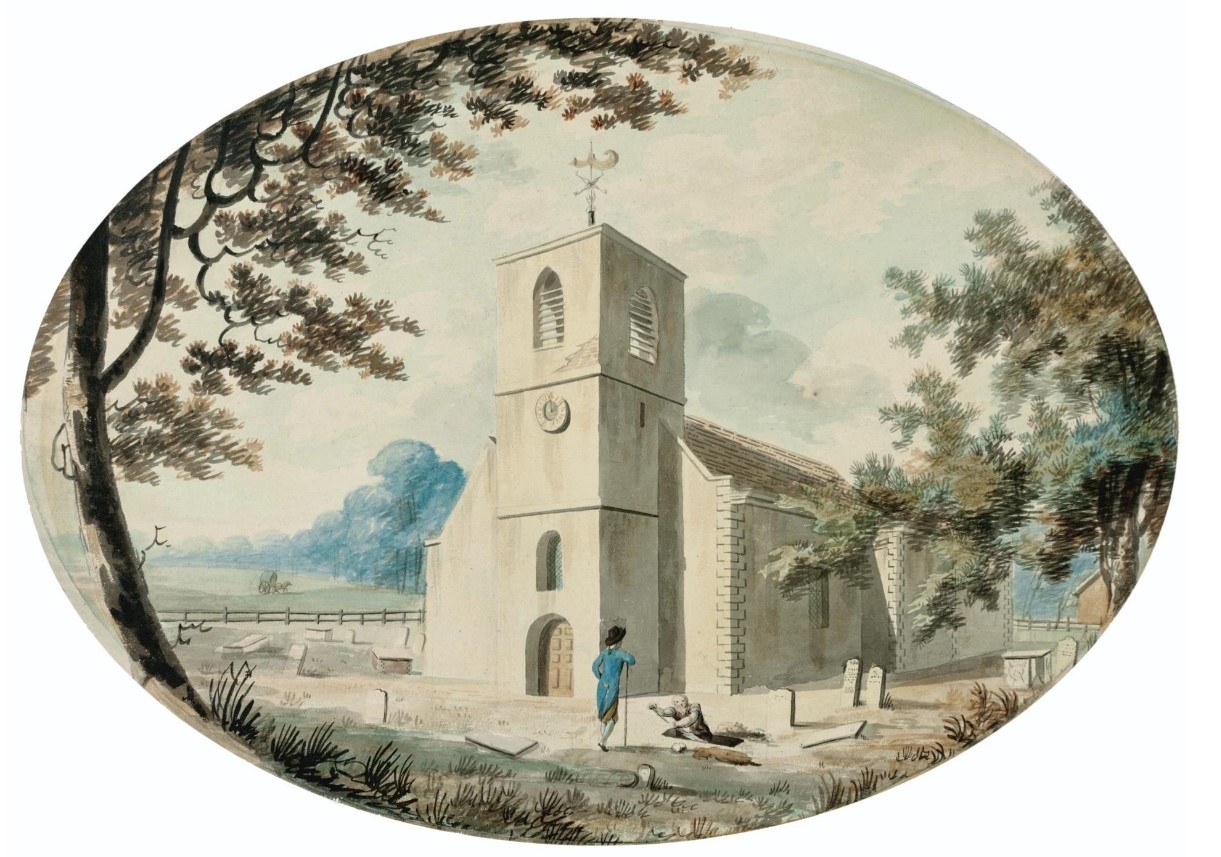
There has been a church on the site of St Mary’s for at least 800 years; the first record of the parish dates from 1208.  Some of the memorials in the churchyard predate the current church; the oldest headstone is for James Waly who died in 1685. The new church was built between 1787 and 1790, the architect was Thomas Hardwick. JMW Turner was briefly in the employment of Thomas Hardwick and his boss sent him off to Wanstead to produce a watercolour of the old church before it was demolished. Turner’s picture shows a square towered church surrounded by a churchyard filled with headstones and chest tombs. A gravedigger stands waist deep in a half excavated grave observed by a gentleman in a bright blue frock coat, black felt hat, breeches and white stockings who leans casually on his walking stick. The new church Pevsner described as being “worthy in its appearance of the noble aspiration of the mansion." The mansion has, of course, been long demolished but the elegant Georgian church is now Grade I listed. 


The oldest newspaper story I could find mentioning the churchyard (apart from the graverobbers of 1824) was this from the London Mercury, 27 August 1837, about the overly hasty burial of an initially unidentified body found in Epping Forest:

SHOCKING OCCURRENCE — An inquest was held on Saturday evening last at the Eagle Inn, Snaresbrook, on the body of a gentleman of the name of Cooper, which had been found in a very decomposed state in Epping Forest. A lengthened investigation took place, but as no satisfactory evidence was produced the jury returned a verdict ‘that the deceased was found dead in Epping Forest, with a pistol wound through his body; but whether such was inflicted by his own hand or by any other party there was no evidence to the jury;' and the body was interred on the following morning in Wanstead churchyard without funeral rites. (There was nobody to pay the parson.)

In consequence of a letter written by Mr. Baker, a surgeon, and which appeared in some of the Sunday journals, the friends of the deceased called upon that gentleman, and on Sunday they proceeded to Snaresbrook for the purpose of identifying the body, but, to their great astonishment, they found that the inquiry had been held and the deceased interred; but, on the clothes being produced, the identification of the unfortunate gentleman was fully established. He was a single, man, and had held responsible situations under Government. He left his residence in Crown street, Westminster, on last Friday fortnight, at which time he was in a very low dejected state of mind, arising from his affections having been blighted. Soon after he absented himself his brother, who resides in the Regent's Park, received a letter from him (deceased), of which the following is a verbatim copy:

"Thursday Evening.  Dear Brother, I thought it best to send a few lines to you, so that you might break the melancholy news to my poor dear mother, who, I am afraid, will take it greatly to heart. I do indeed intend to make my exit. I have provided myself amply with the means to effect my purpose; it is, indeed, a premeditated act, and which I have contemplated for a long time; this is all owing to my dear Emma. I wrote to her, saying she would hear disagreeable news of me, but of what nature I gave her no reason to guess. Dear brother, support and strengthen our dear mother for my sake. So far from being dejected I feel quite happy respecting the change I am about to undergo. Farewell for ever.  F. Cooper"

The deceased was respectably connected. On Monday Mr. Baker, the surgeon, applied to the Lord Mayor for his opinion respecting the indecent manner in which the deceased had been interred.


Another body found floating in a pond on Wanstead Flats in 1856 was never identified. This is from the Essex Standard of Friday 08 August 1856;

An inquest was held on Friday last, before C. C. Lewis. Esq. at the Eagle Inn, Snaresbrook, touching the death of a man unknown, found dead in a pond at the rear of Clark's Buildings, Wanstead.— A witness having deposed to the fact of finding the body, the jury returned a verdict of "Found dead in a pond; but how deceased came to his death there is no evidence to show." The body is described as from 35 to 40 years of age. 5ft. 8in. or 9in. high, dark complexion, hair and whiskers; dressed in blue striped blouse, black waistcoat, cord trousers, blue striped shirt, cotton handkerchief, blue ribbed stockings, blucher boots, and black cap with peak. The body was interred the same evening in Wanstead churchyard.


A seaman’s funeral at the churchyard from the Shipping and Mercantile Gazette of Monday 16 January 1882:

The remains of Captain Sim, the much-respected veteran Mariner, aged 94 years, were conveyed to his last resting-place on Saturday in Old Wanstead Churchyard. Numerous friends (about 150) were there to pay their last tribute of respect; amongst them were many ancient Mariners—viz., Captains Carr, Mainland. M'lntyre, Price, Frost, Paddle, Ike; also Messrs. George Ward, Strang, T. B. Walker, Wilkinson, Sherman. &c. The deceased always took great interest in the Merchant Seamen's Orphan Asylum. The worthy Secretary and his wife, with 12 of the Seamen's orphans, were in attendance, the girls with baskets of white flowers to strew on the coffin; also some of his female attendants, one with an anchor of white flowers, and others with white wreaths of flowers. There were several mourning coaches and private carriages.


Another funeral, this one from the Leytonstone Express and Independent - Saturday 21 April 1883:

A TOUCHING SCENE—On the 10th inst., in the presence of as large an assemblage as has been seen since the death of the late rector, there was buried in Wanstead Old Churchyard, a young girl, Sarah Ann Smith, aged 15. who, with her parents was well known in Wanstead. She was a member of the Girls' Friendly Society. About 30 of her fellow members followed her to her last resting-place, all of whom bore some tokens of mourning and flowers. We understand that the circumstances of her death were very sad. She was living in Clapham and was killed by an accidental fall from a high window. Great sympathy has been felt for her parents who are much respected in the neighbourhood, where the deceased was born and brought up.


From the Staffordshire Sentinel of Tuesday 19 March 1929:

RAIL CRIME MYSTERY, Mrs. Winifred East, of Gordon Road. Wanstead. the victim of the London tram murder. whose decapitated body was found on the line at Kidbrooke. S.E. early last Thursday. was buried this afternoon in St. Mary's Churchyard. Wanstead. Scotland Yard officers to-day visited Swansea in connection with their inquiries into the mystery.

The Derry Journal of Monday 18 March 1929 gives more details of the circumstances surrounding Winifred East’s death:

WOMAN’S TERRIBLE DEATH, HEADLESS BODY FOUND London detectives are probing the mysterious facts connected with the death of Mrs. Winifred East (28), the wife of an auctioneer, whose decapitated body was found on the Southern Railway between Kidbrooke and Eltham. A young man who is known to have entered the carriage in which Mrs. East travelled, and left at a later station, is being sought the police. When the driver of the electric train had just passed Kidbrooke station he saw in the distance dark object lying between the two sets of rails. As he came closer, he saw that it was the decapitated body of a woman. He reported the matter to the stationmaster at Well Hall, the next stopping place. After establishing the woman’s identity, the police searched the train in which she was known to have left Barnehurst, and the discovery of number of her personal belongings under a seat were able to determine the actual compartment in which she travelled. The coach was run into a siding, and Supt. Brown and other C.I. D. officers made a close examination of the compartment.

The murder was never solved. 


And finally, a rather harrowing story which has nothing to do with the churchyard but occurred in the local area. It is a little masterpiece of stomach-churning concision from the Illustrated Police Budget of Saturday 21 January 1899. Whatever happened to poor Mary Bradord?:

Strange Affair at Wanstead. It reported from Wanstead that Mary Bradford, aged 26years, who has been employed as a kitchen maid at a large private residence in Cambridge Park, Wanstead, for about two years, complained to a fellow-servant on Friday of being unwell, and went upstairs, saying she would be down again directly. As she did not return, the other servant went to her bedroom door, which she found locked on the inside. Hearing a baby cry, she asked Bradford if she was better, and received a reply that she would be downstairs immediately. The girl left and returned to the kitchen, followed shortly afterwards by Bradford. The housemaid then left the kitchen and went to Bradford's bedroom, which she found in great disorder and confusion. On lifting the lid of an old deal box she discovered the dead body of a newly-born female child, wrapped in a coarse apron. Returning the kitchen, she taxed Bradford with being the mother, and it is stated that Bradford admitted that she was. and begged her fellow servant to “try and forget it.” and keep it quiet from the people of the house. The other girl, however, informed her mistress. A doctor was sent for, and it is alleged that stated he would communicate with the coroner for the district. At half past eight the following morning the housemaid took some breakfast to Bradford and on entering the bedroom was astonished to find the bed empty and the girl gone. The dead body of the child had also disappeared. The housemaid states that about a quarter of hour earlier she heard someone in the hall quietly, but took no particular notice of the fact. The police had made every inquiry, and although four days had elapsed no tidings of either the girl or the dead child had been discovered. How she could travel in her weak state of health, without attracting the attention of anyone seems marvellous. She had always stated that she had no friends or relatives in London, and it is surmised that she has drowned herself after disposing of the child’s body. It may be added neither the girl’s mistress nor her fellow-servants suspected her condition. A thorough search has been made throughout Wanstead Park and Epping Forest of all the bushes and ponds, but without result. The police are pursuing their investigations at all the workhouses and infirmaries, but up to the present are without a clue. It has been ascertained that about three weeks ago Bradford told her fellow servant that she had been married to engineer.


Friday, 2 September 2022

A morning stroll amongst the tombs; Cemitério de Agramonte, Porto, Portugal


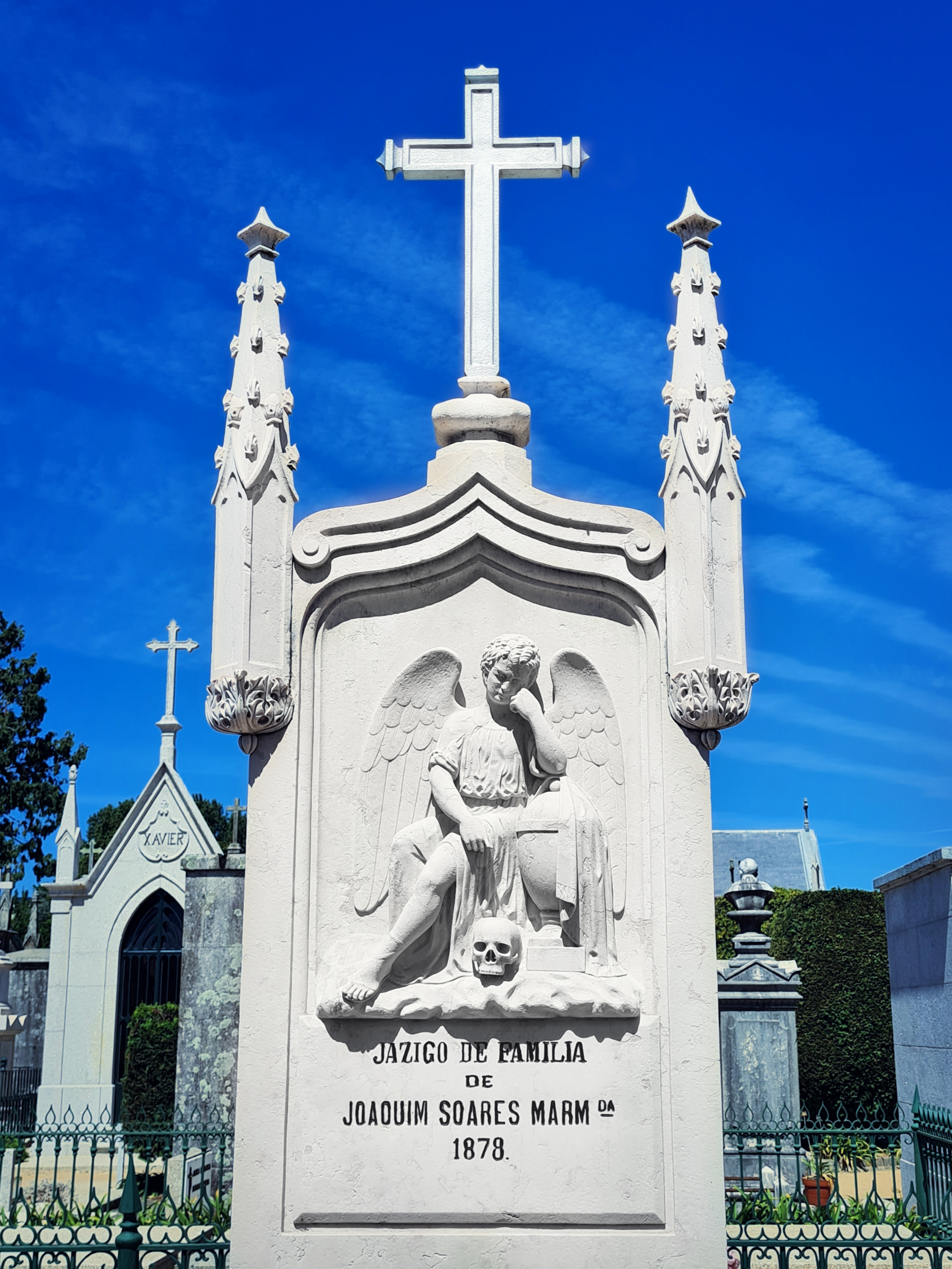
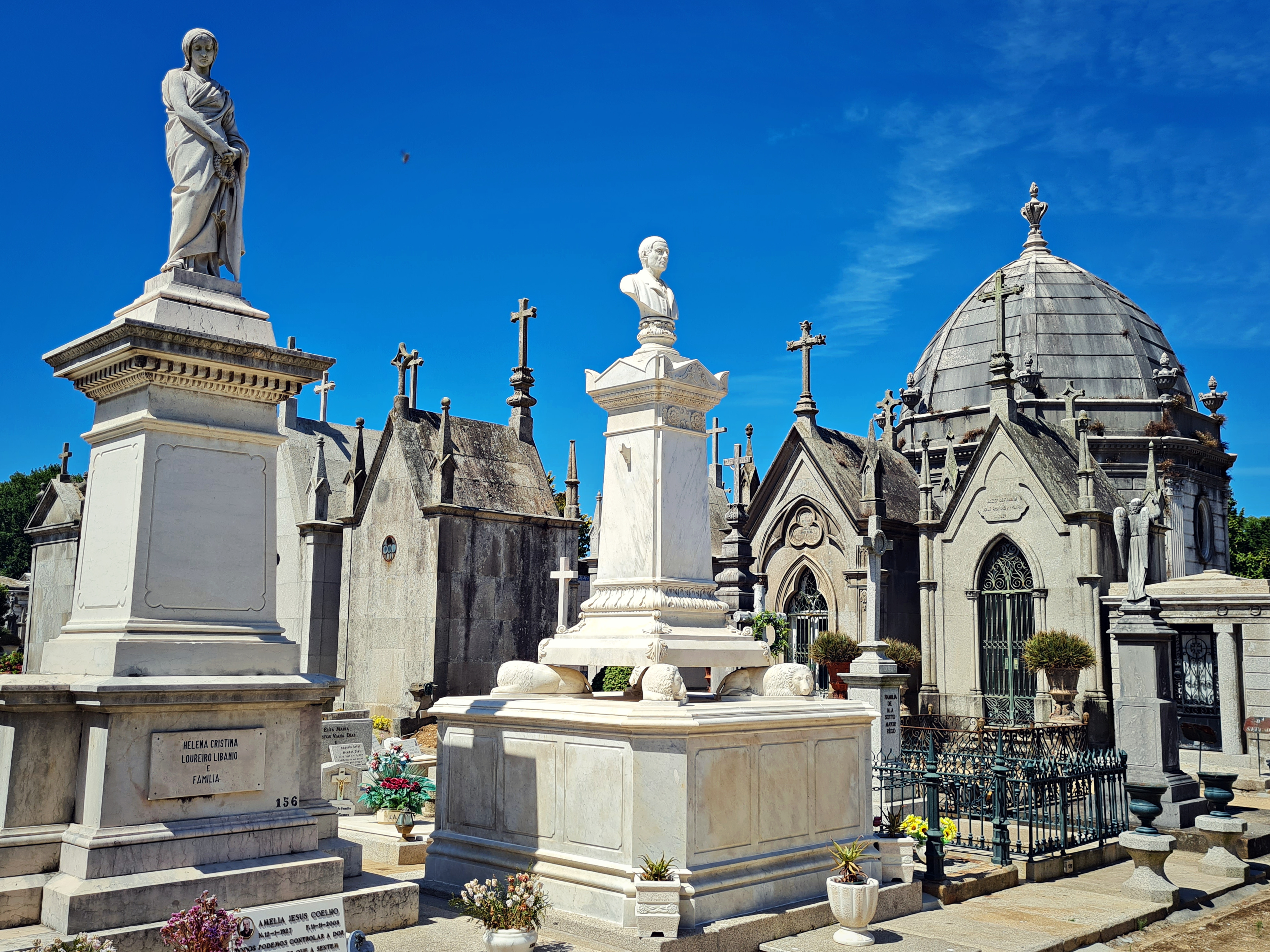
It was by complete accident but I could not have planned it better. We spent a couple of days in Porto as part of our holiday in Portugal and with only the haziest idea of the city’s geography, the hotel was booked because of its relative proximity to the city centre, not close enough to be disturbed by late night revellers but still within walking distance. When I wondered how far the nearest cemetery was from the hotel, Google maps told me that the Cemitério de Agramonte was a 290 metre, four minute walk. So on our first full day in the city I twisted my wife’s arm (metaphorically) into taking a morning stroll amongst the tombs and mausoleums. As we got ourselves ready to leave we watched the morning news on RTP and discovered that we had arrived in Porto on the very day that the heart of the former Emperor of Brazil, Dom Pedro I, preserved in a glass vat of formaldehyde, was being flown back to Brazil by military plane so that the dead monarch could take part in the country’s bicentennial independence celebrations. 


We arrived at the cemetery mid-morning but the temperature was already close to 30 degrees and Porto’s heat is significantly more humid than further south in Portugal. The sky was completely cloudless, blue scored by numerous vapour trails from the jets descending to land at Francisco Sá Carneiro airport. The sun was already high and the light, bouncing off white marble and grey stone, dazzling. Anything not facing into the sun lay in deep shadow so many tombs and memorials were difficult to photograph. My wife, although she is ten years younger than me, has reached that stage in life where the ages of the recently deceased are no longer decades older than her and she has begum to grow alarmed at the prospect of her own mortality. While I wandered the paths of the cemetery looking for interesting memorials, she quietly worked her way along the tombs calculating the ages at which the dead had died.  The results were not comforting. Her research revealed, she told me, that almost everyone died either when they were a child or in their 40’s and 50’s. I told her that surely this is what you would expect in a 19th century cemetery? Maybe the modern section would be more cheerful and provide better news about contemporary longevity? She wasn’t convinced and thoroughly disconsolate went to sit on a bench in the shade by the chapel to distract herself by scrolling though Facebook.    


Agramonte is a municipal cemetery, opened by the city council in 1855 in response to a cholera epidemic. Church burials were prohibited in Portugal in 1835 and the decree which banned them also obliged all municipal authorities to open a public cemetery in every city, town and village in Portugal, at least 143 metres away from residential arears and enclosed by a wall at least 2.25 metres high. There was widespread public resistance to the new law, protests became riots so violent that it brought the country to the brink of another civil war. Local authorities were not always quick to obey the new law or fudged it where possible. In Porto church authorities opened a private cemetery, Lapa, next to the church, in a bid to head off the threat from the local authority. The council allowed feelings to simmer down before they finally opened the first municipal cemetery, the Prado do Repouso in 1839. Demand for the municipal cemetery was so low that much of the land it occupied was leased out as a farm; for many years the authorities received more revenue from agriculture at the cemetery than they did from selling grave spaces. When Agramonte opened it was initially used to bury cholera victims and then became the place where the poor of Porto buried their dead cheaply. Its character changed in the 1860’s when the city authorities finally clamped down on private cemeteries. The catholic associations and brotherhoods demanded large private plots at Agramonte to replace their closed cemeteries. When the city council agreed the cemetery went through a rapid phase of gentrification, being landscaped, new chapels were built and suddenly the middle and upper classes of Porto were buying large burial plots on which they could erect mausoleums or excavate family vaults.     


Tuesday, 2 August 2022

The Lost Andean Mummy of The Royal College of Surgeons

The Hunterian's Peruvian mummy as depicted in Pettigrew's History of Egyptian Mummies (1834)
 

Don’t ask me why but I am fascinated by the lost mummies of the Hunterian Museum. Before the second world war the Royal College of Surgeons had an outstanding collection of preserved corpses including the mysterious Miss Johnson who died at the Locke Hospital in the early 1770’s but was preserved by the surgeon John Sheldon and then kept naked in his bedroom in a specially designed cabinet. Also dating from the 1770’s were the remnants of Maria Van Butchell embalmed by her eccentric dentist husband Martin and John Hunter himself. Along with these relatively recent, and unusual, experiments in human preservation the museum had a small selection of Egyptian mummies, both human and animal and as well as sundry other preserved remains acquired at one time or another by John Hunter or his successors.  A recent anonymous comment on my post about the mummified boy found in a bricked-up vault at St Botolph’s Without Aldgate in 1742 alerted me to an entry in C.J.S. Thompson’s 1929 Guide to the surgical instruments and objects in the Hunterian, which included the St Botolph’s mummy. I had not been aware that this object had found its way into the Hunterian – I had thought it had simply been lost. It was in my efforts to trace when the Hunterian acquired the mummy that I came across an article on the museum from 1860 by Andrew Wynter in the long defunct Once a Week magazine.  The article mentions not only the St. Botolph’s but yet another lost mummy, this one from Peru. It even carries an illustration of it although it is only mentioned in passing in the text. The Peruvian mummy however is not mentioned in the 1929 guide and must not have been on display at the time so there is a possibility it survived the incendiary bombs. 


Note from Sir Everard Home


The Peruvian mummy was donated to the Hunterian on 27 May 1823 by King George IV; a hastily scrawled note from Sir Everard Home, John Hunter’s son-in-law, in the archives of the RCS says “Gentleman, I have the King’s command to authorise the transfer of the mummy of the Inca to the Royal College of Surgeons”. Entry 742 on page 53 of Part IV of the 1831 catalogue of the Hunterian, printed for the RCS by Richard Taylor of Red Lion Court, not only explains how it came to in the museum but gives a very detailed description. This striking passage is quoted in full in Thomas Pettigrew’s History of Egyptian Mummies (1834) alongside a line drawing of the mummy;

The body of a Peruvian, which was found in one of the native sepulchres, or guacas in some calcareous hills in the district of Caxamarca in Peru. Tradition, preserved among the inhabitants of the country, stated the spot in which the body was found buried, to have been the site of a voluntary sacrifice of the life of a Curaca, one of an order of nobles immediately following in dignity the members of the blood-royal. Colonel Tomas Heres, at that time (1821) Governor of the province of Caxamarca, hearing of this tradition, and knowing it to have been the custom of the ancient Peruvians to bury with their dead whatever household goods or implements they had, during life, been possessed of, ordered these guacas to be opened. As he expected, he found therein various objects of interest, which he remitted to the Museum of Lima. He also found, at about ten or twelve feet below the surface, three human bodies viz the above specimen which is a male, another of a female, which crumbled to dust when exposed to the air, and a third, of a young child about a year old, which latter was presented by Colonel Heres to General Don Juan Gregorio las Heras, and is preserved in the Museum of Buenos Ayres.

Tradition also places the period of interment a very short time previous to the arrival of Pizarro at Rimac, or Lima, somewhere between 1530 and 1540. The only weapon found with the bodies was an axe, or bludgeon of green jade stone very similar in shape to those brought from New Holland. Under the arm of the child was a ball, of two or three inches diameter, of very fine thread or worsted of Vicugna wool. The bodies were merely placed in an excavation in the earth of about ten feet deep. The soil is calcareous, and perhaps, to this circumstance, as well as the dryness of the air, is to be attributed the preservation of the bodies in an undecomposed state. Indeed throughout the highlands of Peru the desiccating process goes on so fast, as to arrest the putrefactive process very much; animal substances will be completely dried up by mere exposure to the air. The bodies are not found wrapped up in linen, as amongst the Egyptians, but they are sometimes covered with the skin of the Vicugna or Peruvian camel, bound closely to the body with ligatures. The poorer classes were generally buried on the eastern aspect of mountains, while the richer were entombed in their own dwellings; the bodies being clothed in their accustomed garments and the weapons, utensils &c. they had used during life, were buried with them; the house was then forsaken by the rest of the family, and the interior of its walls filled up with earth so as to become quite solid. The bodies are generally found extended and lying on the back.

The native Peruvians are now Catholics, and bury their dead according to the rites of that church, although they introduce some of their Pagan customs with the prescribed ceremonies. The above specimen was brought to England by the late General Paroissien, Deputy from the government of Peru, as a present from General San Martin to his late majesty King George the Fourth, by whom it was presented to the Museum in 1823.

General James (Diego) Parossien

General James Paroissien is an interesting character. Despite the French name he was born in Barking in 1784, to a Huguenot family.  At the age of 22, recently qualified as a doctor and fired with the spirit of freedom and liberation that was sweeping Europe at the time, he took ship to South America and joined the army fighting to free Chile and Peru from the yoke of Spanish rule. He became surgeon-general to the army of the Andes and a trusted confidant of José de San Martín, the liberator of Argentina, Chile and Peru. In 1822 he was sent on a diplomatic mission to Europe to raise funds for recently liberated Peru. He was in London when he heard the news that San Martin had resigned and waited here until the exiled General arrived, arranging temporary lodgings for him until he moved to Brussels. To aid Paroissien’s diplomatic mission he had been sent with gifts for King George IV, including the Peruvian mummy. The mission was brought to England by H.M.S Conway, commanded by Captain Basil Hall. There is an original letter in the collection of the Pierpont Morgan Library in New York from Captain Hall to General Paroissien dated March 13 1823. Hall writes about the arrangements that will be needed to get “the old Inca” through customs and recommends the commissioning of a glass case to protect from the damp English climate before it is presented to the British Museum. Hall also wrote about the mummy in his diary which was published in 1823 as Extracts from a Journal Written on the Coasts of Chile, Peru and Mexico;   

Captain Basil Hall of H.M.S. Conway

13th of Dec.—I went this morning to breakfast with the Protector, and to see a curious mummy, or preserved figure, which had been brought the day before from a Peruvian village to the northward of Lima. The figure was that of a man seated on the ground with the knees almost touching his chin, the elbows pressed to his side, and the hands clasping his cheek bones, the mouth was half open, exposing a double row of fine teeth. The body, though shrivelled up in a remarkable manner, had all the appearance of a man, the skin being entire except on one shoulder. In the countenance there was an expression of agony very distinctly marked. The tradition with respect to this and other similar bodies, is, that at the time of the conquest many of the Incas and their families were persecuted to such a degree that they really allowed themselves to be buried alive, rather than submit to the fate with which the Spaniards threatened them. They have generally been found in the posture above described, or pits dug more than twelve feet deep in the sand, whereas the bodies of persons known to have died a natural death are invariably discovered in the regular burying places of the Indians, stretched out at full length — There was seated near the same spot a female figure, with a child in her arms. The female had crumbled into dust on exposure to the air, but the child, which was shown to us, was entire. It was wrapped in a cotton cloth, woven very neatly, and composed of a variety of brilliant colours, and all quite fresh. Parts of the cloths also, of which the female figures had worn, were equally perfect, and the fibre quite strong. These bodies were dug up in a part of the country were rain never falls, and where the soil consequently is so perfectly dry, as to cause an absorption of moisture so great, that putrefaction does not take place. The male figure was sent to England in the convoy, and is now in the British Museum.

As already mentioned, the Peruvian mummy did not feature in the 1929 Guide to the Hunterian. Did the Royal College of Surgeons give it away? If they did, I can’t trace it to any other location. If it wasn’t on display in 1929 was is it in storage safely somewhere else? Did it survive the 1941 bomb? There are no answers to any of these mysteries that I can find and so I have contacted the Royal College of Surgeons and asked them if they can shed any light on the fate of the mummy from Cajamarca.  

The mummy as illustrated in Once A Week magazine in 1860

Friday, 22 July 2022

The Corn Cutter of Broadway; Dr. Issachar Zacharie (1826-1900) Highgate East Cemetery


It isn’t the most spectacular of monuments but amongst the plain grey headstones the polished pink granite memorial with its masonic symbols does stand out and snag the attention long enough for you to read the inscription:

In Loving Memory Of Issachar Zacharie M.D. First Grand Supreme Ruler Of The Masonic Order Of The Secret Monitor Within The British Empire Who Died On September 18th 1900 Aged 73 Years – Sempre Fidelis.   This memorial Of Their Lasting Esteem & Regard Was Erected By The Members Of The Order

Issachar Zacharie was a bit of a con man and quite a successful one. For a start he was not entitled to use the appellation of MD, he was not a doctor and although in his later life newspapers often described him as an Orthopaedist, he was nothing more than a humble chiropodist, a cutter of corns and trimmer of toes according to the less polite American newspapers. His most famous client was Abraham Lincoln and the two men struck up something of a rapport. In early 1863 Lincoln told the Canadian Christian mystic and Zionist Henry Wentworth Monk that “…I myself have a regard for the Jews, My chiropodist is a Jew, and he has so many times “put me upon my feet” that I would have no objection to giving his countrymen a “leg up”…” The esteem in which Lincoln held Zacharie ruffled feathers in Washington; US newspapers were particularly scathing, as reported here by The Belfast News-Letter on 13 October 1864:  

Then we have had a more sanguinary scandal in New York city. The other day one Doctor Issachar Zacharie, a corn cutter in Broadway, quarrelled with his partner and brother chiropodist, Mr. Samuel Barnett. Barnett drew a revolver, and shot Zacharie through the jaw. The wounded man is out of danger; the assailant is out on bail; and the affair will be probably arranged, and never heard of in a criminal court; but the opportunity was too rich a one to be neglected by the World. It found out that Doctor Issachar Zacharie was the confidential friend and bosom companion of his Excellency Abraham Lincoln; that he was the ami de la maison at the White House, and that by means of his influence over the President he had carried on a regular trade in pardons and releases, notably in the enlargement of one Mr. Mordecai, who was sitting for his sins, not, as he should have done, in the gate, but in the inner hold of a military prison. "Many a time," thundered the World, "has the President of the United States left a Cabinet Council to indulge in an hour's sweet converse in the parlour with this contemptible toe-nail trimmer." It seems beyond a doubt that this Dr. Issachar Zacharie was at one period a person of some note at the Republican Court, for he was appointed by special edict ‘Chiropodist-in-chief to the army,’ and was permitted to strut about in an absurd military uniform! You will pardon this note of exclamation, for this is certainly the first time that I, or probably anybody else, heard of an army in the field having bunions. What a treasure Dr. Issachar Zacharie would have been to the rebels in their corn-cutting expedition in the Shenandoah last July.

A carte de visite produced for Zacharie by Turner and Killick of 17 Upper Street, Islington

Zacharie was born in Chatham in 1846, the son of Jewish immigrants from Prussia. By the age of 10 his father had apprenticed him to a physician but a few later, in the mid 1840’s the whole family upped sticks and moved on again, this time to the United States.  By 1846 he was treating toes and pulling teeth in Baltimore but was soon setting on professional tours to other major cities across the US. He gulled his clients with fraudulent endorsements from more famous medical men including one from Sir Astley Paston Cooper which claimed that Zacharie had studied chiropody under him and that the famous surgeon considered “him to be fully competent to perform the duty of a Chiropodist upon all who may favor him with their patronage”. Sir Astley had supposedly dated the endorsement 27 June 1837 which would made have made Zacharie astonishingly precocious as he would only have been 10 at the time.  In 1860 he published “Surgical and Practical Observations on the Diseases of the Human Foot”, the composition of which gave him little trouble as he simply plagiarised the entire tome from an identically titled book by John Eisenberg (and from whom he had also filched the idea of fake celebrity endorsements). When the American Civil War broke out Zacharie wrote to the US Secretary of War suggesting the creation of an elite corp of chiropodists would help keep the Unionist Army on its feet. Stanton rejected the idea but as he needed his own corns cutting summoned Zacharie to the war office. He was so pleased with the results of the consultation that he introduced Zacharie to a fellow martyr to bunions, the President. The rest, as they say, is history. Zacharie somehow charmed his way into Lincoln’s good books and into a position of power and influence way beyond that merited by even the most expert use of nippers and clippers, files, probes and rasps. He was sent on sensitive diplomatic and spying missions deep in Confederate territory in New Orleans and Virginia. He backed Zacharie to be the Chiropodist General to the US Army even though the army had neither before nor since felt the need  for this particular role within its ranks. In 1865 Zacharies stellar American career came to an end when John Wilkes Booth shot Lincoln in the head at the Ford’s Theater.    


An endorsement for Zacharie, this time a real one, written by Abe Lincoln himself

By the early 1870’s Zacharie had apparently forgotten that the post of Chiropodist General to the US Army did not exist and billed Congress $45,000 for his services in the non-existent role in which he claimed to have treated 15,000 soldiers. The claim was rejected and he returned to England in umbrage in 1874. He took premises at 80 Brook Street near Grosvenor Square and placed adverts in the major newspapers claiming to be a foot surgeon and late chiropodist general to the United States Army and inviting anyone suffering from corns, bunions, enlarged joints and nails penetrating the flesh to come and be cured. He also set up The Secret Monitor, a branch of the Free Masons, through which he again appears to have achieved some measure of power and influence, according to the Daily Telegraph & Courier of 22 June 1899:

Although the title of the Order of the Secret Monitor sounds very cabalistic and recondite, it nevertheless simply means a modem off-shoot of Freemasonry. It only dates back to 1887, but already it has several well-known members the craft, and its present Grand Supreme Ruler is ! the Earl of Warwick. It hold its annual convocation of Grand Council last evening in the Hotel Cecil, at which his lordship presided, and at this particular meeting the custom elect, instal, and proclaim the Grand Supreme Ruler for the year, the rand Treasurer, and appoint and invest the now Grand Officers. The result of this convoca- tion, far regards officers, was that the Earl of Warwick again became Supreme Ruler, and that next in rank him was Dr. Issachar Zacharie. Judge Philbrick, Q.C., the Earl of Halsbury, Dr. Muglistoa, Mr. C. E. Keyser (High Sheriff of Berks), Deputy-Inspector General Dr. Belgrave Ninnis, Mr. Frederick West, Judge James Copley Moyle, Mr. George Richards (Transvaal), and many others received Grand Office.” Benevolence, the groat principle of Freemasonry, is not forgotten in this degree, and mot ion was on the business paper to support the Secret Monitor Benevolent Fund Festival in the autumn, at which the presence of ladies is to be invited.


Lloyd's Weekly Newspaper of 03 October 1880 describes a domestic incident which must have taken Zacharie right back to the days of the Civil War: 

SLAPPING THE FOOTMAN. At the Marlborough- street police-court, on Friday, Catherine Keats, cook, was brought before Mr. Mansfield on a warrant charged with assaulting Henry Smith, a lad of colour, footman, both in the service of Dr, Issachar Zacharie, orthopedist, 80, Brook-street, Hanover- square. Complainant stated that as he was going to lock the area gate, it being his master's orders that it should be fastened at night, the prisoner said she was the mistress of the house, and would not have it locked. On complainant telling her that he would not acknowledge her as the mistress, she struck him several times, and took up a knife and said she would rip him up. The housemaid got between them, and the matter ended. One of the blows the prisoner gave him caused his ear to bleed, and he had been a little deaf ever since. Some further evidence having been given by the housemaid, the prisoner said the footman accused her of being drunk, and she slapped him, but did not use a knife. Mr. Mansfield fined the prisoner 20s.

Friday, 15 July 2022

Master Masons and Rear Admirals, Indian Chiefs and Housebreakers, Armed Robbers and Odd Fellows, All Welcome at St John's Burial Ground, Horseferry Road, SW1

ST. JOHN'S BURYING GROUND, Westminster, is very spacious and overcrowded; the churchwardens have been obliged to give up a part of the ground, for the interment of the poor, which had formerly been set apart, for the more fortunate. The soil here is very damp, and, at a shallow depth, the water flows in abundantly; the depth of the graves varies from four to eight feet.

George A. Walker Gatherings from Graveyards (1839)

So populous was the parish of St Margaret in Westminster that it was divided in 1727 by the creation of the new parish of St John the Evangelist. The church has an unusual design of four towers and is known as Queen Anne’s footstool as legend has it that when the architect Thomas Archer asked her majesty how she would like the church to look, the petulant queen, keen no doubt to get rid of the tiresome old architect and get back to romping with Sarah Churchill and Abigail Hill, kicked over the stool she was resting her heels on and told him “Like that…” It didn’t appeal to Dickens; in Our Mutual Friend, he describes it as "appearing to be some petrified monster, frightful and gigantic on its back with its legs in the air", which makes it sound more Gothic than Baroque. Roque’s map of 1746 shows that the church had quite an extensive churchyard, Mrs Basil Holmes in London’s Burial Grounds (1896) says that it “used to extend, at the beginning of the century, for some distance on the south side of the church, but was thrown into the road. Now all that remains is a very small bare enclosure, not ¼ acre in size, railed in round the church.” Even at its most extensive the churchyard was not big enough to provide enough burial spaces for the teeming parish it served. The vestry acquired additional land for a burial ground on what was then Market Street but is now the lower end of Horseferry Road. The new ground was consecrated by Dr Joseph Wilcocks, Dean of Westminster, on 29 July 1731 but soon had its own capacity issues.  One ten-year period saw 5,126 graves dug and the parish was soon reduced to desperate remedies to try and create more space for interments including adding additional earth on no less than three occasions and raising burial fees to prevent "low fees attracting interments from other parishes." Despite being extended in 1823 it was closed in 1853 by the Government on the grounds of having become a great public nuisance. 

In 1880 a committee of local ratepayers was appointed to look at converting the disused burial ground into a public garden in order to bring an end a row with the vestry about a proposal to build a mortuary on the site. When Horseferry Road was widened the strip across the front was surrendered without protest but a public mortuary was too much for the ratepayers. Luckily the Duke of Westminster stepped in and “most liberally offered the parish the freehold of a site in a retired position more suitable for the purpose, at the back of the Penitentiary, and within a short distance of the burial ground.” The vestry accepted the site offered by the Duke at the back of Jeremy Bentham's Panopticon prison and allowed the burial ground to be repurposed as a garden. The headstones and chest tombs were cleared away, lawns and flower beds were laid and in 1885 the new garden was opened by the Duke. A decade later Mrs Basil Holmes commented approvingly “it is neatly kept by the vestry, and much frequented.” It still is. The lay out is pretty much as it was back in the 1880’s, a shelter in the centre has been replaced by a fountain but otherwise it is neat and well kept by the council. When I was there small children raced around the fountain on bicycles and a boy in his early teens languidly pushed himself around the boringly flat terrain on a skateboard. Dog walkers exercised their canine companions whilst smokers sat on benches puffing away contentedly. It was the early evening so they all looked like local residents; there wasn’t an office worker in sight (they were all around the corner packing out the Marquis of Granby on Romney Street). It is not obvious that the garden was once a burial ground and that there must be 20 or 30,000 people mouldering away beneath the manicured lawns and the paving slabs. The paving looks suspiciously like chopped up old headstones; at the sides of the park there definitely are old headstones being used as paving slabs, the inscription on one reads “In memory of Benjamin, John and Sally the infant children of William and Mary Ginger of this parish, Also of Mary their daughter wife of the Revd. William Hughes who died 6th April 1799 aged 33 years.”  Ledger stones are set up against the walls of the neighbouring buildings. “I think the best way of disposing of tombstones is by putting them against the walls,” wrote Mrs Basil Holmes, “in St. John’s Garden, Horseferry Road, they are cemented into an even row against the wall, and look as if they would last for ever.” Personally, I wish they had just left them where they stood. Thank God only half of Bunhill Fields was cleared to create a large lawn and the rest was left to let us see what these tiny crowded grave yards looked like. When I think of the destruction wrought by the Midland Rail Company, Baroness Burdett Coutts and the vestry of St Pancras on Old St Pancras and St Giles burial grounds I could weep.  Apart from the ledger stones cemented into the walls and the headstones being utilised as paving there are just two tombs left in St John’s, an anonymous chest tomb surrounded by black metal railings and the grade II listed memorial to Christopher Cass. 


J.E. Smith in St John the Evangelist, Westminster: parochial memorials (1892) says “On the east side of the ground stands an unsightly monument in granite, clumsily inscribed in huge letters to the memory of “Chr"- Cass, Master Mason to His Maj.'s Ordnance.  Died Apl.  21, 1734.  Aged 58."  He was employed on the construction of St.  John’s Church, and on several of the other churches built by Queen Anne’s Commission. He was also one of the original vestrymen appointed by the Commission.” The Biographical Dictionary of Sculptors in Britain, 1660-1851 has further details of Christopher Cass and says that he was a “conspicuously successful master mason whose team worked in London, Cambridge and at a number of large country houses.” They add;

He died in London and was buried in the cemetery of St John, Westminster, under a heavy granite monument inscribed ‘Chr. Cass, master-mason to his Maj. Ordnance. Dy’d Ap. 21, 1734’. In a report to the RIBA ‘On the Mechanical Processes of Sculpture’ Charles Harriott Smith suggested that this monument was one of the earliest works in England to be executed in granite, and that ‘its mouldings, though such as would now be considered rude in form and execution, were highly esteemed in his (Mr. Smith’s) boyhood’ (Builder,1851, 215). In his will Cass originally expressed a wish to be buried in a vault beneath the portico of St Martin-in-the-Fields, but he substituted St John’s burial-ground in a codicil. To Edward Strong II, ‘my friend and benefactor’, he left £50, declaring that he owed him what ‘I and my family, under the good providence of God, have’. He named Andrews Jelfe his executor, and bequeathed him 100 guineas. Thomas Gayfere received £20 and ‘all his wearing apparel, linen and woollen of all kind’.

Cass’s widow survived him and died in 1742. Andrews Jelfe, writing in that year to William Dixon, tells him that ‘Mrs. Cass was buried last week. She had left all her part to Mr. Bright, a young lawyer, who married her daughter’.

The gardens with the Cass Memorial from Mrs Basil Holmes London's Burial Grounds (1896)

There is a large damaged and weathered ledger stone cemented to the north wall which carries the name of Admiral Ommanney and his wife Martha. A visitor to the gardens on 30 June 1923 reported the full inscription to Notes and QueriesHere lieth the Remains of Rear Admiral Cornthwaite Ommanney who died the 26th day of March 1801 aetat 65. Also the Remains of Martha Ommanney his widow who died on this 18th day of March March 1813 aetat 65. Likewise Edmund Woods Ommanney their grandson, son of Henry Manaton and Ann died 19th May, 1813, aged 2 years... On 27 March 1937 another correspondent noted that “one of the most interesting of the memorials was badly broken in moving it, involving the loss of part of the inscription to Rear-Admiral Cornthwaite Ommanney (died 1801). Fortunately this inscription had already been placed on record in ' N. and Q.' of June 30, 1923.”  Rear-Admiral Cornthwaite Ommanney was born in 1736 in Portsea, Hampshire. He was commissioned lieutenant in the Royal Navy on 22 August 1758 and promoted to commander in 1765. He commanded the HMS Zephyr, Otter, Panther and the Tartyr and saw active service in Newfoundland and in New York in 1776 participating in the campaign to recapture the city from the rebels. He became a superannuated rear-admiral in 1794 and died on 26 March 1801, ‘sincerely lamented by all his acquaintance’.


Both Holmes and Smith mention that the burial ground supposedly contains the remains of an Indian Chief. This story turns out to be true. The burial took place just two years after the grounds were opened. I found the following in the Newcastle Courant of Saturday 10 August 1734:

On Friday last dy'd of the Small-Pox, at his Apartments in the Little Ambrey, Westminster, one of the Indian Chiefs, Brother to the Queen, who was lately brought over by James Oglethorpe, Esq; The particular Manner of burying him in the Burial Ground of St. John the Evangelist in the Horseferry Road, according to the Custom of the Kings and Inhabitants of the Karakee Creeks, was as follows, viz. the Deceased being sewed up in two Blankets with one Deal Board under and another over him, and tied down with a Cord, was placed upon a Bier, and carried to the Place of Interment, and laid in the Earth without any Ceremony, his Cloaths, a Quantity of Glass Beads, and some Pieces of Silver, were thrown into the Grave, it being the Indian Custom to bury all their Effects with 'em.

James Oglethorpe was a soldier, a Member of Parliament and the founder of the colony of Georgia. He paid a visit to England in 1734/35 bringing with him a delegation of Creek Indians and their chief Tomochichi, who had been invited by the Georgia trustees to be present during the formal ratification of their treaty with Oglethorpe.   An oil painting by William Verelst, now in the Winterthur Museum in Delaware, shows Oglethorpe presenting the Yamacraw Indians to the Georgia Trustees on July 3, 1734. Perhaps the man who was buried in St John’s was amongst the group depicted in the painting. If so he was dead and buried just five weeks later.


Other interesting funerals which took place at the burial ground included Charles Cartwright who had been executed at Hertford for a robbery (in which no one died – punishments were harsh in the early nineteenth century). It was reported in the Public Ledger and Daily Advertiser of 18 August 1824: 

Monday, Cartwright, who had been executed at Hertford, for the robbery at Mr. Gordon’s, was buried in St. John’s Burial Ground, Westminster, with “Gypsy Nan," for the Chief Mourner. The deceased was not much above 19 years of age; who the Chief Mourner was may be imagined. An immense crowd followed the corpse, consisting of an appalling assemblage of those who are not held in too much esteem by the world’s law; however, the Queens Square Police Officers, &c were on the ground, and all went off very orderly.

And then there was James Lawns, a burglar, reported in the Morning Post of 02 August 1832:

DEATH OF A NOTORIOUS HOUSEBREAKER - On Saturday last, at an early hour in the morning, James Lawns, a noted "cracksman" in Westminster, well known to the police, was attacked with the cholera in the streets. He was taken home to his lodgings in Union-court, Orchard-street, and was attended by several medical gentlemen but without success. Lawn has frequently been in custody, and, for the last few years, is supposed to have been concerned either directly, or indirectly, in the greater part of the burglaries which have been committed in the metropolis. On his death being made known, his companions in crime raised a subscription to bury him, and on Monday afternoon the funeral took place. A fellow named Ned Nix, was the chief mourner; and the corpse was followed to St. John's burial ground, Westminster, for interment, by upwards of 500 of the most notorious thieves and vagabonds in the metropolis, many of whom shed tears.


On 23 September 1823 the Morning Advertiser reported the funeral of Henry Davy, Odd Fellow (who lived in a Pineapple, but not under the sea):

Funeral of an Odd Fellow. —On Sunday afternoon a crowd of parsons assembled in Pine Apple-court, and Castle-lane, Westminster, to witness the funeral procession of Henry Davy, an Odd Fellow. About four o’clock the avenues leading to the spot where the corpse lay were blocked up with spectators, and considerable curiosity was excited in the neighbourhood by the novel appearance of those belonging to the St. Luke’s, St. Peter’s, and St. James’s, arriving, wearing their several orders, insignias of office, and carrying the banners of the respective Lodges; in the former the deceased was a brother, six whom supported the pall. The procession moved slowly through the principal streets, towards St. John’s Church, a band of music playing at intervals sacred tunes with the drum muffled. On arrival of the corpse at St. John’s New Burial Ground, Horseferry Road, the coffin was lowered into the grave, and the funeral service read, after which the band stood forward and played the Evening Hymn; on its conclusion the earth was thrown in, and the remains covered. A vast concourse of persons collected, and the novelty of the sight was much noticed. The procession returned in the same order, and soon after dispersed.

And finally George Edmonds, military bandsman, the best performer on the French horn in Europe, reported in the Perthshire Courier of 19 September 1823;

On Thursday afternoon, at four o’clock, was interred in St John's burial ground, Westminster, the mortal remains George Edmonds, one the band the Coldstream, or Second Regiment of Foot Guards, with grand military honours, far surpassing anything of the kind witnessed in Westminster for several years. The deceased was considered to be the best performer the French horn or bugle in Europe, had the honour of being privately introduced, and having played for the King, all the Royal Family, and most of the distinguished Nobility and Gentry, and had frequently attended private parties, till his fame had spread all over the kingdom.