Tuesday, 13 May 2014

Thomas Joseph & Esther Tate, St Marylebone Cemetery (East Finchley)


Probably the best known and certainly the most striking monument in St Marylebone (East Finchley) Cemetery is Frank Lynn Jenkins cast bronze pedestal and sculpture of a young man for Thomas Joseph Tate and his wife Esther, who died within a fortnight of each other in February and March 1909. There are many who think the tomb too showy, too ostentatious, too….French. You certainly see more of this type of bronze memorial in the great cemeteries of Paris than in London. And what is it meant to represent? A half naked man, apparently in the prime of life, reclining on a bed; is he dying? The symbolism is hard to decipher.

He may have been a man of means (cast bronze memorials produced by celebrated sculptors do not come cheap) but Thomas Joseph Tate would be an almost completely forgotten name today if it were not for this monument and a handful of tennis racquets. He was born in 1832 according to the memorial but 1831 according to his baptism record in Huntley Street, now WC1, and baptised at Old St Pancras Church. He was the second of four children born to Charles James Tate, a cabinet maker, and his wife Mary. At the age of twenty he was living in Early Mews in Camden with his cousins 18 and 20 year old Joseph and Charles Gomez; all three gave their occupations as Bow and Arrow Makers. It was a career Thomas was to follow for the best part of the next forty years. His cousins worked in the family business making long bows but Thomas eventually became a foreman on archery production working for Buchannan’s of Piccadilly. He married Esther and lived with her in rented rooms at a number of overcrowded lodging houses in Westminster. It wasn’t until he was almost fifty that his fortunes seemed to improve. By 1881 he had moved south of the river to Newington Causeway in Southwark where he and Esther finally lived alone at number 84. Ten years later he was back north of the river in Great Portland Street.

The 1891 census was the first time he records his occupation as being other than bow and arrow maker; he is now a bat maker. We don’t know when or where he started making tennis racquets but he was good at it, designing and producing top class equipment. Two of his best known customers were the Renshaw twins, William and Ernest. William Renshaw won twelve Wimbledon titles, seven of them the men’s singles (an all-time record shared with Pete Sampras and Roger Federer), six of these between 1881 and 1886 won consecutively, a record that has never been beaten. The Renshaws accepted a lucrative deal from the Slazenger Company to allow one of their racquets to be named after them but they actually played most of their title matches with Thomas Tate racquets. In the 1901 census Thomas lists himself as a racquet maker and as an employer producing goods and living at 18 Prince Street in Westminster.   

Thomas and Esther lived together for over forty years but there were no children. Although she was five years younger than her husband she seems to have lost the will to live once he died and she only survived him by a fortnight; Thomas dying on  Thursday 25 February 1909 and Esther on Thursday 11 March.


Tuesday, 6 May 2014

John Crook (1827-1902) and Grace Sophie Crook (1830-1914), Kensal Green Cemetery


John Crook, a retired inn-keeper, and his wife Grace Sophie Crook were both from Lancashire and spent almost all their lives there, inexplicably moving to London in their old age. John was born in Blackburn in 1827 the son of a grocer. His early working life was spent in the cotton mills. At the time of the 1851 census when he was 24 he was still living with his parents in Salford Street but was already married to Grace. His occupation was described as overlooker of power looms. Grace was a power loom operator; perhaps they met at work? George ,their first child, was born the following year but died at the age of 18 months. The couple did not have another child until 1860 when their daughter Sarah Theresa was born. By 1862 John was the license holder at the Bowling Green Inn in Eanam, Blackburn. He was prosecuted in July that year for selling drink during church hours; there were nine men in his house drinking at 11.50am on a Sunday morning. He admitted the offence, telling the magistrate the men were the brewer’s carters who had stabled their horses at the Inn whilst alterations were being carried out at the brewery. He was fined 10 shillings. The Bowling Green Inn must have been a profitable concern because by the 1881 census John Crook was living at 2 Maple Street in Blackburn and at the age of 54 describing himself as a retired inn keeper. The 22 year old Sarah was a pupil (i.e. student) teacher. The current 2 Maple Street is a very modest terraced house that looks like it might well have been standing in the 1880’s. There is a more substantial property across the street and perhaps the houses have been re-numbered in the last 130 years? There is no reason to think that John Crook and his family ever lived in straitened circumstances At some point in the late 1890’s they left Blackburn to come to London, buying a semi detached villa at 32 Clifton Hill, St John’s Wood, NW8, a property that is currently worth over  £4 million and even at the tail end of the 19th Century would have been a substantial and expensive middle class address. John Crook died in 1902; Grace his widow lived on in the house until her own death in 1914.  

John Crook's one brush with the law - selling drink during church hours - the Blackburn Standard 09.07.1862
    

Tuesday, 1 April 2014

General György Kmety, 1813-1865, Kensal Green Cemetery

The Kmety Obelisk in Kensal Green Cemetery

Hungarian General György Kmety's funeral took place in Kensal Green on Monday 1st May 1865. The newspapers reported that the General was buried in the morning “in the presence of a numerous assemblage of private and personal friends. The procession consisted of two mutes in silk robes, state lid of feathers, hearse surmounted feathers, drawn by four horses with feathers and velvet trappings, ten mourning coaches, each drawn by two horses with feathers and velvet trappings. The private carriages of his Excellency the Turkish Ambassador, the Earl of Ducie, Lord Dufferin, Count Svtaray, and a number of carriages of the ambassador's suite and the friends of the late general, followed…… The brass engraved plate on the lid of the coffin bore the following inscription: —'General George Kmety (Ismail Pacha), of the Imperial Turkish and the late Hungarian Armies. Born May, 1813, in Hungary; died in London April 25, 1865.'" (Dublin Evening Mail 03 May 1865).


General Kmety with his troops during the Crimean War

The General was born in 1813 in Pokoragy, a village now on the Hungarian-Slovack border. His father, a protestant clergyman, died when he was four and his mother took him to live with her uncle, also a clergyman. He was a bright youngster who did well enough at school to be sent to the Protestant Lyceum in Pressburg and to win a scholarship to a German University. Unfortunately a clerical error awarded his place to another student with the same name. “This disappointment so much chagrined the youth that he went to Vienna and turned soldier,” said the General’s obituary in the London Standard. In 1848 Kmety joined the Hungarian revolution as a Captain and ended it as a General after distinguishing himself in several engagements. With the failure of the revolution and under sentence of death he fled to the Ottoman empire and joined the army as Ismail Pasha (though he never converted to Islam). He was instrumental in modernising the Ottoman Army and served with his old comrade Józef Bem (one of the leaders of the 1848 revolution in Hungary) who had become a Muslim and been rewarded by being made the Governor of Aleppo. When Bem died in 1850 Kmety moved to London where he kicked his heels for a couple of years and relieved the tedium of civilian life by entering into a public squabble with another Hungarian General, Artúr Görgey who had published a book trying to justify his controversial leadership during the revolution. When the Crimean War broke out Kmety raced back to Constantinople and rejoined the Ottoman Army. He became famous serving under the British commander, General William Fenwick Williams, at the heroic siege of Kars where only cholera and starvation eventually forced the gallant garrison to surrender to the Russians. He retired in 1861 and returned to London where he died four years later.    

Kmety by Károly Brocky (or Charles Brocky as he became known), a fellow Hungarian exile and member of the Royal Academy
 

Monday, 31 March 2014

Henry Taylor, Pallbearer, killed by a coffin 1872, Kensal Green Cemetery


An artists recreation of the terrible accident from the Illustrated Police News of 9 November 1872 

For the unfortunate Henry Taylor fate dotted the i of irony when he was killed on pallbearing duties in Kensal Green by the coffin he was carrying.

"KILLED BY COFFIN. Dr. Lancaster held an inquest Saturday evening at the University College Hospital, London, on the body Henry Taylor, aged 60. The evidence of E. J. Heading, undertaker's foreman, and others showed that on the 19th inst. deceased, with others, was engaged at a funeral Kensal-Green Cemetery. The Church service having been finished, the coffin and mourners proceeded in coaches towards the place of burial. The day being damp, the foreman directed the coaches with the mourners to proceed to the grave by the foot-way, and the hearse across the grass towards a grave-digger, who was motioning the nearest way. The coffin was moved from the hearse and being carried down a path only three feet six wide, by six bearers, when orders were given to turn, so that the coffin, which was what is known in the trade as a four pound leaden one, should head first. While the men were changing, it is supposed that deceased caught his foot against a side stone and stumbled ; the other bearers, to save themselves, let the coffin go, and it fell with great force on to deceased, fracturing his jaws and ribs. The greatest confusion was created among the mourners who witnessed the accident, and the widow of the person about to be buried nearly went into hysterics. Further assistance having been procured the burial service was proceeded with, while deceased was conveyed to a surgery, and ultimately to the abovementioned hospital, where he expired on the 24th inst. The jury recommended that straps should be placed round coffins, which would tend to prevent such accidents. Verdict—accidental death. "
 
Illustrated Police News - Saturday 02 November 1872

Wednesday, 26 March 2014

Jonathan Tyers, 1702-1767, St Mary Magdalen, Bermondsey

Jonathan Tyers - his entry in the burial register for St Mary Magdalen, Bermondsey. The impatient parish clerk did not blot his entries on the facing page and when the register was closed the wet ink stained the older entries making them almost indecipherable in places.
Jonathan Tyers was born in Bermondsey in 1702, the son of a woolstapler and fellmonger (a dealer in wool, skin and hides).  He worked in the family business until his mid twenties when he obtained a lease on New Spring Gardens in Kennington, a run down pleasure garden first mentioned by Samuel Pepys in 1662 which had become little more than a “rural brothel” by the time Tyers took over the management. The young man turned out to be a talented entrepreneur and he transformed the fortunes of Vauxhall (as New Spring Gardens would eventually become known) from a shabby place of sexual assignation to a smart pleasure garden that attracted the patronage of royalty and the cream of 18th century society. It could attract huge crowds to its tree lined walkways illuminated at night by thousands of lamps; 12,000 turned up to hear a rehearsal of Handel’s Firework Music in 1749.  James Boswell, musing on its success wrote, “Vauxhall Gardens is peculiarly adapted to the taste of the English nation; there being a mixture of curious show, — gay exhibition, musick, vocal and instrumental, not too refined for the general ear; — for all of which only a shilling is paid; and, though last, not least, good eating and drinking for those who choose to purchase that regale.”


Jonathan Tyers with his family, a portrait of around 1740 by Francis Hayman
The hugely successful Tyers bought Denbies,an estate in the hills of Surrey, close to Dorking. To general surprise he set about creating another garden, but this one was private and so different in spirit to New Spring Gardens that the Harlequin Magazine later called it “Anti-Vauxhall”. The centre piece of the garden was an 8 acre wood which he named Il penseroso, after Milton’s vision of poetic on Melancholy, which contained a temple dedicated to Fleeting Life and Inevitable Death. Its centre piece, now sadly lost, was a stucco monument to Tyer’s friend Lord Petre, the botanist and gardener who had died at the early age of 29. The monument by Louis-Francois Roubiliac must have been as magnificent as his famous memorial for the Nightingales in Westminster Abbey An angel was shown blowing the last trump and causing a stone pyramid to crumble. Inside the pyramid a corpse threw aside its shroud and prepared to rise from the dead with an expression of ecstasy and bewilderment on its cadaverous face.  

Other highlights of the temple were a statue of a white raven, lecterns supporting chained copies of Edward Young’s ‘Night Thoughts’ and Robert Blair’s ‘The Grave’ and a hidden clock that chimed every minute, “forcibly proclaiming the rapid march of time” to remind listeners of their mortality.  

Near to the temple a gateway led to the Shadow of the Valley of Death, a walkway which led to another building whose entrance was formed by two stone coffins on top of which were the real skulls of a prostitute and a highwayman.  A long inscription beneath the prostitute’s skull started:
 
Blush not, ye fair, to own me! - but be wise,
Not turn from sad mortality your eyes;
Fame says (and Fame alone can tell you how true)
I –once- was lovely, and belov’d like you.

And below the highwayman’s skull:

Why start? – the case is yours – or will be soon;
Some years, perhaps – perhaps another moon;
Life, at its utmost length, is still a breath,
And those who longest dream, must wake in death.

Inside, in an alcove at the rear just behind a statue of Truth trampling on a mask were two paintings by Francis Hayman, now lost (except for engraved copies), comparing the deaths of a good and a bad man. The good man reclines comfortably in his bed with a beatific look on his face as he awaits the genial bearded figure of old father time whilst, the bad man starts up in his chair in terror as a ghastly skeleton calls to take him to an eternity of damnation.


"The Bad Man at the hour of his Death," an engraving by Thomas Chambers after Francis Hayman's painting 
 
After Tyer’s death in 1767 his family sold off Denbies. The new owners were not keen on a garden full of memento mori and dismantled the buildings and either sold or, more likely, destroyed their contents. Tyers was interred in the vaults of St Mary Magdalen in Bermondsey.
 
St Mary Magdelan, Bermondsey where Jonathan Tyers lay in the vaults.   
 

Friday, 14 March 2014

Reginald Alfred Alabaster, 1922-1944, Barkingside Cemetery


In loving memory of our dear boy
Reginald Alfred Alabaster  R.A.F.V.R.
Killed in action 11 September 1944 aged 21 years


Had you known this boy of ours
You would have loved him too
You would have liked his smiling eyes
His spirit fine and true
A merry soul he made you feel
That life was good indeed
A gay warm hearted fellow
A plain and simple creed
He believed in England
And he loved her faithfully
Didn’t talk about it much
But died to keep her free
He left a happy memory
With everyone he knew
Had you known this boy of ours
You would have loved him too.

We don't know which one of Reginald Alabasters bereft parents wrote his epitaph, his father Alfred Thomas Alabaster or his mother Emily Cynthia. For some reason the date of his death on the headstone seems to be wrong – he almost certainly died on 14 September rather than 11th.  He was based at RAF Leuchars in Fife and was a crew member in 206 squadron on the Liberator bomber BZ961. At 2.00pm on Wednesday 13 September 1944 two Liberators, BZ961 and EB887, took off from Leuchars to go on a routine anti submarine patrol a couple of hundred miles northeast of the Faroes.  When the 12 hour patrol ended the two aircraft were ordered to divert to Tain on the Cromarty Firth because of poor weather conditions in Leuchars. The EB887 landed at 3.40am and Reginald’s BZ961 at 4.15am. The exhausted crews rested until the afternoon of the 14th and then started to think about flying back to Leuchars. Weather conditions were still bad but one of the crew of the EB887 was about to get married on Saturday and was obviously anxious to get back to base as soon as possible. A civilian meteorologist, Jack Davidson, who worked for the Air Ministry was due to go on leave. He too was keen  not to spend his precious leave kicking his heels in the highlands. He wanted to get home to Edinburgh and begged a lift from the crew of the BZ961. The crews of the two aircraft eventually decided to risk the poor weather and make an attempt to fly to Leuchars.  The EV887 left Tain first, at 6.40pm, followed shortly by the BZ961.  The EV887 arrived at Leuchars in low cloud (barely 100 feet above sea level) and poor visibility. Because of the high ground to the west of the runway the pilot made his approach from the east, over the sea. It took him three attempts to get his plane down.  The crew were barely out of their aircraft when they heard the BZ961 approaching the runway. To their horror the plane overshot the runway and flew on about 3000 yards before crashing into Lucklaw Hill. They heard the sound but the mist stopped them seeing anything  of the explosion except the sudden red glow in the grey evening fog. All 11 of the crew, including Reginald, were killed instantly as was Jack Davidson the meteorologist who had only wanted to get back to his family in Edinburgh.  

The Air Ministry later wrote to the families of the dead crewmen:
"It was the opinion of the investigators that the pilot should have turned back to RAF Tain in view of the weather conditions. The 206's squadron commander was also deemed irresponsible for permitting the aircraft to return, in view of the weather conditions of low cloud and poor visibility. The AOC-in-C considered the accident due to the failure of the pilot to return to RAF Tain and the failure of the aircraft to receive a wireless telegraphy message issuing this instruction. The CO of 206 Squadron was particularly responsible for permitting the flight in the first place."

Apparently the shape of the plane was still visible in the turf of Lucklaw Hill well into the 1960’s. The hillside itself was covered with wild pansies and  later disappeared into the workings of the famous red felsite quarry at Balmullo.  
Consolidated B24 Liberator bomber

Thursday, 13 March 2014

Mae Amos, 1910-1937, Ilford Cemetery, Buckingham Road


It doesn’t take much to stand out at the very dull Buckingham Road cemetery in Ilford. Mae Amo’s ballerina (a portrait of Mae herself?) is distinctive enough to catch the eye as you wander around acres of dull generic late 19th and early 20th century headstones. The headstone describes Mae as being the Principal of an eponymous School of Dance but according to Ben Thompson's memoirs  lessons were conducted in the front room of Mae’s parents house:

“It turned out that one of Dad’s work-mates had a daughter who ran a dancing school from her family home only a short cycle ride away from our house……. The dance teacher, called Mae Amos, was a thoroughly nice person. She was lively and outgoing and treated us pupils as equal conspirators. We took our lessons, individually, in the front room of her house; in the back room kitchen she kept a sister of about the same age as herself and a mother. She pressed along with our instruction so that all her pupils would be able to perform in some way or other at the show which she put on annually at a local hall for the benefit of the parents…..”

Mae died at the age of 27 but apart from her headstone and Mr Thompson’s memoirs I can find no trace of her.


Wednesday, 12 March 2014

Richard Honey & George Francis, slain 14th August 1821, St Paul's Churchyard, Hammersmith


Here lie interred the mortal remains of
Richard Honey, Carpenter,
aged 36 years, and of
George Francis, Bricklayer, aged 43 years,
who were slain on the 14th August, 1821, while attending the
funeral of Caroline, of Brunswick,
Queen of England
The details of that melancholy event
Belong to the history of the country
In which they will be recorded
Together with the public opinion
Decidedly expressed relative to the
Disgraceful transactions
Of that disastrous day
Deeply impressed with their fate
Unmerited and unavenged
Their respective trades interred them
At their general expence
On the 24th of the same month
to their memory.
Richard Honey left one female orphan.
George Francis left a widow and three young children.
 
Victims like these have fallen in every age
Stretch of pow'r or party's cruel rage
Until even handed justice comes at last
To amend the future and avenge the past
Their friends and fellow-men lament their doom
Protect their orphans, and erect their tomb.

“Harris I am not well, pray get me a glass of brandy,” were George IV’s first words at being presented to his future bride, the German princess Caroline of Brunswick.  Lord Malmesbury introduced the pair and later described what had happened. Caroline had knelt before the then Prince of Wales who raised her to her feet and embraced her before wordlessly retreating out of earshot and begging the footman to fetch him a brandy. Apparently equally unimpressed Caroline turned to Malmesbury and speaking in French told him that the prince was rather fat.

Queen Caroline in 1820
It was a bad start to what became a disastrous marriage. Unbeknown to Caroline,  George was already secretly married, to Maria Fitzherbert, and had also just acquired a mistress, Lady Jersey. During the marriage ceremony on 8 April 1795 in St James Palace, George was visibly drunk. As regards the wedding night, George wrote to a friend that "it required no small effort to conquer my aversion and overcome the disgust of her person." Caroline claimed George was so drunk that he "passed the greatest part of his bridal night under the grate, where he fell, and where I left him." Both agreed that despite mutual repugnance and George’s overindulgence in alcohol they managed to have sex twice that night. The following night they managed another loveless coupling but that signalled the end of their sex life. Caroline gave birth to a daughter 9 months later which George refused to believe was his. Three days after his daughters birth George made out a new will leaving all his money to Mrs Fitzherbert and one shilling to Caroline. George was a notorious philanderer but Caroline appeared to feel herself equally free to see whoever she pleased and rumour linked her with Admiral Sir Sydney Smith and George Canning amongst others. Hypocritically George, who had a string of mistresses, appointed a special commission to investigate his wife’s alleged adultery and refused to let her have access to her daughter. In 1814 Caroline went into exile in Italy where rumour linked her with a man she had hired as a servant, Bartolomeo Pergami. She continued to live in Italy until 1820 when her father-in-law died and her husband became King. After being snubbed by the Pope Caroline decided to return to England to assert her rights as a Queen. George ordered his ministers to get rid of her and they offered her an annuity of £50,000 if she promised to stay away from England. She refused the offer. George demanded a divorce and applied pressure on his ministers to change the law to allow him to annul the marriage. His behaviour scandalised the general public with whom he was deeply unpopular. When Caroline returned to England riots broke out in support of her and the Guards in the Kings Mews mutinied. George finally persuaded the peers to pass a law denouncing Caroline as an adulteress. Caroline is reputed to have remarked that he had indeed committed adultery – with the husband of Maria Fitzherbert. As for the general public – almost 800 petitions with over a million signatures were produced in her favour. Nothing George or his ministers could do seemed likely to dent her popularity. When she tried to attend the coronation the doors of Westminster abbey were famously locked against her whilst inside her husband made cow eyes at his latest mistress, the Marquise of Conyngham.


Queen Caroline's funeral procession

Three weeks later Caroline, at the age of 53, was dead. Inevitably there was speculation that she had been killed on her husband’s orders. It had been Caroline’s wish to be buried in Brunswick (beneath a tombstone with the epitaph ’Here lies Caroline, the injured Queen of England’) and on 14 August her funeral cortege set off from Brandenburgh House in Hammersmith to transport her coffin to Harwich. The authorities, mindful of public reaction, wished to travel north of London avoiding the city and any potential trouble but huge crowds took to the streets and barricaded all available routes north, forcing the funeral cortege through Westminster. In heavy rain the procession reached Hyde Park where the soldiers of the Royal Guard tried to repeatedly force a way northwards through an increasingly belligerent crowd. Stones and clods of mud were hurled at the soldiers. A magistrate sanctioned them to use force and fifty shots were fired from pistols and carbines into the crowd. Two men died, George Francis a bricklayer at the scene and Richard Honey a carpenter a few hours later. At their inquest the jury returned a verdict of “wilful murder against a life guardsman unknown,” in the case of Francis and manslaughter for Honey. No one was ever prosecuted.  

George Cruikshank's caricuture of the death of Honey & Francis

Monday, 10 March 2014

Joseph Denison, c1726-1806, Bunhill Fields


Non conformists in matters of religion were often conventional when it came to anything else. The desire not to stand out in a crowd is evident in the rows of plain headstones of almost identical proportions that mark the graves of Bunhill Fields where ostentation and ornamentation were obviously frowned upon and there are few large tombs or monuments. Merchant banker Joseph Denison’s grand neo-classical, Portland stone pedestal tomb suggests that he had a streak of worldly pride that trumped the desire to remain inconspicuous.  There is some obscurity about his origins but we know that he came from Leeds, was born in the mid 1720’s and was probably from a mercantile background. Accounts of his life which claim that he was a “parish boy ignorant of reading and writing who made his way from Yorkshire up on foot” are unlikely to be true considering that once in London he  became a clerk in the  counting house of Mr Dillon an Irish Catholic merchant (whose business eventually failed forcing him, in one of those neat reversals of fortune usually only found in fiction, to take a job in the counting house of his former clerk Joseph Denison whose career was, and remained, in the ascendant). “At length he entered into business for himself,” says Dodsley’s Annual Register, summing up his life in the year of his death, 1806,”and by unabated industry and the most rigid frugality, worked himself into very high credit, and an increasing fortune.” As well as his house in London he bought, in 1787 the estate of Denbies in Surrey once owned by Jonathan Tyers, and in 1782, from the Duke of Leeds for the huge sum of £100,000 the east Yorkshire estate of Seamere near Scarborough. 

Joseph Denison married twice, his first wife, Sarah Sykes was from Salford and, according to Dodsley’s, “very assistant to his prosperity,” helping with his bookkeeping and looking after his affairs when he travelled away on business. Sarah died young and the marriage was childless.  His second marriage, to Elizabeth Butler of Southwark, was even shorter. After a mere three years of matrimony, during which she produced  three children, a son and two daughters, Elizabeth died in 1771 at the age of 32 leaving her young family to be brought up by their father.
 

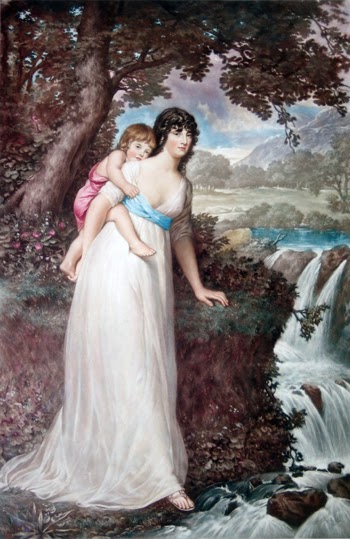
Portrait of Elizabeth Denison-Conyngham with her eldest child.

Joseph’s son  William Joseph, became the senior partner in his father’s business and an MP. In business he was extraordinarily successful leaving an estate worth £2.3 million to his nephew when he died in 1849. Anna Maria his youngest daughter made a decent marriage to Sir Robert Lawley, later 1st Baron Wenlock. His eldest daughter Elizabeth married an Irish peer Henry Conyngham, Viscount Conyngham, in 1794. By all accounts an attractive woman in her youth, Elizabeth had a number of admirers and lovers including  the then Tsarevitch  of Russia, the future Nicholas 1. Her greatest and most famous conquest though was of the notorious philanderer George IV. Lady Conyngham  supplanted Lady Hertford in the King’s affections in 1820 and she more or less lived openly with him as his unofficial queen (with her real husband made Lord Steward of the Kings Household and promoted to Marquess as reward for his complaisance) until his death in 1830. The obese King was apparently besotted with his equally rotund 50 year old (and mother of five) mistress and would be constantly "kissing her hand with a look of most devoted submission.” During the Kings Coronation when his rightful Queen, Caroline of Brunswick was denied admission to Westminster Abbey turned away from the door by the Royal Guards, George made himself ludicrous by ‘nodding and winking… and sighing and making eyes’ at Lady Conyngham. She lived with him at the Royal Pavilion in Brighton where George developed chronic alcoholism and left his mistress looking “bored to death and never speaking” at interminable formal dinners according to Charles Greveille.


"The guard wot looks after the sovereign" - Lady Conyngham as the butt (of all jokes)

The Kings disrespectful subjects found an endless source of mirth in the ridiculous figures of two overweight elderly people apparently being in love:     

‘Tis pleasant at seasons to see how they sit,
 First cracking their nuts, and then cracking their wit,
 Then quaffing their claret - then mingling their lips,
 Or tickling the fat about each other’s hips.

 and another example:

 ‘Give the devil his due, she’s a prime bit if stuff,
 And for flesh she’s got conscience enough,
 He’ll never need pillows to keep up his head,
 Whilst old Q and himself sleep and snore in one bed.

When George died in 1830, The Times declared that ‘there was never an individual less regretted of his fellow creatures than the late king’. Henry Conyngham died in 1832 in Kent, alone again as Lady Conyngham had moved discretely to Paris where she lived for the next thirty years. She only returnined to England to die at the age of 92 and be buried with her husband in Kent at St Mary's, Patrixbourne.  

Sources:

Dictionary of National Biography

Dodsley's Annual Register Volume 48

George IV's Royal Visit to Ireland
 

Sunday, 2 March 2014

William (1757-1827) and Catherine (1762-1831) Blake, Bunhill Fields


William Blake in youth, drawn by Catherine
 
Blake died in such poverty and obscurity that his burial in Bunhill Fields was largely unnoticed and on borrowed money, nineteen shillings for an unmarked grave, the body nine feet down, stacked on top of three others, and eventually followed by four more. The headstone was erected later and only approximately in the areas they were buried.
 
He married Catherine Sophia Boucher on the 18th  August 1782 at St Mary’s in Battersea. Friends said they lived their married life in ‘uninterrupted harmony’ though there were stories of Blake upsetting his wife by planning, perhaps not entirely seriously,  to “add a concubine to his establishment in the Old Testament manner.” The poet “gave up the project because it made Mrs. Blake cry." Their friend Thomas Butts liked to recount how he came across the pair of them sitting naked in their garden at Lambeth reciting passages from ‘Paradise Lost’ in character as Adam and Eve.


Catherine made the most of the time she spent with her husband because, as she once told some visitors who came looking for him “I have very little of Mr. Blake’s company. He is always in Paradise.” On his deathbed in 1827, "one of the very last shillings spent was in sending out for a pencil," with which he then proceeded to draw a portrait of his wife "Stay, Kate! Keep just as you are -- I will draw your portrait -- for you have ever been an angel to me." "Just before he died "His Countenance became fair," wrote a friend later, "His eyes Brighten'd and He burst out into Singing of the things he saw in Heaven." Even death did not separate them, according to contemporary accounts she "saw Blake frequently after his decease: he used to come and sit with her two or three hours every day …he advised with her as to the best mode of selling his engravings." When she died witnesses said she was "calling continually to her William, as if he were only in the next room."