Thursday, 28 September 2023

A fine and private place; Edward Adolphus Seymour, 11th Duke of Somerset (1775-1855) Kensal Green Cemetery


The grave's a fine and private place,
But none, I think, do there embrace

Andrew Marvell – ‘To his coy mistress’

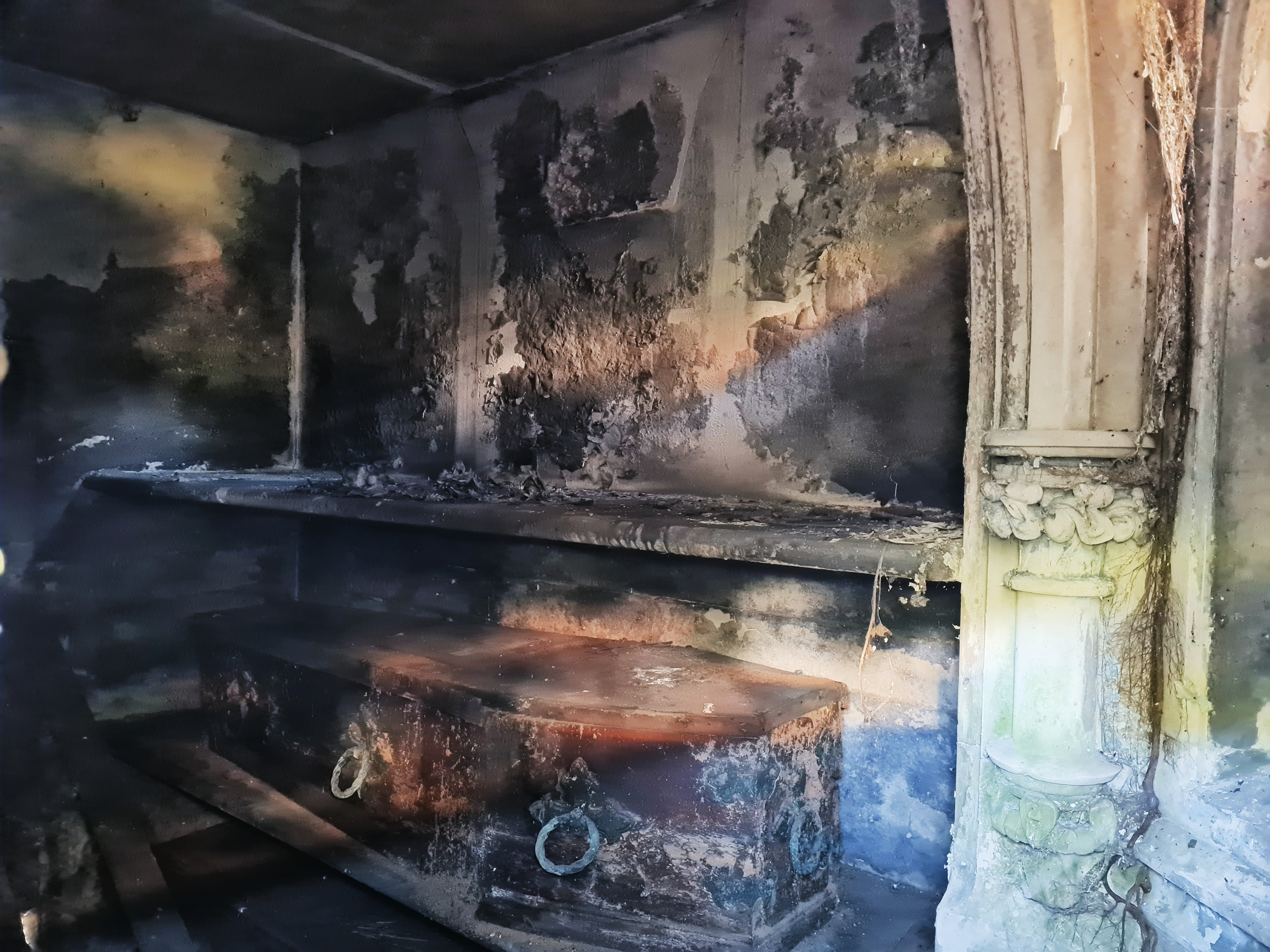
Andrew Marvell was wrong; the graffiti on the interior rear wall of the now bricked up mausoleum of the Duke of Somerset in Kensal Green quite definitely states that someone, possibly with the initials LL, “fucked here July 2000”.  A cold stone floor, in the blackened inhospitable interior of a drafty mausoleum, doesn’t strike me as a fine place to embrace but LL is clearly made of sterner stuff than I am. The late Duke and Duchess almost certainly never imagined that they would be sharing their final resting place with rutting teenagers. Luckily their coffins lie in a vault below the mausoleum, safe from prying eyes and sacrilegious fingers. Most of the recent Duke of Somerset (by recent I mean since the late 17th century) are buried in the parish church of Maiden Bradley in Wiltshire, close to the ancestral home. But Edward Adolphus, the 11th Duke chose to build this relatively modest mausoleum in Kensal Green Cemetery and to be buried away from his relatives. His descendants seem unconcerned with the poor state of repair of their ancestors grave. The door has long gone, the doorway bricked up, and the interior thoroughly vandalised.  The far wall once carried two shield-shaped marble slabs with the names and titles of the 11th Duke and his second wife surmounted by a ducal coronet and family crest; one of the marble slabs is now completely missing.  

Edward Adolphus Seymour was born on 24 February 1775 at Monckton Farley in Wiltshire; he was the third son of the tenth duke but both of his elder brothers predeceased him. He succeeded to the peerage on the death of his father in 1793. His mother was Anna Maria Bonnell, daughter and heir of John Bonnell of Stanton-Harcourt in Oxfordshire. His maternal grandfather had been a successful London merchant and no doubt the marriage between the 10th Duke and the commoner had brought a welcome injection of cash into the ducal family as well as freshening up the stale genetic lineage. Certainly Edward Adolphus developed an intellectual bent that was hitherto unknown in the Seymour family. He was educated at Eton and was created M.A. at Oxford on 2 July 1794. According to Edward Irving Carlyle in the 1927 D.N.B. “from an early age he devoted himself to science and mathematics, displaying genuine aptitude for both studies. He was equally well versed in historical and antiquarian knowledge.” He was a fellow of the Royal Society, the Society of Antiquaries, the Linnean Society, and a member of the Royal Asiatic Society. He was vice-president of the Zoological Society and president of the Royal Institution, the Royal Literary Fund, and the Linnean Society. In 1820 he was elected president of the Astronomical Society but resigned the position after just a few days in post at the request of his friend Sir Joseph Banks who felt that astronomical phenomenon should be in the sole remit of the Royal Society. He was bearer of the orb at the coronation of William IV in 1831 and of Victoria in 1838 and was made a knight of the Garter in 1837. He was the author of two books on Mathematics, ‘The Elementary Properties of the Ellipse deduced from the Properties of the Circle,’ (1842) and ‘Alternate Circles and their Connexion with the Ellipse,’ (1850). 


According to Fisher and Jenkins in The History of Parliament Edward Adolphus was “credited with ‘great amiability of temper and gentleness of manners’, he was reputedly henpecked by his Scottish wife, who carried domestic penny-pinching to ‘a very extraordinary length’.” When he was 25 the Duke fell in love with Lady Susan Hamilton, the daughter of the 9th Duke of Hamilton but Lady Susan’s rather formidable older sister Lady Charlotte took a shine to the diffident Edward and somehow coaxed him into proposing to her instead. Charlotte was three years older than her husband and was perhaps, at the age of 28, starting to worry that she had been left of the shelf. On their marriage in 1800 Charlotte brought cartloads of heirlooms from the Hamilton estate (including several Rembrandts, Rubens and Van Dycks, and much more), not always it seems with the agreement of the family. Thomas Creevy called her “a false devil” who robbed her elder brother of his birthright. She had a reputation of being mean, the artist Joseph Farington records in his diary, her dinner table as being “nothing but a leg of mutton at the top and a dish of potatoes at the bottom”. Charlotte died on 10th June 1827, a fortnight before what would have been their 27th wedding anniversary.  Whatever tensions there were in the marriage did not stop the couple producing children – they had seven. Charlotte died just two weeks shy of what would have been their 27th wedding anniversary in 1827. Edward did eventually marry again, but not until 1836 when he was 61 and his bride, Margaret Shaw-Stewart, was 30 years his junior.  

The burial plot and the mausoleum were acquired and built before the death of the Duke. It was sitting empty when the Duke offered it to the heirs of Lord Raglan, the commander of the British army in the ill-fated Crimean War, in 1855 when the general unexpectedly died of dysentery at Sevastopol. On 21 July 1855 the Longford Journal was confidently reporting;  

THE LATE LORD RAGLAN. Arrangements have been made for the reception of the late Lord Raglan, whose remains are expected to arrive in this country about the 24th instant, from the Crimea. They will be sent from Southampton on a special train of the South Western Railway, to his residence, No 5. Great Stanhope-street, London, and will be finally deposited in the mausoleum of his Grace the Duke of Somerset, All Souls’ Cemetery, Kensal-green, Harrow-road. The funeral will be as private as circumstances will permit.


Edward Adolphus Seymour, 11th Duke of Somerset

Lord Raglan was not buried at Kensal Green but close to the family home at Badminton in Gloucestershire. The Duke himself died at his home. Somerset House in Park Lane on the 15th August 1855 at the age of 80. The Morning Post reported on his funeral on the 24th:

FUNERAL OF THE DUKE OF SOMERSET Yesterday the mortal remains of the Duke of Somerset were consigned to the tomb. The funeral procession left Park-lane at 11 o'clock for the cemetery at Kensal- green, the mournful cortege, preceded by the customary attendants, consisting of a hearse and six horses and six mourning coaches, escorted by pages. The mourners were Lord Seymour, grandson of the late duke, Lord Archibald St. Maur, Lord Algernon St. Maur, and the Rev. Mr. Howarth (rector of St. George's, Hanover-square), be- ing in the first coach; Mr. Blount and Mr. Tollemache, sons-in-law of the deceased; Mr. J. Osborne, Lord Glenelg, Hon. Colonel Bruce, Mr. Stewart Nicholson, Mr. Currie, Mr. J. Festings, &c. The remaining coaches were occupied by the chief members of the late duke's household. In compliance with the wishes of the duke, the funeral was conducted on a very unostentatious scale — the armorial bearings on the hearse and the bearer of the ducal coronet being dispensed with on the occasion. The funeral procession reached the cemetery shortly before 12 o'clock, and the body was borne to the chapel, when the solemn service was commenced by the Rev. Mr. Howarth. After the ordinary prayers, the body was conveyed to the mausoleum, situate at the north- western corner of the grounds, where the burial service was concluded at about half-past 12 o'clock. It may be as well to add that the present duke is on a cruise with Mr. Bentinck, M.P., on board the Dream yacht, in the North Sea, and, it is feared, is still uninformed of his father's death, which will account for his absence at the funeral. His grace's eldest son was consequently the chief mourner.

His widow died at the age of 75 in 1880. This account of her funeral is from the London Daily Chronicle of 23 July 1880;

The remains of the Duchess (Margaret) of Somerset were laid to rest yesterday side by side with these of her husband, the late Duke of Somerset, in Kensal-green Cemetery. The mausoleum, which is situate in that portion of the grounds known as the General Cemetery, was yesterday opened for the first time since the interment of the late duke, now a quarter of a century ago. Facing the iron-grated entrance to the vault there are let into the wall two shield-shaped marble slabs, one of which bears the name and titles of Edward Adolphus St Maur, Duke of ‘Somerset, who died August 15, 1855; and the other the name of Margaret, Duchess of Somerset, his wife with a space left for the date of her death. At the foot of the latter shield is the passage from the Book of Ruth, “Where thou diest I will die, and there will I be buried.” The whole is surmounted by the ducal coronet and family crest. At half-past twelve the funeral cortege which consisted of the hearse, drawn by four horses, five mourning carriages, followed by the family coach and several private carriages, moved away from the residence of the deceased duchess, Somerset House, Park-lane, and took its way along Bayswater-road and Westbourne terrace to Kensal Green, which was reached at the appointed time. Here the coffin, the outer casing of which was of polished oak with brass handles and coronets, and having on its breast a plate bearing the plain inscription, “Margaret, widow of Edward Adolphus, 11th Duke of Somerset, died July 18, 1880," was borne into the chapel, where, as at the grave, the funeral service was read by the chaplain, the Rev. H. C. Johnstone, M.A. From the chapel to the mausoleum a procession was formed, in which the chief mourners were Lord Algernon St Maur, the Lord Chief Baron, Sir Michael Shaw Stewart, Admiral Sir William Houston Stuart, Mr. Tollemache, Mr, Percy St. Maur, Mr. Ernest St. Maur, Sir Herbert Maxwell, Sir John Heron Maxwell, Colonel Alexander, Mr. J. A. Shaw Stewart, Mr. Collyer Bristow, and Mr. Edward Ross. Some flowers were placed upon the coffin as it was lowered into the vault.

Wednesday, 20 September 2023

Dog day afternoon; Paddington Old Cemetery, Willesden Lane, NW6

And there were dogs, more dogs. Devoted dog-tendance—by schoolchildren, by women in fairly high style, by certain homosexuals. One would have said that only the Eskimos had nearly so much to do with dogs as this local branch of mankind. The veterinarians must be sailing in yachts, surely.

Saul Bellow – Mr Sammler’s Planet

There seemed to be more dogs on parade in Paddington Old Cemetery than I have ever seen anywhere in London with the possible exception of Crufts. It was a sunny September afternoon and there were, as far as I could see, no mourners whatsoever in the cemetery. There were dozens of visitors though, large numbers arrive on foot but also a steady stream of them kept arriving by car and parking in front of the fenced off chapels; every single one, pedestrian or driver, was accompanied by at least one canine, often two sometimes three. Bowls of water are scattered throughout the cemetery for the comfort of canine visitors, most of whom were off the leash and roaming at will. It was a very middle-class collection of hounds, certificated pedigrees (french bulldogs, golden retrievers, dachshunds), and designer crossbreeds (cockapoos, labradoodles, schnoodles), predominated. There were no youths from council estates with squat, muscular, short muzzled, bull baiting breeds, shuffling their way along the paths on overdeveloped thighs and frightening the native bourgeoisie. It was all very genteel. There wasn’t even any dog shit on the ground; every single owner was responsibly collecting their pooch’s still warm stools in black plastic bags and disposing of them out of sight. I have never seen so many dogs in a cemetery.    

Even for those without a penchant for dog watching Paddington Old Cemetery is worth a visit. It does not have any really outstanding monuments but there are quite a few interesting ones and the cemetery has more than its fair share of occupants with colourful pasts. Paddington was one of the first municipal cemeteries (as opposed to private ones like nearby Kensal Green or Highgate), opening in 1855 just three years after the 1852 Metropolitan Internment Act began the process of closing London’s churchyards and parish burial grounds to further internments. The Paddington Burial Board acquired 24 acres of land close to what was then the still rural village of Willesden. The cemetery was designed and laid out by Thomas Little, a mainly ecclesiastical architect who designed the gothic chapel at Nunhead (best known today perhaps because George Devey, a much better architect, spent nine years working as his pupil). Little designed the twin chapels with porte cochere and central belltower which luckily still stands at the centre of the cemetery (though it is in the habit of shedding masonry at inopportune moments and so is now completely fenced off to prevent lumps of Kentish ragstone dropping onto the dog walkers). The cemetery still has its two original lodges but both of these have been sold off and are now private residences. 

The cemetery is now immaculately kept but this was not always the case as reported by the Marylebone Mercury on Saturday 03 July 1937;

PADDINGTON CEMETERY Councillor Turner asked whether a letter had recently been received from a relative of persons buried in the Willesden Lane Cemetery, complaining of desecration alleged to be due to wanton neglect, and stating that "the scene beggars description and has to be seen to be believed"; and did the writer complain that, by reason of the overgrowth around it, he and his wife had great difficulty in finding graves of departed relatives, and there were other bereaved persons in similar straits? Were letters of complaint received but not presented to the Committee? Councillor Mrs. Seale M. chairman of the Cemetery Committee, said several letters of complaint had been received. It was impossible to cut all the grass at the cemetery at one time. There were 32,410 graves, and not sixty per cent were looked after by the people themselves. The others had to be cut by the Council. Letters of complaint were placed before the committee, investigated and dealt with.

By the 1980’s the cemetery had become the responsibility of Westminster Council, a responsibility that weighed heavily on the shoulders of the council leader Dame Shirley Porter. Paddington was one the cemeteries that Dame Shirley wished to divest the council of and sold off for a nominal sum (usually a pound) but unlike the other three (Hanwell, East Finchley and Mill Hill) the sale of Paddington never became a scandal for the simple reason that it was bought by a responsible owner, Brent Council. With no intention of milking their asset Brent simply continued to run the cemetery as a cemetery, raising a large section of the ground in the southern part to allow new burials to take place.  


Paddington’s most famous burial is a relatively recent one, Michael Bond, who died at the age of 91 at his home near Paddington and is best known, of course, as the creator of Paddington, the bear from darkest Peru with a liking for marmalade and a penchant for creating chaos. The bear had popular since the early 1960’s (I eagerly read the books as a schoolchild in South Yorkshire, having seen Thord Hird read the stories on Jackanory) but Bond didn’t live to see his creations greatest triumph, taking tea with the Queen at the 2022 Jubilee just before Her Majesty also shuffled off the mortal coil. Bond’s grave is decorated with small Paddington statues left by admirers. There is also a potted plant, perhaps a reference to another of his creations, the BBC TV series The Herbs.  

Other interesting burials include jockey Captain Martin Becher; the identification of his burial site was reported in the Liverpool Echo of 11 November 1996:

GRAND National expert Reg Green has solved a 130-year-old racing mystery. The super sleuth has tracked down the unmarked grave of Aintree legend Captain Becher in a London cemetery. The flamboyant jockey gave his name to Aintree's brook fence after toppling into the water during the 1839 race. For decades his final resting place has baffled race historians. Now race officials are planning to mark Becher's contribution to the famous steeplechase by buying a new headstone. The plot was grassed over in 1963 when officials at Paddington Old Cemetery in Kilburn destroyed several damaged, unsafe and forgotten gravestones. Records show Captain Martin Becher, 67, was buried on October 15, 1864. His wife Susan and son Ernest, five, are buried with him… Aintree marketing manager Joe McNally said: "It is a terrific piece of detective work. We want to get a new headstone but we need permission of living relatives who I want to get in touch with us."

No new headstone was ever put up for Becher (whose party trick was leaping onto a mantelpiece from a standing jump apparently, impressive for a short man) presumably because no living descendants were traced. Becher is famous for not winning the Grand National but another cemetery resident, Danny Maher won the Epsom Derby three times (1903, 1905, 1906) and the Ascot Gold Cup in 1906 and 1909. He was born in 1881 in Hartford, Connecticut and had a successful career in the US before coming to Britain where he won an astonishing 1421 races. He died in 1916. 

The Dundee Courier (and many other newspapers) reported on 08 April 1930 on the funeral at Paddington of actress Anita Foy Tipping;

ACTRESS BURNED TO DEATH WOMEN IN TEARS AT GRAVESIDE. Moving scenes wore witnessed at Paddington Cemetery yesterday, where the funeral took place of Miss Anita Foy Tipping, the young actress and dancer, who was burnt to death at Twickenham Film Studios when her frock caught fire. Scores of women, among them many of Miss Tipping's colleagues from studio, gathered near the grave. When the cortege arrived, and the plain oak coffin was carried to the grave, many of the women were in tears. The brief service the graveside was conducted by Father Herbert Vauglian, of Brondesbury. Scores pf magnificent wreaths had been sent, and these were piled up about neighbouring graves. Among them was enormous wreath of daffodils in the form of cushion three feet square from the "boys and girls of the 'Here Comes the Bride' Company." Nearly all the wreaths were composed of spring flowers, and the senders included Mr and Mrs Julian Wylie, members of ‘Cinders’ company, the Film Artists' Guild, and Twickenham Film Studios.

Nita Foy, as Anita Tipping was professionally known, was a chorus girl in West End theatres and was currently appearing in ‘Here Comes the Bridge’ at the Piccadilly Theatre, at the time of her death. She and five other girls from the chorus line had been given parts in a ballet scene for the fil ‘Spanish Eyes’ by Twickenham Film Studios. The scene was being shot on the last day of the production and could only be filmed when the girls had finished at the theatre. It was well after midnight when the exhausted actress was invited to his dressing room by Donald Calthorp, the star of the film for a brandy and soda. Calthorp told the inquest at Richmond Coroners Court that “she came in, and sat down on the sofa, which is beside an electric radiator, and I pulled out a small bottle of brandy… and poured a little out and said, “Would you like soda, or water, or plain?” Mr Coote, the assistant director, then put his head in the door and said, “All ladies are wanted on the set.” Miss Tipping was then standing and I noticed that her eyelashes were white with powder. I said to her, “Surely you cannot go on. We always darken our eyelashes - it is better for the camera.” She said, “Oh, have you got any wet black?” and I pointed at a little red tin on a shelf over the radiator. I remember turning to the door… There was a flash behind me… I turned round and saw that Miss Tipping was a sheet of flame.” The chorus girls were dressed in crinolines for the ballet scene and it was this that caught fire on the electric radiator. 

Meller and Parsons (London Cemeteries - An Illustrated Guide and Gazetteer) mention the mausoleum close to the Lidiard memorial; “a lavish exercise in the fourteenth-century Gothic style including a sculpture of the Ascension in the tympanum, fearsome over-sized gargoyles and a three-sided apse with shattered fragments of stained glass in the lancet windows. It is a tragedy that such an extraordinary building has suffered from neglect and vandalism.” The broken windows at least allow you to peer in and see the coffin still sitting on its shelf. Meller and Parsons do not name the occupant of the mausoleum, I presume because, Like me, they could not make out the name inscribed on the step. 

They also mention the ‘early examples of porcelain photographs of the deceased’ such as the ones below; 


Thursday, 14 September 2023

Respeito pelos mortos; Cemitério da Lapa, Porto

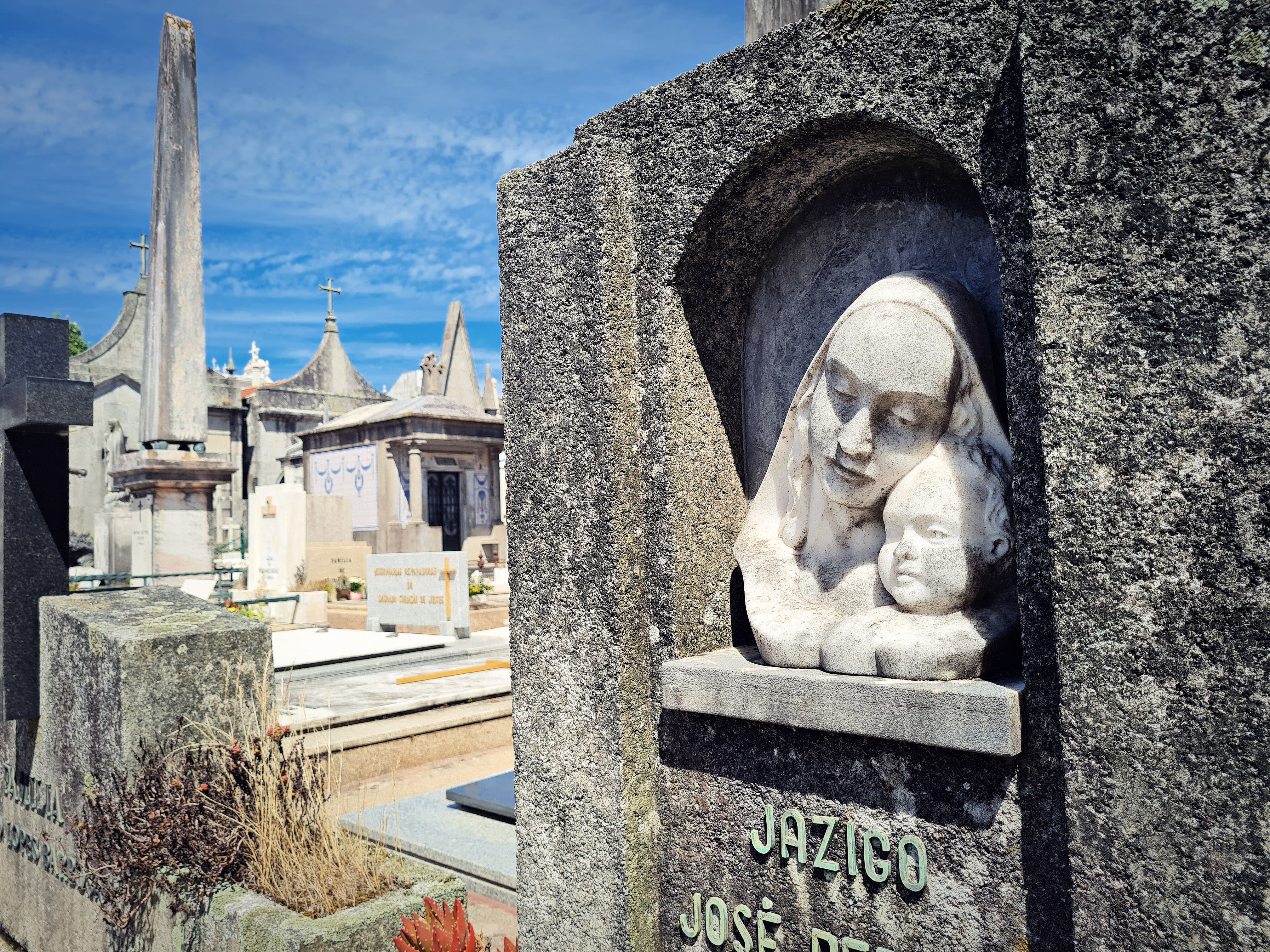
It is a long uphill trudge to the Igreja de Nossa Senhora da Lapa from the centre of Porto. Our hotel was close to the Rotunda da Boavista which meant he had a more or less gradient free walk across the north of the city to the Cemitério da Lapa and meant we didn’t have to make that long climb on a hellishly hot day. It turned out to be a flying visit; we had set out to walk there on the 15th August without realising that it was a feriado, a public holiday to mark Assumption Day (marking the Virgin Mary’s ascent into heaven), which meant that the cemetery closed early. When we first arrived, there were a few other people there visiting graves or, a very typical sight in Portuguese cemeteries, busying themselves with sweeping brushes and dusters, tidying up the family mausoleum. After an hour the place was deserted until a grumpy official from the church tracked me down and began ostentatiously tapping his watch and pointing to the exit. When I did not scurry away immediately, he pulled a large set of keys from his pocket and shook them at me; the meaning was clear, ‘bugger off or I’ll lock you in.’ 

The cemetery attached to the Igreja da Lapa is one of Portugal’s most famous burial grounds. Legal authorisation for the construction of a cemetery next to the church was granted by Dom Pedro IV to the Lapa Brotherhood in July 1833, in the final weeks of the year long siege of Porto during the Portuguese civil war.  High mortality rates during the siege and the subsequent cholera epidemic had rapidly filled up existing burial spaces in the city. The catholic authorities were also aware that the liberal government of Dom Pedro was planning to pass laws forcing municipal authorities in Portugal to open public cemeteries, a very controversial measure at the time. Lapa was a private Catholic cemetery and effectively became, when consecrated in 1838, the first modern cemetery in the country.  


The original cemetery was designed like an Italian Campos Santos with large vault- chapels at the edge of the cemetery surrounding a central section which was the space for smaller monuments. The vault-chapels were private chapels which had space for 8 or more coffin burials on shelves that were then enclosed with a stone carrying the deceased’s epitaph. Only the wealthiest families could afford a vault-chapel. The middle section of the original cemetery was the space for more modest memorials, though it has to be said that most of these are fairly spectacular and clearly were extremely expensive. The poor were buried elsewhere! The cemetery proved to be extremely popular and within ten years additional land had to be acquired to extend. Further extensions followed during the 19th century until there was no available adjacent land to extend onto.

One of the most striking aspects of the cemetery Cemetery is its architectural diversity. It boasts a variety of tomb styles, from neoclassical and neo-Gothic to Art Nouveau and modernist designs. This architectural eclecticism reflects the changing tastes and trends of the eras in which the tombs were constructed, offering a visual journey of bourgeoise funereal fashion through time. Elaborate angels, saints, and mournful figures can be found adorning many graves. Dotted around the cemetery are notices inscribed in stone enjoining 'Respeito pelos mortos', respect for the dead. In its time Lapa was a trendsetting cemetery for northern Portugal and its design and memorials were used as templates for other cemeteries such as Agramonte

The tomb of António Francisco Ferreira da Silva Porto (24 August 1817 – 2 April 1890) describes him as ‘o grande sertanejo’, the great explorer of the interior of Angola. He was famous enough at the turn of the 19thh century for his death and funeral to be reported in the provincial English newspapers:

Silva Porto, the old pioneer of Portuguese exploration in Africa, has been buried at Oporto, and extraordinary public honours were paid the remains of the deceased on being conveyed from Lisbon to Oporto. Members of the Royal Family and the Ministers walked immediately behind the coffin. Cardinal Ferreira dos Santos Silvas pronounced the absolution over the remains of the Portuguese explorer, Silva Porto, at the Lapa Church in Oporto. immense congregation was present, including representatives of the King and Queen and Royal Family, the Minister of Marine, and other prominent officials.

Tamworth Herald - Saturday 18 April 1891


Wednesday, 6 September 2023

Churchill's personal tragedy; Marigold Churchill (1918-1921), Kensal Green Cemetery

DIED AT BROADSTAIRS MR. AND MRS. WINSTON CHURCHILL BEREAVED Taken ill while on holiday at Broadstairs with her two sisters and only brother, little Mistress Marigold Frances Churchill, the three-year old child of Mr. Winston Churchill, Colonial Secretary, and Mrs. Churchill, died last night. In charge of a nurse, the children arrived in Thanet some time ago, to stay at the residence of Col. Charles and Mrs. Grant. Marigold was then apparently in her usual health but was taken suddenly ill about a week ago. Up to yesterday it was understood the complaint from which she was suffering had not been satisfactorily diagnosed. On Monday evening her condition was so serious that the father cancelled his engagement to attend the bedside, to which Mrs. Churchill, who had been on a visit to the Duke and Duchess of Westminster, had hurried. Both were present last night when their child died.

East Kent Times and Mail - Wednesday 24 August 1921

Reviewing the TV drama ‘Churchill’s Secret’ The Times (28.02.2016) noted that the death of his young daughter “was the personal tragedy that haunted Winston Churchill throughout his lifetime but has gone largely unnoticed.” The opening scene of the production showed Churchill imagining two-year-old Marigold as she ran on the beach at Broadstairs in the days prior to her death in 1921. It would have been a feat of imagination rather than recollection for Churchill to summon up an image of his daughter playing on the beach as neither he, nor his wife Clementine, were with their children at Broadstairs. Churchill, as always, had urgent government business to attend to and Clementine was visiting the Duke and Duchess of Westminster. The French governess was nervous of reporting Marigold’s ill health to her parents and delayed sending a telegram to Clementine until the child was in serious danger. Clementine travelled to Broadstairs and having seen her daughter immediately summoned Winston. Both parents were at Marigold’s bedside when she died; according to Churchill biographer William Manchester Clementine “shrieked in agony, like an animal in mortal pain,” when she realised her daughter was dead.


Mr. CHURCHILL'S LOSS The funeral took place Kensal Green yesterday Mr. Winston Churchill's three-year-old daughter. Marigold Frances Spencer Churchill, who died August 23 at Broadstairs. The service was conducted the Rev. B. C. H. Andrews, chaplain, and only members of the family were Present.

Daily Herald - Saturday 27 August 1921

The funeral took place at Kensal Green just three days later. It was a private ceremony but press photographers appeared in the cemetery; confronted by Winston and asked to leave they departed without taking a single shot. There seems to be only one photograph of Marigold in the public domain; taken with her mother the little girl has her back to the camera and her face is not clearly visible.

Marigold’s memorial, attributed to the now notorious Eric Gill, is grade II listed. The rather simple cross is in fact a replacement for a much larger Gill stone column and sculpted crucifix that was stolen. The original inscription is still in place on the square sectioned base.  Marigold was the only Churchill buried in the cemetery and the family had often expressed its wish to disinter her and rebury her with the rest of the family in Bladon churchyard in Oxfordshire, close to the ancestral home at Blenheim Palace. An article in issue 87 of ‘Telamon’, the magazine of the Friends of Kensal Green Cemetery says that “the task of re-interment was completed earlier this year.” (2019). On February 27 2022 the International Churchill Society’s website stated “The Churchill family have announced that the body of Marigold Churchill, the fourth child of Winston and Clementine Churchill, was quietly moved in 2020 from its original resting place at Kensal Green Cemetery in London and reinterred at the churchyard of St. Martin’s, Bladon, where Marigold’s parents, sisters, and brother are all laid to rest.” It isn’t clear why the family would be announcing this two years after the event and neither is it clear whether it actually happened in 2019 or 2020. 

Wednesday, 19 July 2023

A too early date with death; Richard Newton (1777-1798) St. Paul's churchyard, Covent Garden

A google search for ‘William Holland undertaker’ serendipitously threw up results for the totally unrelated print seller William Holland and images from one of his artists, Richard Newton, who I had never previously heard of. Newton’s promising career came to an abrupt end in 1798 when at the age of 21 an infected louse gave him a dose of typhus and he succumbed to a lethal fever.  A brief obituary appeared in the Hereford Journal on Wednesday 12 December:

On Sunday morning died in the 21st year of his age, Mr. Richard Newton, Caricaturist and Miniature-Paint of Brydges-street Covent-Garden, London, — a native of Dormington, in this county. His natural abilities and fertile genius promised a rapid course to first rate eminence in his profession; and his early loss will be long regretted by his relations, friends, and numerous acquaintances.

Not much is known about Newton’s short life. He is generally held to be a Londoner born and bred but the Hereford Journal was sure that he was a Herefordshire man, from the small village of Dormington.  With scarcely any time to hone his talent and, as far as we know, no formal training, he became a brilliant caricaturist and satirist in the golden age of printmaking in London. Had he lived he would almost certainly have been the equal of Rowlandson and Gillray.  He published his first caricature at the age of 13 and by the time of his death he had produced over 300 prints. For most of his too short career Newton worked for the radical printseller William Holland at his premises at 50 Oxford Street where he charged the public 1 shilling for admittance to his 'Museum of Graphic Genius'. As well as designing prints for Holland, Newton also illustrated editions of Laurence Sterne’s ‘A Sentimental Journey’ and Henry Fielding’s ‘Tom Jones’. In 1793 Holland was prosecuted and imprisoned for selling a copy of Thomas Paine's ‘Letter Addressed to the Addressers’. Whilst he was serving his sentence at Newgate, Newton ran Holland’s shop for him but shortly afterwards, according to Vic Gattrell in ‘City of Laughter’, he opened his own shop in Brydges Street (now renamed Catherine Street) in Covent Garden, “opposite the pit door, Drury Lane” as advertised on his later prints.

Newton’s satirical targets were the usual late c18th century suspects; clergymen, actors, the aristocracy, politicians, George III, high fashion, all mocked with ribald and earthy humour. His sense of humour had a macabre strain, with death and undertakers being a notable theme. It was these caricatures that caught my eye; a skeletal death clutching an hour glass and sitting on the shoulder of an undertaker who is carrying a coffin on his back. “How do you do, my good friend and carcass box,” says death, “looking over my book I find you are next on the list.”  The undertaker responds saying that “there are many of the same name. It’s an old man of eighty on the next street.” On the same sheet of this dance of death, a spade wielding skeleton makes off with a naked baby while his plump mother in bonnet cries “Oh, you ugly kidnapping monster, don’t rob me of my only little one.”  

In another of his ‘Dance of Death’ series, a skeletal death lays his bony hands on a wild haired miser to escort him by force if necessary into the next world. The terrified miser clutches one of his money bags tight to his chest and tells death that he doesn’t owe even a penny. On the table is piece of paper on which is written ‘Plans for a hospital’ – perhaps Newton took his inspiration for this image from the story of Thomas Guy, the miser who founded Guy’s Hospital? 

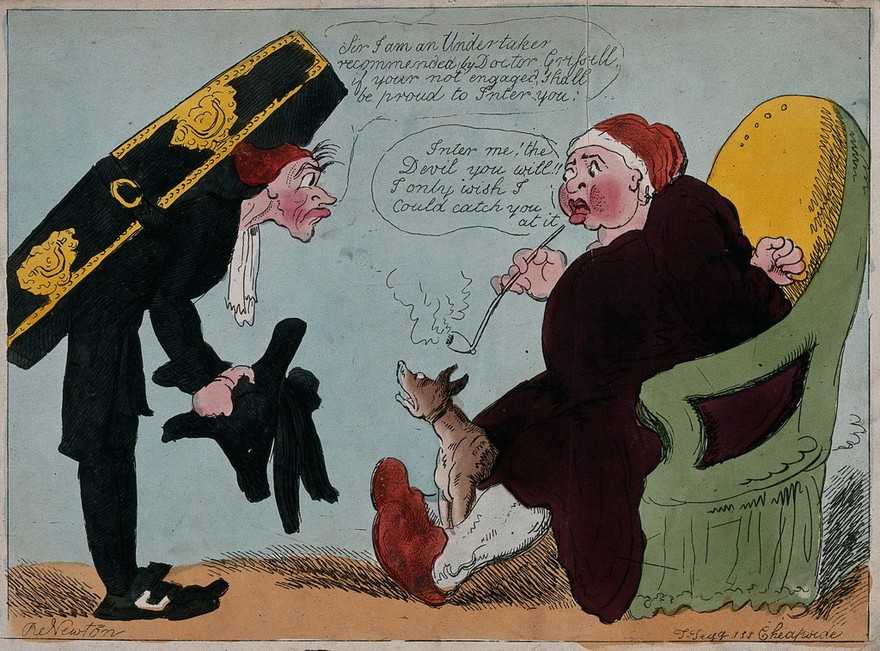
In this picture an undertaker touts for business amongst the still living, presenting himself, with empty coffin strapped to his back, to a high living old man, “I am recommended by Dr Griffield,” he says “and shall be proud to inter you.” His prospective client is clearly offended “Inter me!” he shrieks “The devil you will!”

Death interrupts a gout stricken gourmand as he is about to tuck into his dinner of roast sucking pig…

“Giving up the ghost” is one of Newton’s most successful prints, so successful in fact that Rowlandson later produced his own version. A moribund old man lies quietly expiring on his bed while a skeletal death stands by his window and takes aim with his dart. A parson who is supposedly comforting the dying man snoozes in a chair by a his bedside and an undertaker carrying a coffin on his back stands hopefully at the door. 

In ‘Undertakers in at the death’ Newton again mocks the men who make their living from the dead. Three undertakers pursue a nightgowned old man in a red cap who is about to be ambushed by a spear wielding, hour glass holding skeleton.  One carries the traditional staff of the funeral mute, with a cross fixed to the top hung with black crepe. Another balances a coffin on his back.

Friday, 23 June 2023

The enduring influence of Sir Thomas Browne; 'A Cabinet of Rarities' Erik Desmazières (Thames & Hudson 2012 £35)

When the funeral pyre was out, and the last valediction over, men took a lasting adieu of their interred friends, little expecting the curiosity of future ages should comment upon their ashes; and, having no old experience of the duration of their relicks, held no opinion of such after-considerations.

Sir Thomas Browne - Hydriotaphia, Urn Burial, or, a Discourse of the Sepulchral Urns lately found in Norfolk (1658) 

When Thomas Browne was born James I was on the throne and Shakespeare was still alive. He is a difficult writer; his arcane subject matter, Latinate vocabulary and long serpentine sentences can sometimes make his prose impenetrable. In the Oxford English dictionary, he has 775 entries crediting with him with the first use of a word in English; alchemical, ambidextrous, coexistence, computer, continuum, disruption, hallucination, holocaust, therapeutic, and transgressive are amongst the many words he is said to have coined.  He is cited in the OED over 6500 times, which include 4131 entries in which his writing is the earliest evidence of a word used in the language. He perhaps never intended to be a published author; his first book initially came out in an unauthorised edition based on a manuscript that was circulating amongst his friends. Although he survived to a what was a ripe old age for someone born at the beginning of the 17th century, he had been preoccupied with mortality, the impermanence of life and the prospect of death, since his youth. That first published book was a pirated version of the Religio Medici, written when he was in his early thirties; “If we begin to die when we live, and long life be but a prolongation of death, our life is a sad composition; we live with death, and die not in a moment,” he wrote, rather desolately, for a man in the prime of his life.

Despite spending most of his long, relatively uneventful life in Norwich, Browne was a Londoner, born in the parish of St Michael-le-Querne in Cheapside in 1605. His father was a well to do mercer who died when he was 8. His mother remarried within six months of her husband’s death, to Sir Thomas Dutton. He was educated at William of Wykeham’s foundation in Winchester and Broadgates Hall at the University of Oxford, graduating in 1627 and going to the continent to study medicine at the Universities of Padua, Montpellier and Leiden, where he was awarded a medical degree in 1633. After a short stint in West Yorkshire Browne settled in Norwich to practice medicine, in 1637.  He married Dorothy Mileham in 1641 and the couple had 10 children. When the Civil war broke out Browne was a staunch Royalist living in a town largely loyal to Parliament. He did the sensible thing, kept his views to himself and lived his life as quietly as possible during the tumult of the war and Commonwealth. He was knighted by Charles II on a Royal visit to Norwich in 1671. John Evelyn, one of Browne’s correspondents, was in the royal entourage and took the opportunity to visit; he wrote admiringly in his diary that Browne’s "whole house and garden is a paradise and Cabinet of rarities and that of the best collection, amongst Medails, books, Plants, natural things". He published just four books in his lifetime, the Religio Medici (authorised version) in 1642, the Pseudodoxia Epidemica or Vulgar Beliefs in 1646, an early attempt to combat superstition and widely accepted but false ‘facts’, Hydriotaphia, Urn Burial, or a Brief Discourse of the Sepulchral Urns lately found in Norfolk, and The Garden of Cyrus, or The Quincuncial Lozenge, or Network Plantations of the Ancients, Artificially, Naturally, and Mystically Considered, both published in 1658. 


To be gnawed out of our graves, to have our skulls made drinking bowls, and our bones turned into pipes, to delight and sport our enemies, are tragical abominations….

Sir Thomas Browne - Hydriotaphia

According to William Stukeley Sir Thomas "dyed” on his 77th birthday, the 19th November 1682,“after eating too plentifully of a Venison Feast." He and was buried in the chancel of the church of St. Peter Mancroft in the centre of Norwich, just a few yards from his house. There he remained, quietly decomposing, for 150 years until 1840 when the sexton, George Potter, was preparing the ground for a new grave for the vicar’s recently deceased wife. The gravediggers were excavating a trench in front of the altar when a pickaxe hit a piece of buried metal. This turned out to be the brass plate on a lead which had split neatly in two from the force of the blow. The inscription on the plate named the occupant of the lead coffin as Dr Thomas Browne hoc luculo indormiens, corporis Spagyrici pulvere plumbum in aurum convertit (sleeping in this grave, by the dust of his alchemic body he changes the lead to gold).  In a letter to the Athenaeum dated September 5thh 1840 Thomas D. Eaton, one of the churchwardens gave an account of what happened next:  

On a closer inspection, the coffin, quaintly described above as having been " transmuted into gold" by the potent dust" of the mighty "alchymist," was found to have been literally converted into a carbonate of lead, which crumbled at the touch, disclosing the bones of its illustrious tenant. There is no truth whatever in the report pretty widely circulated, that the "features remained entire." The flesh had returned “to earth as it was," but the hair of the beard was in good preservation. A portion of this was compared with its representation in an oil painting of the knight, suspended in the vestry, and the colour of the original corresponded exactly with that of the copy. Now we have the testimony of Sir Thomas Browne himself, that ''teeth, bones, and hair give the most lasting defiance to corruption." The skull was sound, and still contained a mass of brain. Unhappily for the phrenologists, the forehead was narrow, low, and receding; whereas that part appropriated to the animal propensities was unusually large. It may he right, perhaps, to add, that the venerable bones thus fortuitously exposed were seen by few, and were reverently handled. After having slept undisturbed for more than century and a half, it was reasonable to presume that they had become incorporated with the soil; no sort of blame therefore could reasonably attach to the selection of their resting place for another occupant. I have thus given the true particulars of a circumstance which I should not have made public, had not erroneous reports gone abroad respecting it. 


One of the ‘few’ who were summoned to see Browne’s bones was local antiquary Robert Fitch, a man later described as one “whose ‘acquisitive complex’ was abnormally developed even for an antiquary.” Shortly after Fitch had visited the coffin plate was noted as missing. Fitch strenuously denied having removed and claimed that the plate was in the possession of the sexton George Potter. Potter denied having taken the plate or having it in his possession. Accusation and counter accusation were made but the plate was not found; not until 1893 that is, 53 years later, when Robert Fitch died and his heirs found the coffin plate in his desk drawer. His shamed faced executors returned the plate to the church. So much attention had been focused on the hue and cry raised over the coffin plate that seemingly no one had noticed that an even bigger trophy had been removed from the grave – Browne’s toothless skull. This reappeared much sooner than the missing coffin plate; by 1845 it was in the possession of a certain Dr. Lubbock who donated it, along with a lock of hair also said to belong to Browne, to the Norwich Hospital where it stayed on public display until the 1920’s. George Potter, the sexton, was (and still is) generally claimed to have been responsible for removing the skull from the grave and then hawking it around Norwich trying to sell it to the highest bidder. Canon Frederick James Meyrick, who was responsible for the campaign that led to the return of the skull to the church in 1922, did not believe George Potter’s to be the guilty party. The Canon, who had a rather snappy writing style for a man of the cloth, wrote an account of the affair entitled ‘Thomas Browne; the story of his skull, his wig and his coffin plate’ which was published in the British Medical Journal on 06 May 1922. “Now the sexton in 1840, when the grave was ‘knav’d,’ was a most worthy and loyal servant of the church,” he wrote, “The sexton of 1840 was a man of considerable means, for he could afford to present the church that he served with such fidelity with a beautiful oak door.” Canon Meyrick’s money was on Robert Fitch; “Did the antiquary, who was the only man who claimed to have seen the skull and who most certainly ‘borrowed’ the coffin plate, also ‘borrow,’ with or without the churchwarden’s consent, the skull?” he asks rhetorically before answering his own question, “it looks like it.” 

Canon Meyrick campaigned long and hard for the return of the skull to the church and on 16 January 1922 the Westminster Gazette reported:

SIR T. BROWNE'S SKULL TO BE REINTERRED BY THE CHURCH.  The controversy between the authorities of the Norfolk and Norwich Hospital and of St. Peter Mancroft Church regarding the disposal of the skull of Sir Thomas Browne, the famous seventeenth-century Physician and philosopher, ended on Saturday by the decision of the governors of the hospital to hand the skull back to the church, from which it had been taken seventy years ago. The board of management of the hospital recommended that the skull he handed back on condition that it be interred reverently, and not exposed to public view. Canon Merrick, vicar of St. Peter's, suggested that this first condition was like asking a hospital doctor to perform an operation, and adding, "Don't be drunk when you do it." The skull would be interred reverently as a matter of course. Ultimately the governors agreed by a small minority to return the skull to the church unconditionally. Canon Meyrick said that whether it was the skull of the great philosopher or of a poor peasant, it had been entrusted to the church till the end of Time.

Before reburying it in the church, Canon Meyrick sent the skull to the Royal College of Surgeons to be weighed and measured and have a cranial cast taken. On 4 July 1922 it was reinterred in the chancel, Meyrick duly recording the fact in the burial register noting in the address column ‘Norfolk & Norwich Hospital Museum’ and recording Browne’s age as 317. 

Browne’s baroque prose style has garnered many literary admirers over the years including Dr Johnson, Coleridge, Charles Lamb, Thomas De Quincey, Herman Meville, Edgar Allen Poe, Lytton Strachey, Virginia Woolf, Borges and, most recently, WG Sebald. The admiration is often leavened with an undercurrent of condescension; some of Browne’s “most pleasing performances,” said Dr. Johnson, “have been produced by learning and genius exercised upon subjects of little importance.” Coleridge considered him a man with “a little twist in the brains” while Melville described him as “a crack’d angel.” Chesterton wrote that he was “a man who reverences small [things], who reduces himself to a point, without parts or magnitude, so that to him the grass is really a forest and the grasshopper a dragon.” Jorge Luis Borges, without even a hint of irony, considered him as the best writer of prose in English and said in an interview “When I was a young man, I played the sedulous ape to Sir Thomas Browne. I tried to do so in Spanish.” Browne is a writer’s writer and it is unusual to find him influencing an artist. But the French lithographer and printmaker Erik Desmazières seems to have often had his imagination fired as much by writers as by other visual artists. His 2012 book Le Miroir des Vanités (published in English as A Cabinet of Rarities by Thames & Hudson) is, as the English subtitle puts it, an examination of the “antiquarian obsession and the spell of death”, taking as its starting point Sir Thomas’s posthumously published Musaeum Clausum (also known as the Bibliotheca Abscondita).  

Erik Desmazières was born in the Moroccan city of Rabat in in 1948. His father was a French diplomat and he spent his childhood moving between Morocco, Portugal and France. Following family tradition, he studied political science at the Institut d'Etudes Politiques de Paris and after graduating began working for the French civil service.  His heart was not really in his career and at night classes he studied drawing and printmaking. In 1975 he gave up his job and devoted himself full time to his art. Under the influence of Albrecht Dürer, Giambattista Piranesi, Jacques Callot and Maurits Escher his prints are finely executed, highly detailed, often hyper realistic but with fantastical elements. His has illustrated limited editions of Borges ‘The Library of Babel’, Kleits ‘The earthquake in Chile’, Melville’s ‘Benito Cereno’ and, in 2009 Browne’s ‘Musaeum Clausum’ (the closed museum).  Desmazières only produced a handful of images for the published book but the subject matter clearly fired his imagination and he went on to produce the dozens that appear in A Cabinet of Rarities.  

In The Common Reader Virginia Woolf wrote that Browne’s mind was ‘one of the finest lumber rooms in the world — a chamber stuffed from floor to ceiling with ivory, old iron, broken pots, urns, unicorns' horns, and magic glasses full of emerald lights and blue mystery’. This propensity to jumble together the most disparate objects is seen strongly in the ‘Musaeum Clausum’ and which Desmazières draws on so productively in his book. The ‘Musaeum Clausum’ is a tract that reflects Browne's fascination with collecting and cataloguing curiosities, antiquities, and natural objects. A Borgesian note is struck by the fact that all the objects described in the work are invented including a picture of “an Elephant dancing upon the Ropes with a Negro Dwarf upon his Back”, “a large Ostridges Egg, whereon is neatly and fully wrought that famous Battel of Alcazar, in which three Kings lost their lives”, and “the Skin of a Snake bred out of the Spinal Marrow of a Man.” Desmazières wonderful images draw on Browne iconography, his version of the famous photo of Browne’s skull posed on top of a copy of Religio Medici and the painting of Browne and Lady Dorothy in the National Portrait Gallery. There are countless visual mediations on death and decay and three extraordinary fold-out panoramas of a Scarabattolo (influenced by a painting by Domenico Remps?) a representation of Rembrandt’s famous Kunstkammer and a phantasmagoric Wunderkammer with all manner of fish, snakes, walrus and crocodiles suspended from the ceiling of a cavernous room lined with glass cabinets crammed full of urns, vases, coral, stuffed monkeys and birds, mummies, figurines, clocks, shells and other marvellous objects.  

Tuesday, 13 June 2023

The amputee army of angels; Putney Vale Cemetery, Stag Lane, SW15

I was rather shocked to see that I had taken these photos on 17 September 2014, almost 9 years ago. Where does the time go? I remember one boring afternoon as a child, when the hours were crawling tediously by, asking my grandmother why time went so slowly? It only goes slowly when you are young, she told me, the older you get the faster time goes. I didn’t understand what she meant then, but I do now. No doubt you have heard the expression life is a rollercoaster? That is because you spend the first half of it slowly ascending that incline, barely looking at the view, impatient to be at the top and start the fun of the descent. And when you reach the top, the descent is over in seconds, gone by so quickly that you can’t tell if the feeling in the pit of your stomach is anxiety or excitement. And then you are dead! So much for the fun of the fair. Anyway, no one is interested in my existential angst are they? Putney Vale cemetery is why we are here…

On the north-west edge of Wimbledon Common, on the other side of the busy A3 from Richmond Park, Putney Vale isn’t easy to get to by public transport, with no stations nearby (the closest, Southfields, is a 40-minute walk away) the only way to get there is by a meandering bus journey from Putney, Wimbledon or Kingston. In this affluent corner of South West London anyone who can afford to be buried at Putney Vale won’t be using public transport. A standard grave (40-year lease) plus burial costs at least £8711, though there are discounts if you are a resident of the London Borough of Wandsworth. The cemetery also has a crematorium for which the fees are much more affordable, £690 including a 45-minute service in the chapel, though if you don’t mind being incinerated first thing in the morning, a pre 10am slot with a 20-minute service is a bargain at £342. This cemetery has cachet; “the hard marmoreal glitter of Putney Vale, built on fields that had been farmland since medieval times,” say Meller and Parsons in London Cemeteries, “was, and probably still is, one of the most popular cemeteries south of the river, having superseded the once fashionable West Norwood and Nunhead.”

The cemetery opened in 1891 and proved such an immediate success, that it was extended in 1909 and then again in 1912, and now covers 45 acres. At Putney Vale we see a late flowering of Victorian monumental masonry dating from just before the turn of the century through to the 1920’s and beyond. There are plenty of famous names buried here, archaeologist Howard Carter, who discovered the tomb of Tutankhamen and died in 1939 (and whose grave, to my everlasting embarrassment, I have never been able to locate), Russian prime minster Alexander Kerensky who lost his position in the Bolshevik Revolution and died in exile in London in 1970, and Jacob Epstein the New York sculptor who created the Art Deco flying angel on Oscar Wilde’s tomb in Paris but who is himself buried under a rather dull rock (he died in 1959). I have already covered the graves of J. Bruce Ismay, the chairman of the White Star Line who was rescued from the Titanic, Colonel Alexander Gordon, who has an Egyptian style mausoleum (which featured on a Judas Priest albim cover), Percival Lea-Wilson, who was murdered by the IRA (and has only himself to blame) and Antonio de Vasconcellos who held his 26th birthday party on the pleasure steamer the Marchioness the night that she was sunk by the Bowbelle.    

Its relatively remote location and, for many years, the easy accessibility on public footpaths from Wimbledon Common led to an unusual amount of vandalism in the cemetery. The angels look like they have all been invalided out of the army of heaven after fighting the last battle of the Book of Revelation. There is barely a single one who has not suffered at least a single amputation, many are double amputees forlornly holding up the stumps from missing arms or hands. A figure of Christ with open arms has also been left completely armless. The best tombs are on the perimeter road that runs from the chapel and crematorium, round the southern boundary and ends at the Ismay memorial. Meller and Parsons say that the monuments range from the ‘sublime’ (the Gordon Mausoleum) “to the ridiculous, exemplified by the flower strewing angels in the blue and orange tiled loggia on Caroline Lyons’ tomb (1924)…. Granite, marble, limestone and bronze jostle in frenzied commemoration of wealthy residents from Wimbledon, Putney and Streatham.”   

When the cemetery opened it stood close to the rifle range once used by the National Rifle Association for its annual meetings. These stopped in 1889 but the ranges continued to be used by army volunteers with fatal consequences for gravedigger John Ingram who was hit in the back by a stray bullet whilst digging a grave on Tuesday 22nd May 1894. This is the story as told by the Surrey Independent and Wimbledon Mercury in that week’s Saturday edition;

On Tuesday afternoon an accident occurred at Putney New Cemetery, Kingston Vale. It appears that a gravedigger named John Ingram. residing at the Plain, Wandsworth, was digging a grave in the cemetery, when he was struck in the back by a bullet, which penetrated his shoulder blade and embedded itself in his right lung. His cries for help soon brought aid, and he was removed to the Putney Police Station, where he was seen by Drs. M'Geoagh and Orr. Upon their advice he was removed to the West London Hospital. The medical men hold out no hope of Ingram's recovery. The cemetery is situated at the rear of the Wimbledon Common rifle ranges. and the injured man was working with his back to them. At the time of the accident a squad of men from the Civil Service Volunteer Corps were practising. and it is supposed that it was a stray bullet from one if their rifles that struck Ingram. Some time ago, upon the representations to the ranger by the inhabitants around the Common, many of the ranges were closed, and it is understood that the Duke of Cambridge only assented to the present use of range in question for the sake of the metropolitan volunteers. The accident to Ingram terminated fatally, the unfortunate man succumbing to his injuries in the hospital on Wednesday morning. The deceased man, who was only thirty-three years of age, and resided at 78 Point Pleasant, Wandsworth, was in the employ of Mr. Williams, of High -street. Putney, the contractor to the Putney Burial Board. It appears at the time of the accident three corps were shooting at the ranges, namely the 12th Middlesex, the 25th Middlesex and the 4th Surrey, but from inquiry which has been instituted it cannot be stated by which of the three corps the shot would have been fired.

Questions were immediately raised in Parliament by John Cumming Macdona the MP for Rotherhithe and responded to by the Home Secretary, Herbert Asquith (a textbook politicians answer - “I understand that a military inquiry, ordered by the General Officer commanding the Home District, has been made, and I have no doubt that the result of the inquiry will receive the careful consideration of the Military Authorities with a view to the prevention of further accidents.”) By July the Surrey Comet was reporting that the Putney Burial Board was seeking an injunction in the High Court to stop the commander of the various volunteer regiments from allowing his amateur soldiers practising their shooting on the common. Whether the injunction was granted or whether the volunteer regiments gave up of their own accord, there was no further shooting practice next to the cemetery.