Sunday, 28 January 2018

London's Malign Geometry; A Hawksmoor Tour (Part 1 Bloomsbury to Bishopsgate)


Unusually I had a spare afternoon; a work appointment fell through at the last minute and I had almost all of the afternoon to myself. I was already in Westminster so this was the opportunity to take myself on the Hawksmoor tour I'd promised myself. I had just read Iain Sinclair’s ‘Lud Heat’, his book of poems and short prose pieces published in 1975, in which he created the dark legend of Nicholas Hawksmoor (a legend exploited to the full by Peter Ackroyd in his novel ‘Hawksmoor’ and Alan Moore in his graphic novel ‘From Hell’.) In ‘Lud Heat’ Sinclair sets out a theory that the 8 Hawksmoor churches along with a number of pyramids and obelisks dotted around London form a sacred geometry of power lines in the shape of an ancient Eygptian Hieroglyph  "Eight churches give us the enclosure, the shape of fear; ... erected over a fen of undisclosed horrors, white stones laid upon the mud and dust" This ‘enclosure’ covers the ancient city and its Roman temples dedicated to Mithras, its plague pits and cemeteries, its prisons and places of execution and the scenes of its most notorious crimes, the Ratcliffe Highway Murders of 1811 and the Whitechapel murders, the Jack the Ripper killings, of 1888.  The Ratcliffe Highway Murders happened almost in the shadow thrown by the massive tower of Hawksmoor’s St George-In-The-East in Shadwell. His Christ Church in Spitalfields was, according to Sinclair a "magnet to the archetypal murder myth of the late 19th century ... The whole karmic programme of Whitechapel in 1888 moves around the fixed point of Christ Church ..." Obviously none of this is coincidence, it is the result of the malign forces summoned by Hawksmoor’s mysterious geometry, concentrating evil and darkness in the East End of London.  Although he has a febrile imagination it is hard to believe that a man as sensible as Iain Sinclair really believes all this twaddle. But the myth has gained some currency and Hawksmoor, a protégée of Christopher Wren’s, has acquired all the allure of darkness and mystery as a result.


There are 6 Hawksmoor churches (Sinclair gets 8 by including 2 designed in collaboration with another architect but excluding his other great collaboration, the Western Towers of Westminster Abbey) which lie roughly in a straight line from St George’s in Bloomsbury to St Alfege’s in Greenwich. My afternoon off work seemed enough time to do the 6/7 mile walk from Bloomsbury to Greenwich until I remembered that (a) it gets dark at 4.00 now and (b) the Greenwich foot tunnel is closed making a direct walk impossible. I cut my walk down to 5 churches, St George’s, St Mary Woolnoth at Bank, Christ Church at Spitalfields, St George-in-the East at Shadwell, and St Anne’s at Limehouse. Even so I did the last two in the dark. Which meant I had to go back later to get more photographs.  

  
There is something odd about Nicholas Hawksmoor’s architecture. It is hard to put your finger on what exactly the oddity is in his six striking London churches. Their sheer scale is impressive; most of them are massive buildings, far bigger than the average London parish church. They are built of Portland stone which, when it has been cleaned, as many of them recently have been, is almost blindingly white even in weak London winter sun. Their style is idiosyncratic; no Hawksmoor church looks like any other church anywhere, even though they are composed, for the main part, out of standard classical elements (though they also almost all contain at least one highly unusual feature). I read somewhere that Hawksmoor built churches that had Gothic silhouettes out of classical elements. Certainly Spitalfields is a bit like that being a spired church but I’m not sure about the others. St George’s in Bloomsbury has a very distinctive stepped tower, almost a ziggurat or a Mayan pyramid. Hawksmoor based it on a written description of the mausoleum at Halicarnassus by Pliny (the portico is based on the Temple of Dionysus at Ballbeck in the Lebanon) and has a statue of George the First in a Roman toga at the top and lions and unicorns, symbolishing the victory over the first Jacobite rising, gambolling around the base. The Lions and Unicorns were recently reinstated, the originals having fallen off in the 1880’s I believe.


St George’s, Bloomsbury was the last of Hawksmoor’s churches. Work started on it in 1716 and it was consecrated by the Bishop of London on the 28th January 1730. The church was built at the request of the residents of fashionable Bloomsbury who petitioned the Church Commissioners for a new parish. Bloomsbury belonged to the parish of St Giles-in-the-Fields, the church stands a couple of hundred metres away from St George’s. Those two hundred metres though were occupied by the Rookery, one of London’s most notorious districts, home to every type of lowlife imaginable; whores, bawds, thieves, drunkards, murderers, cut-purses, fences……the area is portrayed in Hogarth’s “Gin Lane”. The tower of St Georges is clearly identifiable in the background, just below the pawnbrokers golden balls. The church has been recently restored back to its original glory thanks to British vice (gambling money from the Heritage Lottery fund) and American philanthropy from Anglophile multi-billionaire Andrew Mellon’s estate.


Although quite a lot is known about Nicolas Hawksmoor’s professional life, very little is known of his private life or his personality and for that reason he remains a relatively enigmatic figure. He was born in 1661 or 1662 at East Drayton in Nottinghamshire. He probably went to grammar school and he worked first as a Judge’s clerk before moving to London at the age of 18 to work as a domestic clerk for Sir Christopher Wren, Surveyor of Works to King Charles II. Hawksmoor remained closely associated with Wren for the rest of his employers life. His duties within his mentors household changed and he became almost exclusively involved in working on Wren’s architectural projects. He was senior draftsman on the reconstruction of St Paul’s for more than 19 years and he worked on the construction of the Royal Naval Hospital in Greenwich. In 1699 he met Vanbrugh and worked with him on the Earl of Carlisle’s home at Castle Howard and the Duke of Marlborough’s Bleinham Palace. He did independent work in Oxford and Cambridge, including the remodelling of All Soul’s College in Oxford and designed the two West Towers of Westminster Abbey (which most people assume are the same age of the rest of the medieval building but are in fact only 300 years old). But his most celebrated achievements are the six London churches he built following the 1711 Act of Parliament requiring 50 new churches to be built in the capital and its suburbs. The act set up a commission, headed by Sir Christopher Wren to direct the work. Wren appointed Hawksmoor to work on designing and building the new churches. Only 12 of the 50 were built by the time the commission was wound up in 1733; 6 of them exclusive Hawksmoor creations, and two others designed in collaboration with John James (who was another of the commissioners).

Hawksmoor’s work wasn’t always appreciated. Horace Walpole called St George’s “a masterpiece of absurdity” (though, to be fair, he also said that Hawksmoor’s Mausoleum at Castle Howard was so beautiful it would tempt one to be buried alive), the London Guide of 1876 described it was the “the most pretentious and ugliest edifice in the metropolis”, a sentiment echoed by Pevsner who also described it as ugly. After arousing a fair amount of controversy in his own lifetime, in the 19th century and for much of the 20th century Hawksmoor aroused only indifference. By the 1950’s Christ Church at Spitalfields was scheduled for demolition.   

            
Unreal City,
Under the brown fog of a winter dawn,
A crowd flowed over London Bridge, so many,
I had not thought death had undone so many.
Sighs, short and infrequent, were exhaled,
And each man fixed his eyes before his feet.
Flowed up the hill and down King William Street,
To where Saint Mary Woolnoth kept the hours
With a dead sound on the final stroke of nine.
There I saw one I knew, and stopped him, crying: 'Stetson!
You who were with me in the ships at Mylae!
T.S. Eliot - The Wasteland

The photo above is looking down King William Street with St Mary Woolnoth on the corner. It is, along with Christ Church at Spitalfields, generally acknowledged as Hawksmoor’s masterpiece. In Peter Ackroyd’s novel the architect bludgeons a colleague to death as a human sacrifice and drops the body into the foundations of St Mary’s. There are no bodies around St Mary’s now. Between 1897 and 1900 the City and South London railway built Bank tube station beneath the church. They had originally been given permission to demolish the church but a public outcry caused a rethink. The company has to restrict itself to using only the subsoil on the site. They were forced to purchase the crypt and to remove the bones for reburial at the City of London Cemetery in Manor Park. The church structure was supported on steel beams and girders to allow the excavation of lift and staircase shafts for the station directly beneath the floor of the building.   


From Bank it is a short walk up Cornhill, to Gracechurch Street and on to Bishopsgate. One of the principal streets in the City of London Bishopsgate is named after one of the seven gates in the original London wall. The gate had existed, in one form or another, since London was a Roman city but it was demolished in 1760. By this time the walls were redundant and the gates an obstruction to the movement of traffic in what was then the world’s biggest city. 46,000 people work in Bishopsgate ward but there are only 48 residents. It is an area of offices, shops and stations – Liverpool Street is about halfway up it. It was the site of an IRA truck bomb in April 1993 which killed a journalist, injured 40 and caused over £1 billion of damage. It caused so much havoc in fact that Lloyds of London looked like the insurance payouts might sink them, triggering a crisis in the insurance business. As I walked up the street an empty Marlboro packet perched on the red plastic bench of a bus stop caught my eye. Like a dosser I couldn’t help giving it a quick shake to make sure there wasn’t a forgotten cigarette inside it. It is over three months since I stopped but I still get the odd urge now and then – well, more than now and then to be honest. Two or three times a day. Even more irritatingly I dream about cigarettes quite regularly. I dream about buying them, about finding forgotten packets in drawers or rucksacks, about being given them. I sometimes dream that I’ve smoked one and find myself in a mild panic about being found out. All these dreams make me feel guilty for having given in to temptation. I never dream about actually lighting one up though and smoking it, mores the pity. At least that might be a substitute of a sort.

The picture below is also taken on Bishopsgate. The Golden Beaver is at 60-64 Bishopsgate above what was Hudson House, the home of the Hudson Bay Company. The office block in the background is Heron Tower at 230 metres the tallest building in the city of London and the third tallest building in London (after the Shard and Canary Wharf).


To get to Christ Church, Spitalfields, the third Hawksmoor church on my afternoon tour, you pass Dirty Dicks and turn right into Middlesex Street (the pub gets its name from Nathanial ‘Dick’ Bentley an 18th century merchant who refused to wash himself or clean his premises after his fiancée died on the eve of their wedding. His house and warehouse/shop became so filthy that he became a celebrity. He died in 1809. A pub called the Old Jerusalem cashed in on Bentley’s celebrity by changing its name to Dirty Dicks and recreating the look of Bentley’s warehouse in the salon bar, including dust, cobwebs and dead cats. They are still there today but hermetically sealed for health and safety reasons in this more fastidious age in a glass cabinet.) 

This piece was originally written and published on Flickr in November/December 2011. 

Monday, 15 January 2018

All the names - Valentines Park, Ilford


The strategy of thwarting mortality and getting yourself remembered by inscribing your name on some sort of memorial has been around since the Assyrians invented cuneiform and the Egyptian's hieroglyphics. The Parks Service of Redbridge Council aim to assist anyone wanting not to be forgotten after their demise with their tree sponsorship programme. This offers an opportunity for sponsors to celebrate “a special occasion, a new birth, or a memorial to a lost one.” Almost all sponsored trees are memorials to the deceased; there are so many in fact that Valentines Park in Ilford is starting to become something of a surrogate cemetery (albeit one without bodies). Most of the little metal plaques standing beside saplings of varying degrees of health and vigour are memorials created by the relatives of people who have been cremated. Many crematoriums have memorial gardens attached but this is often just a lawn on which grieving relatives are only allowed to plant a small wooden cross which gets easily lost alongside hundreds of other identical wooden crosses. Sponsoring a tree gives the bereaved something more akin to a traditional grave to focus on. One of the few rules set by the Parks Service about sponsored trees is that “no further items of flowers or memorabilia are attached or placed around” them but the rule is often ignored. The charge for sponsoring a tree is £200 plus VAT but if you want a metal plaque with an inscription that is another £100 plus VAT; around £360 in total, much cheaper than a grave.  
 

If you want something more substantial than a metal plaque and a sapling you have the option of paying for a new memorial bench at a cost of £1200 (plus VAT) including plaque or inscription. “The majority of these benches are often sponsored by loved ones in loving memory of those who once enjoyed the beauty of visiting our parks and were a part of the parks community,” says the council. If the cost seems prohibitive then there is a cost effective alternative, a refurbished bench with a new plaque is a mere £350 plus VAT.  


'Generations to come will stroll beneath trees in Ilford's parks grateful for the shade but oblivious to the fact that some of the town's leading citizens spent the best part of a gloomy, raw December morning in 1937 planting them,’ said the Ilford Recorder of 2 December 1937. An avenue of trees was planted to commemorate the coronation of King George VI earlier in the year. The idea came from a local woman, a Miss Wynne-Jones, and taken up by the Men of the Trees, an early environmental organisation set up by Richard St Barbe Baker to promote reforestation (one of his more ambitious ideas was to reclaim the Sahara desert by strategic planting of forests). St Barbe Baker turned up in person to make a speech at the December planting of the avenue. Local dignitaries were commemorated by hefty cast iron plaques bearing their names planted at the side of the tree. The trees are now mature, many of the plaques are still there (though some are broken and others have been pilfered by scrap metal thieves).  The photo shows the plaque of Councillor Adam Wilde of Ilford Urban District Council. Councillor Wilde has long since returned to the dust of which he was made and his reputation and story have joined them and become totally extinguished. But his name lives on, cast in something more durable than collective memory, on his plaque.    


Professor Sasha Gogolin died of lung cancer at the age of just 45. He was born in Tiblisi in 1965, the only child of two physicists. He studied at Moscow State University and the Lebedev Institute and then became a research associate in Moscow, before moving to Aachen, Grenoble and finally London. His “formidable reputation in his field of condensed matter theory” won him a Lectureship at Imperial College. He was the co-author of the book “Bosonization and Strongly Correlated Systems”.  
“Outside physics Sasha was an avid reader and he liked nothing better than to enjoy his secluded garden in Ilford,” says his obituary on the Imperial College website.

Alan Hooker was born in Teignmouth in Devon but his family moved to London when he was still a boy. At school he represented London at discus at an event in Paris. He studied physics at University and later worked in the research department of Ilford Limited, manufacturers of photographic film and paper. When the company closed its office in Ilford and moved to Cheshire Alan arranged alternative employment as a University Lecturer working on computer graphics and networking. His real love was botany (he even married someone called Cherry), particularly lilies and he was a leading light in the Royal Horticultural Society’s Lily Group, successfully running their international seed list.  


In the Holocaust Memorial Garden is a cenotaph to Leon Greenman (who is buried in the Marlow Road cemetery in East Ham). Leon was born in 1910 in Whitechapel and grew up in Rotterdam and Forest Gate. He was a survivor of Birkenau and Auschwitz (prisoner number 98288), unlike his wife Esther and his 3 year old son Barney, who died in the gas chambers at Birkenau. In fact he and one other man were the only survivors out of a transport of 700 Jews from the Westerbork transit camp in the Netherlands. After the war Leon dedicated his life to the tasks of remembrance and education about the holocaust (work for which he was awarded an OBE). Even as an old man local fascists threw bricks through his windows and sent him Christmas cards telling him that he would make a lovely lampshade. Some people simply are not educable.   

William Peter Griggs was born in Brick Lane in 1849 and worked as a bargeman on the Thames in his younger days. He had a head for business and became a builder. He built whole estates in Ilford and Upminster and sealed his bid for respectability by becoming a councillor on Ilford District Council in 1899, chairman of the council in 1910 and Conservative member of parliament for Ilford in 1918. He was knighted in 1916. He was a local philanthropist but liked to make sure that the recipients of his charity knew who the provider was. In Valentines Park he built and paid for the clock tower which bears a plaque with his name and the date of his largesse, and this drinking fountain presented in 1898 which has lost the metal letters bearing his name, which can only now be dimly made out in the unfinished surface of the marble.   

Monday, 8 January 2018

The Coffin Works & Warstone Lane Cemetery - a date with death in Birmingham


Is there a more entertaining way to spend a cold, dull, and wet day at the fag end of the year than in taking yourself off to Birmingham and visiting a coffin furniture factory and a graveyard? Probably, but I still enjoyed myself visiting the Coffin Works Museum and Warstone Lane Cemetery.
Metal dies for coffin plates line the wall of the Stamp Room
The Newman Brothers, Alfred and Edwin, opened a brass founding business making cabinet furniture (i.e. any visible metal parts for cabinets such as handles or fancy hinges ) at Nova Scotia Street in Birmingham in 1882. In 1894 they moved to new factory premises at 13-15 Fleet Street and began specialising in the production of coffin furniture for the profitable funerary industry. As well as coffin handles, name plates, and crucifixes they diversified into the production of funeral shrouds and coffin linings as well as eventually becoming a clearing house for other undertaking essentials such as embalming fluid or chin supports so that their clients could obtain everything they needed for a decent funeral under one roof. According to Julian Litten, author of The English Way of Death and founder member of the Friends of Kensal Green, Newman Brothers were “the most important manufacturer of such items at a time when England was regarded as the template for funerary pomp and extravagance.” By the 1950’s Newman’s were exporting extensively to the commonwealth as well as supplying the domestic market and employed over 100 staff. The company provided one off items for high end funerals as well as mass producing. They provided the coffin furniture for the funeral of Joseph Chamberlain when his family declined the offer of a state burial in Westminster Abbey and instead opted for a relatively modest interment in his home town (at Key Hill Cemetery, Hockley, just a stone’s throw away from the factory). Newman Brother’s coffin furniture also featured at the two biggest British funerals of the last 50 years, Winston Churchill’s in 1965 and Diana, Princess of Wales in 1997.  But times and tastes had changed dramatically in the 1970’s and the once thriving coffin furniture industry gradually fell on hard times.  Despite being commissioned to work on accoutrements to Lady Diana’s funeral in 1997 the factory closed for good the following year.

Chin rest for discreetly keeping closed a corpse's mouth and a bottle of the hard stuff, Arandee embalming fluid 


Rather than sell off the factory site for redevelopment Newman’s last owner, Joyce Green (more of her later), was very keen to see it turned into a museum. Rumour has it that she turned down at least one offer of £1,000,000 for the site. In 2000 the factory building was listed by English Heritage as Grade II* and in 2002 it was bought by the West Midlands Regional Development Agency with the intention of turning it into a museum. In 2003 it was featured on the first series of Restoration but failed to win enough votes to make the final or secure funds for refurbishment. It took another ten years for the scheme to be fully realised and the Coffin Works museum opened its doors to the public in 2014. The museum’s website says that in 1998, after a hundred years of operation “workers lay down their equipment, and walked out of the building for the very last time, leaving everything, including personal belongings behind…..The shelves and workbenches at Newman Brothers are full of original stock and tools of the trade. With the original machinery working again, you can truly experience how this old Jewellery Quarter firm once operated on a day-to-day basis, producing some of the world’s finest coffin furniture.”


Admission to the museum is by guided tour only and entrance costs £6.00 for an adult. Our guide was Cornelius and he was informative and helpful and willing to wait while the pests in the group (myself included) held up proceedings to take photographs.  The factory has been restored to what it would have been like in the late 1960’s, early 1970’s. This is about the era that British manufacturing stopped investing in new plant and machinery and so it quite possible that nothing much had changed inside the factory when it closed in 1997. The stamp room, the first place you are shown on the tour, looks like it hasn’t changed much since the 1860’s. Workers stamped out coffin plates, handle plates, crucifixes and coffin decorations from sheets of metal using heavy hammer presses. Weight, gravity and human muscle were the main sources of power for the operations taking part in the stamp room rather than anything flashily technological, such as electricity for example.   Cornelius demonstrated the use of a press and brought half a ton of iron down on a tiny piece of tin plate and a metal die to produce an RIP motif. A noose of thick cord keeps the hammer press from falling under its own weight – Cornelius stood in front of us with the noose in his hand and deadpan told us that we were free to take to take whatever pictures we wanted in the museum, except of him holding the noose. He may have been joking and I may have missed a good photo opportunity.  


The factory office is even more of a time warp. It looks like the workers spontaneously evaporated sometime in late 1969, Marie Celeste fashion, leaving their desks scattered with random purchase orders, invoices, catalogues, and correspondence, their jackets still on the coat stand, unopened bottles of Worthington E, half drunk bottles of Gordon’s Orange Gin and whisky and a tin of Will’s Castella panatelas in the Director’s drink cupboard and cans of Campbell’s cream of mushroom soup and chicken risotto on a shelf above the secretaries desk. It was to this office, Cornelius, explained that the young Joyce Green came to work in 1947 after being wooed away from a competing firm across the road. From a relatively humble start as office secretary Joyce rose to become company secretary, somehow persuading the reluctant owners to part with a couple of shares in the company along the way in lieu of a pay increase. Quietly behind the scenes Joyce gradually managed to acquire more shares and increase her influence in the company. The process was so secretive that by the time she gained full control of the company in the late 1980’s it was something of a shock to her colleagues and employees. Some of the men resigned in protest at having a female boss (in 1989? This is what Cornelius said, and who am I to doubt it?), sabotaging their machines before they left and fully expecting to be taken back after a few weeks when Joyce realised she couldn’t manage without them. Joyce’s response was to automate their jobs. It is hard not to want more details of this story but we just seem to have the bare bones of Joyce’s remarkable career.  


In Newman’s sewing room a team of women workers produced shrouds, coffin liners and other fabric funeral goods. Cornelius had another good story about the machinist in the early 1960’s who helped herself to shroud offcuts and other bits of waste material, took them home and made them into her wedding dress. There was even a photo of her, with her husband, on her wedding day, looking slightly nervous as she was worried that colleagues or managers might recognise the remarkable similarities between the fabric of  her bridal gown and the shrouds she made during the day. If they did they were too polite to say anything.  


Warstone Lane is one of two cemeteries in Hockley, the other being nonconformist Key Hill cemetery, less than half a mile on the other side of the railway line. As is often the case the non conformists opened their cemetery first, Key Hill opened for business in 1836, whereas the Church of England Cemetery Company only opened Warstone Lane in 1847 on the site of a disused sand quarry. Birmingham Council compulsorily bought the site in 1952 and it was closed for burials in 1982. There is a handsome lodge still standing on Warstone Lane but the cemetery chapel was demolished in 1954. The chapel was once the dominant feature of the cemetery, standing at its highest point but the centrepiece now is the impressive terraced sandstone catacomb. The Birmingham cemeteries act of 1846 required coffins stored in the catacombs to be sealed with lead or pitch to prevent ‘harmful effluvium’ emanating from them. The cemetery is small compared to London cemeteries (and with few interesting memorials or monuments) but even so over 93,0000 burials or interments have taken place here.
Emma Hipkiss memorial

Friday, 22 December 2017

An eminent botanist, a living fossil and the man who fell to earth; Friedrich Welwitsch (1806-1872), Kensal Green Cemetery


Death of an Eminent Botanist.—A remarkable man, Frederick Welwitsch, well known in scientific, and especially botanical circles, died on Sunday afternoon, in little lodging in Fitzroy Street, near Tottenham Court Road, London. The deceased devoted his whole life to the flora of Africa. He was on the West Coast of Africa for 18 years, in the service of the Portuguese, and was present at the taking of Congo by them. He had collected, l am assured, forty thousand specimens of African flora, and was at the time of his death engaged in a "Magnum Opus" upon them. His lodging, which was almost entirely filled with his specimens and books, so as hardly to admit of locomotion, was a perfect sight. His best known work is on certain African molluscs.

Falkirk Herald - Thursday 24 October 1872
It doesn’t matter how often I visit Kensal Green I always seem to be stumbling across something new or unexpected, often in places I have walked past dozens of times before. Just behind the main entrance on Harrow Road there is a gap between the big memorials lining the verges, occupied by a relatively modest memorial slab, which I often use to get off the path and explore the area behind (which contains the distinctive red sandstone tomb of Daboda Dewanjee).  Stepping across this conveniently low slab for the umpteenth time I happened to glance down and found myself arrested in mid stride by the name on the grave; Friedrich Welwitsch. Any doubts about his identity were quickly dispelled by the Latin epitaph florae Angolensis investigatorum princeps.  Much to my astonishment, because I had no idea that he had any connection with London, I was looking at the final resting place of the discoverer of that phantasmagorical plant of Namibia and the southern Angolan desert, Welwitschia mirabilis. Angolans, of which my wife is one, are inordinately proud of their four national symbols, the Tchokwe sculpture known as O Pensador (the thinker)  the Palanca Negra  (known as the Giant Sable Antelope in the English speaking world), the Imbondeiro, the baobab tree, and Welwitschia, the improbable desert plant which has no English name.  Most Angolans are urban dwellers and very few have seen the giant sable antelope or a baobab tree and even less have had a reason to visit the almost uninhabited scorching deserts of the south where they might see a Welwitschia.


In most photographs Welwitschia mirabilis is rather scraggy and unappealing looking and it is difficult to understand why anyone would give it a second glance. Friedrich Welwitsch’s entranced reaction on first sighting seems due to a touch of sunstroke; “I could do nothing,” he later recollected “but kneel down and gaze at it, half in fear lest a touch should prove it a figment of the imagination”. Welwitschia may be an odd looking plant but its discoverer seems to be overreacting. If you see a photo of the plant with a human being or, even better for a large specimen, a four by four in it to give some idea the scale you start to begin to get some idea of how impressively bizarre it is. In a desert with virtually no plant life, no trees, few shrubs, little grass, barely even any cacti, the sight of a writhing monstrosity just one and a half metres high but almost 45 metres in circumference must be truly startling. Welwitschia is a living fossil that has somehow managed to survive on a peripheral outpost of Gondwanaland whilst all its contemporaries died out sometime in the Triassic. Individual plants can be astonishingly ancient, many specimens would have germinated at the time of the Norman Conquest and be due to celebrate their 1000th birthday in the next few years and the oldest may well have been around since the time of Christ. The untidy cluster of shredded leaves is deceptive, Welwitschia has only two leaves growing from a woody tap root that reaches four or five metres in length, anchoring it almost immovably in the friable desert soil. The plant seems to have a mass of leaves because the two it has shred lengthwise in the harsh desert climate. The leaves are never shed, they continue to grow for the entire life of the plant. The reason that it is unusual for the leaves to reach more than four metres in length is that the ever moving tips are abraded by the stony ground or nibbled at by iron toothed herbivores.  The Namibe desert has almost zero rainfall and Welwitschia survives on the coastal fogs that roll in most mornings from the Atlantic and are formed when the deep, cold Benguela current meets warm shallow tropical waters.  The Namibe desert is an almost unique environment, nowhere else on earth will you see penguins rubbing shoulders with hyenas, and the only other place on earth a transplanted   Welwitschia might survive would be in the Atacama in South America.
Proof that Welwitschia is not carnivorous (photo courtesy of lusodinos blogspot)

Friedrich Welwitsch was born in the southern Austrian region of Carinthia in 1807 into the large family of a prosperous farmer and surveyor who wanted his son to become a lawyer.  Welwitsch had other ideas having been a keen amateur naturalist since his childhood and the resulting conflict between him and his father led to stopping of his allowance and Welwitsch  switching from the law to medicine for his degree in Vienna.  He did eventually make up with his father, after he had qualified as a physician, but during his studies he supported himself by writing theatre reviews and tutoring a nobleman’s son. He also continued with his botanical studies at the Vienna Museum and began to look for opportunities to travel. One came, in a timely fashion according to an early memoir of the naturalist, when “an act of youthful indiscretion on his part, in the course of enjoying too freely the gaieties of Vienna, rendered it expedient for him to leave Austria for a time”, (his act of ‘youthful indiscretion’ was committed at the early age of 33).  The opportunity came via the Unio Itineraria of Wurtemburg, a learned society who sold shares in an expedition to the Azores and Cape Verde Islands amongst their members at 24 florins each, each shareholder being entitled to part of the specimens collected by Welwitsch. It was a fateful opportunity, not only did Welwitsch make his lusophone connections on this trip he also travelled via London and made the acquaintance of the eminent botanist Robert Brown (also buried at Kensal Green a mere stone’s throw away from Welwitsch).  Freidrich learned Portuguese in six weeks and so impressed his hosts that he was offered a job looking after Lisbon’s Botanical Gardens. After thoroughly studying the flora of the Alentejo and Algarve under the aegis of the Portuguese government he travelled to Angola in 1853, stopping at Madeira, Cabo Verde and Sierra Leone en route. He spent almost seven years in Angola, initially in Luanda, exploring the coast and interior, before moving on to jungles of Golungo Alto on the river Bengo where me met and lived with David Livingstone for a couple of months. He later travelled to the south of the country to Benguela on the coast and Mossamedes in the interior. It was here that he discovered Welwitschia.  He only returned to Lisbon in 1860 when a native uprising of 1500 Ovimbundu left him trapped for two months in a settlement near Huila. In 1863 the Portuguese Government gave him permission to take his Angolan specimens to London, to consult with scientists who would help with the work of identifying and classifying the collection. Once in London and absorbed in his work he paid little heed to the increasingly insistent requests of Portuguese officials for news on how the work was going. In 1866 his Portuguese salary was stopped and Friedrich had to resort to selling duplicates from the collection to pay his living expenses. This caused further fury in Portugal where he was denounced in Parliament for selling off the Royal collections and “living in splendour on the proceeds.” A fire at his lodgings at 15 Fitzroy Street (just a ten minute walk from the British Museum) in the summer of 1872 did not damage his specimens but seems to have shaken him. His health rapidly deteriorated and he died in his lodgings on the evening of 20th October 1872, leaving a complicated will written just three days previously.       

In his will Welwitsch bequeathed his collections to a variety of institutions, something that was bound to cause trouble when the Portuguese government felt that they were the rightful owners. His first instruction was “my study copy of African plants to be offered to the British Museum at the rate of E2 10s. per century (100 species) subject to one set of Mosses being first selected thereout and given to Mons. Duby of Geneva.” Two sets were then to go free to the Portuguese Government, others to various herbaria including the Museum at Carinthia, the Imperial Natural History Museum at Rio de Janeiro, the English Government for the use of Kew Gardens, and to the Botanical Museums of Paris, Berlin, Vienna, and Copenhagen and finally he bequeathed his general herbarium and Portuguese herbarium at Lisbon to the Royal Academy of Sciences at Lisbon. Almost as soon as the will went through probate the Portuguese Government, in the name of King Luis I, started proceedings in Chancery try and wrest what they viewed as their collection from the other legatees of Welwitsch’s will. The resulting court battles took almost 3 years to settle.  On the 18th November 1875 the London Evening Standard was able to report that a compromise between the litigant, the King of Portugal, and the executors of  Welwitsch’s will had finally been reached after the court decided “that the King was entitled to all the African collections; that he, as an act of grace and favour, should pay to the defendants £700, in full settlement of all demands; that the study set, next best set, be separated from the general collection by Drs. Hooker and Hiern; that the British Museum should retain the second best set as a gift from the King; that the defendants should hand over all the rest, of the collections to him; and that the King should distribute the collections according to the will as an act of grace and favour.”  The best set went of course to Lisbon but the British Museum did not have to pay the £2 10s per 100 specimens stipulated in the will. 
Welwitsch probate record

When my wife was growing up in Benguela she and her primary school classmates were convinced that Welwitschia was carnivorous, why else would anyone make a huge fuss about such an ugly plant? They imagined a single length of leaf as tough as nylon cord, snaking out from the main body of the plant, creeping stealthily along the ground and soundlessly winding itself around the ankle of a stray goat before hauling its bleating and furiously struggling prey back to a hidden maw in the mass of leaves. Or maybe a tightly coiled stalk would whip out to lasso a careless tribesman or foolish white explorer around the neck and then drag its choking victim along the dusty ground to be sucked dry. Angolans are great story tellers, as people living in the grimmest situations often are. Rumour, exaggeration, gossip, boasting and speculation transform even the most inconsequential incidents into flamboyant narratives. As a result no one believes a word anyone else says if it sounds even slightly out of the ordinary. When the country became independent in 1975 almost half a million white Portuguese hurriedly left Angola, many returning to live in poverty in Portugal where they found themselves discriminated against as retornados. Black Angolans started to flee the country shortly after the colonists when independence degenerated into a prolonged and bloody civil war.
Namibe, Angola by Joost De Raeymaeker

My wife’s family left in the early 1980’s when the civil war was at its height. The Portuguese were never especially welcoming to displaced Angolans of any colour and the white retornados often found they had more in common with the black refugees than they did with their supposed countrymen. My wife’s family settled in a small village outside Lisbon where they found themselves latched onto by a lonely middle-aged white woman who had been born in Luanda. She had been brought up, she said, in colonial splendour on a large coffee growing estate. Tia Maria, as they called her, missed Africa and wanted to endlessly talk about her life there. There was a lot of scepticism amongst her listeners about some of her stories. She claimed, for example, that the family was so beloved by the workers on the estate that they were surrounded by dozens of weeping Africans when they left to return to Portugal in 1975. One of them was apparently so distraught at losing them that he followed them to Luanda and to the airport where, in the confusion and chaos as thousands of people fought to get on flights to Lisbon and Porto, he managed to sneak onto the runway and hide in the wheel well of the aircraft taking the family home by climbing the landing gear. He remained tucked away behind the retracted wheel during the 8 hour, 3500 mile flight from Angola to Portugal. As the plane began its descent towards Portela airport in Lisbon the crew extended the landing gear, dislodging the unfortunate stowaway, who fell several thousand feet and was killed instantly. The Angolan refugees listening to this story snorted with disbelief; firstly, why would any black Angolan want to follow his white mistress back to Portugal? The idea was simply ludicrous. And secondly, even an idiot would know that it is not possible to stowaway beneath a jet plane and survive a journey in the upper atmosphere where there is no oxygen to breath and the temperature plummets to 50 or 60 degrees below freezing. When my wife told me the story I agreed with her – it was ridiculous, attempting to hitch a free plane ride in such a perilous way was unheard of.   


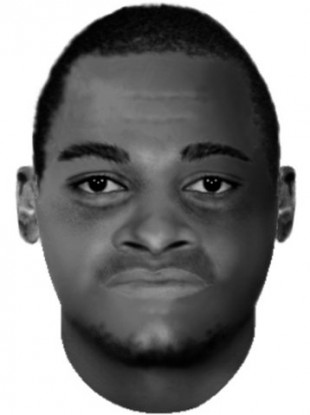
E-fit of Jose Matada issued by the Police
After dismissing the story we were astonished by the news in October 1996 that two brothers from New Delhi had stowed away in the wheel well of a British Airways 747 on a flight from New Delhi to Heathrow and one of them actually managed to survive the flight. And then just a few months later, in March 1997, a 13 year old Kenyan boy was found crushed by the landing gear on a flight arriving at Heathrow from Nairobi. The following year a dead Azerbaijani fell out of the wheel well of a British Airways flight from Baku when it landed at Gatwick. In the following years there were more stories of planes landing with bodies in the wheel well or of bodies falling from the sky as planes readied to land at airports. Tia Maria’s story did not sound quite so far fetched any more, especially when on a quiet Sunday morning in September 2012 British Airways flight BA76 from Luanda flew over a deserted Portman Avenue in Mortlake at 7.42am. Seconds later several residents of the suburban street were awoken by a loud thud but when they looked out of their windows there was nothing unusual to see. A few minutes later two boys on their way to church found an African man dressed in jeans, white trainers and a grey hoodie lying dead on the pavement. The police were called and initially suspected that the injuries sustained by the unknown man were caused by a beating with baseball bats. But when a search of the victim’s pockets showed that the only money he had on him were Angolan Kwanzas and several witnesses came forward to say they had heard a loud noise at a time that coincided with the time that the BA flight from Luanda passed overhead, it began to seem more likely that the man was a stowaway. The victim had no identification documents on him; the only clues to his identity were a tattoo on his left arm with the letters Z and G and an e-fit reconstructed from the remains of his battered face. The police hoped this would be enough for someone in the British Angolan community to recognise him. It took police almost seven months to identify him. In April 2013 they announced that the victim was José Matada, believed to be from Mozambique, not Angola; ironically his 26th birthday was on the 9th September, the day he had fallen from the sky above Mortlake to his death in Portman Avenue. The Police had eventually identified him via an Angolan Movicel SIM card retrieved from the smashed mobile phone found in his pocket. This revealed a string of text messages between him and a woman who was eventually traced to Switzerland. When the police talked to her about the texts she was able to identify José, even describing the tattoo on his arm. He had worked for the woman’s family as a gardener and housekeeper in South Africa. When the family moved away José sent her a stream of texts talking about going to Europe to make a better life for himself presumably hoping she would help or offer him employment. He moved to Angola from South Africa for reasons that have never become clear and made his final, desperate attempt to get to Europe from Quatro de Fevereiro Internation Airport in Luanda on the evening of Saturday 8th September. The pathologist giving evidence at his inquest said that José would have been close to death, possibly even already frozen and suffocated to death, by the time the BA Boeing 777 slowed to 240mph and dropped altitude to 2500 feet on its final descent to Heathrow and he fell from the wheel well to the pavement of Portman Avenue, SW14. The efforts of the authorities in Mozambique to identify José’s family initially ended in failure but then in January 2014 they finally came forward after seeing his story in the newspaper Verdade. José’s body had been marked in an unmarked grave in Twickenham; his family could not afford the $11,500 it would cost to repatriate him back home.


Monday, 18 December 2017

The Lisbon Dead; O Cemitério do Alto de São João, Lisboa


For no good reason I can’t help feeling slightly guilty for deserting, even temporarily, the subject of (dead) London and Londoners. The idea of a sister blog called the Lisbon Dead has appealed to me for some time but I barely have time for one blog and I’m just kidding myself if I think I’ll ever manage to keep up with two. So I may as well bow to the inevitable and allow myself to stray off-piste; what follows is the London Dead on holiday.  This post is an early, and inferior, version of something I wrote for Loren Rhoads ‘Cemetery Travel’ blog. Loren prodded me into writing a better post by asking clever and pertinent questions and in gratitude I will leave the resulting piece on her blog and use the original version on my own.  


My wife is Portuguese and still has family in Lisbon. When my sister in law moved to a new apartment in the high-rise suburb of Olaias I was intrigued by the large hillside cemetery I could see from her 8th floor windows.  It was the cemitério do Alto de São João I was told when I asked.  It didn’t look too far away and I promised myself that I would go and have a good look at the first opportunity that presented itself. This turned out to be one hot August afternoon when I only managed to get into the cemetery 30 minutes before it shut for the day. I stole an extra 15 minutes or so after they had closed the gates but I didn’t want to risk being locked in for the night. 45 minutes wasn’t time to scratch the surface of the place; I moved around as fast as I could and took as many photos as my frantically twitching shutter finger would allow but I knew I needed to go back and explore properly.  I have returned half a dozen times since then and spent whole afternoons there but like all the best cemeteries the place is a labyrinth and no matter how many times you visit there is always something new to discover.  In Lisbon’s strong light the cemeteries deserted lanes, its mausoleums and memorials take on the eerie atmosphere of a De Chirico painting.  The cemitério is a true necropolis, with the dead mainly residing above ground in sepulchres and mausoleums that line the sides of streets that have names and numbers just like in a real town. The site was first used as a burial ground in 1833 during a cholera epidemic when plague pits were dug on what was then a hill top outside the Lisbon city limits.


In the 1830’s Portugal had very few cemeteries. The progressive Bishop of Leiria had created a cemetery behind his cathedral in the 1780’s and the English had created graveyards in Oporto and Lisbon but most Portuguese interments took place inside the walls of religious buildings of one sort or another, mainly churches but also convents, monasteries, even hermitages. Only the rich could afford any sort of memorial, the majority of burials went unmarked. Parish churches became overcrowded and unsanitary following centuries of intermural interments. In 1790 in the small town of Póvoa de Varzim the padre declared that the church doors had to be kept open at all times; incense was no longer enough to disguise the stench of rotting corpses inside the building. In 1835 a Liberal government passed a law obliging the civil authorities to create walled cemeteries in all urban areas of Portugal. It was an unpopular measure, provoking riots on the town of Lanhoso and an anti-government uprising in the northern region of Minho.  There were claims that the new cemeteries were built without walls and that wild animals scavenged corpses. The novelist Camilo Castelo Branco ridiculed the idea that the Government “had ordered the construction of cemeteries, but had had no walls built round them, so that dogs, cats and wild boars got in in such numbers that they dug up the corpses. Nations and naturalists alike must have had a rather inflated idea of the size of the Portuguese cats which dug up corpses, and of the good relations between our dogs and the said cats in the task of exhuming them. They would have been no less surprised by the familiar behaviour of the boars who came from Geres to collaborate with the dogs and cats in extracting rotten flesh from the soil of Lanhoso.”


In the more sophisticated cities of Lisbon and Porto however the Portuguese bourgeoisie were as enthusiastic about cemeteries as their counterparts in London, Paris or Berlin.   The city government of Lisbon founded two in 1835 in response to the new laws, both on high ground on the city outskirts, Prazeres (Pleasures! The name is not ironic, it came from the name of the Quinta, the country estate, on which the cemetery was laid out) and on the Alto de São João, the Heights of St John, looking out over the broad sweep of the river Tejo (Tagus).  Nineteenth century Portuguese society was divided into Conservatives, who were supporters of the monarchy and staunch upholders of tradition and Liberals, who democratic, republican and often bohemian. In death as in life, the Portuguese remained divided and which of Lisbon’s two cemeteries you were buried in depended very much on your political views; Prazeres is the final resting place of choice for the conservatives, for the aristocrats, clergy, military and high financiers who were the backbone of traditional society.  The inhabitants of the Cemitério do Alto de São João on the other hand are Liberals to a man; republican political figures, journalists, writers, artists and the petty bourgeoisie who supported them.


So liberal was the climate at the cemetery that it was the obvious site for Portugal’s first crematorium whose construction was approved in 1912 and built shortly afterwards. The crematorium was bitterly opposed by the Catholic church and even liberals soon proved themselves to be more conservative, certainly in matters relating to burial, than anyone had imagined. The crematorium only became functional in 1925 when an incinerator was acquired from Germany; a bronze memorial in the cemetery, unfortunately one with more than a passing resemblance to a barbecue, commemorates the ‘primeira incineração em portugal’ (the first incineration in Portugal) on 23 November 1925. Once working the crematorium proved a huge flop – between 1925 and 1936 only 22 people choose to be cremated. In 1936 cemetery management conceded defeat and closed the crematorium down. It only reopened in 1985, mainly as a result of pressure from Lisbon’s growing Hindu community. The decoration of the crematorium is remarkable; inside azulejos, traditional blue tiles, show a mysterious ceremony in which ghostly cowled figures march in single file along a crepuscular path to kneel at the base of a sacred flame whilst over the arched entrance skulls, femurs and pelvic bones wreathed in flames and smoke offer a hint of the inferno that almost guaranteed to put off potential clients suffering from religious qualms.


My favourite memorials at the cemetery belong to the bullfighters, Fernando de Oliveira, Daniel Do Nascimento and Tomás Da Rocha. Portuguese bull fighting is very different from Spanish – the bull isn’t killed and the important toureiros, bullfighters, are not matadors but the cavaleiros the horsemen (or cavaleiras, horsewomen, unlike Spain Portugal has women bullfighters) who dress in 18th century costume, are mounted on Lusitano horses and whose job is to stick three or four bandarilhas into the big hump of muscle that sits over a bulls front legs. This makes it possible for the next part of the surreal spectacle to take place; the cavaleiro is replaced by the 8 strong forçada, a group of amateur fighters, who enter the ring armed only with a single green cap, and whose job is to engage the bull in an intimate clinch called a ‘pega’. The forçada drawing the short straw is given the green cap and standing alone, some distance away from his colleagues, attracts the attention of the enraged bulls by putting his hands on his hips, sashaying across the ring and shouting “toiro, hey, toiro…” until the bull, irritated beyond endurance at this ridiculous display, charges. The forçada has to grab the charging bull by the head and once he has him firmly secured, the other forçadas leap in to help. This link will show you what happens when unarmed man meets furious bull.   


Accidents, sometimes fatal, are not uncommon in the Corridas. Fernando de Oliveira (see top photograph for his memorial) died in the Campo Pequeno bullring in Lisbon on the afternoon of the 12th May 1904. Fernando, mounted on his horse Azeitona, was second on the bill fighting Ferrador, a bull bred on the quinta of the Marquês de Castelo Melhor. Fernando managed to sink his first bandarilha into the bulls back but the incensed animal charged, knocking Azeitona’s legs from underneath him. Bullfighter and horse collapsed in a tangle of arms, legs and stirrups and the bull attacked again. Other toureiros ran to help; the bull was coaxed away, the panicked horse climbed back to its feet and ran, bucking and kicking, around the ring. Fernando lay where he had fallen; it was obvious to all that he was dead, the base of his skull crushed.  In the days before film and video no one could be quite sure what had happened in those crucial seconds after Azeitona had stumbled. Some thought that the fall itself was responsible for the head injury. Others were sure that he had been smashed on the back of the head by a flying stirrup. Others swore that the horsemen had managed to raise himself to his knees immediately after his fall but with his back turned towards the bull, who had gored him from behind. Fernando’s monument in the Cemitério was raised by public subscription amongst the aficionados of Portuguese tauromaquia.