Friday, 23 October 2015

Skulduggery in the fur trade; John Moritz Oppenheim (1801-1864) & Frederick Schroeter (1809-1876), Nunhead Cemetery


Unless you know where in Nunhead Cemetery to look the impressive memorial to John Moritz Oppenheim and Frederick Schroeter is hard to find; it must once have been clearly visible from the main path but the unchecked growth of trees and shrubs has hidden it in its own secret grove. Although I had never heard of them I assumed Oppenheim and Schroeter must have been artists – the badly eroded, apparently vandalised, panels seem to indicate that. In one a seated man touches a sculpture of a woman’s head (one description I read described him as ‘fondling a female bust’) possibly of the classically draped woman who stands to the side; sculptor and model I assumed. Another panel shows a seated man and a standing female figure holding what may be a canvas, an artist’s palette and brushes on the floor. In the third panel an angel touches the eyes of a man reclining on a day bed. But Oppenheim and Schroeter were in fact fur traders, and the only connection they had with the arts was Oppenheim’s love of painting. He was a collector and patron who ironically went blind for the last twenty years of his – the angel touching the dying man’s eyes perhaps restoring his vision and the man fondling the bust because he can no longer see?

John Moritz Oppenheim

Johann Moritz Oppenheim was born in Hamburg in 1801/02. We don’t know when he came to England but he set himself up in business as a fur trader in the city in 1823, as soon as he was legally old enough to do so. His business which specialised in the Alaska fur trade (the pelts of seals, sea otters, beavers and racoons) prospered and he died a wealthy man. He never married and lived close to his business in Cannon Street.  He was a passionate collector of art and in his will left several paintings to the National Gallery; his blindness robbed him of one of the great pleasures of his life.  The business was inherited by his nephew by marriage and partner, Frederick Schroeter but he left a number of other legacies including a £1000 bequest to the Hungarian president Louis Kossuth “in admiration of his wisdom, and patriotism”, £100 each to five London hospitals, including St Thomas’, £100 each to his chief clerks in London, Moscow and Hamburg and a year’s wages to all of his servants.

One of the works of art Oppenheim left to the National Gallery

Oppenheim was a quiet man who lived away from the public eye. Apart from his death the only mention of him in newspapers are in court cases where he was the victim of fraud or robbery. In 1840 a young man named Jacob Isaac found himself arraigned before the Lord Mayor at the Mansion House, accused of obtaining goods by deception from a number of furriers.  The prosecuting solicitor ushered Oppenheim into the witness box with no prior warning to the defence to tell his story of accepting a bill for £185 and some shillings from Isaacs, presumably in payment for furs. When the bill had become due and was presented at Barclays the cashier told Oppenheim there were ‘no orders’ and it soon emerged that it was a forgery.  The defence objected to the last minute presentation of what amounted to a new and more serious accusation against their client. The Lord Mayor was unimpressed and forgetting about the original charges of obtaining goods by deception remanded Isaacs solely on the charge of forgery.  Perhaps the case never came to court – I have not been able to trace any trial.

WP Lillicrap, receiver of stolen goods
In April 1862 another German born furrier, Gotthard Pohler, went on trial at the Old Bailey accused of receiving stolen goods, namely two sealskins, 26 muskrat skins, and 160 racoon tails to the value of £5.00.  Pohler had received the furs from Leopold Warnecke of Buttesland Street, Hoxton, an employee of Oppenheims who had pilfered them from his employer. Warnecke was soon caught; he only worked for Oppenheim for 8 weeks.   As soon as he was caught, and afterwards in court, he had no hesitation in both confessing and informing on his partners in crime. Pohler had bought the furs from Warnecke and then sold them on to his employer, a supposedly respectable furrier, William Pearce Lillicrap of Davis Street, Berkeley  Square who clearly operated an ’ask no questions’ policy when offered stock at knock down prices by his employees. He was most put out when Oppenheim’s manager and a detective from the City Police paid him a visit. Lillicrap called Pohler and, swearing he knew nothing of the origins of the stolen furs, handed him over to the police. Warnecke was spared prosecution in return for his sworn testimony in court. Lillicrap too walked away scot-free, happily giving evidence to the court about Pohler but earning himself the censure of the jury who clearly thought he was as dodgy as his employee, to which the Recorder added his agreement, saying that his excuses should not be allowed. Poor Pohler, whose wife was about to give birth, got four years hard labour.

The Alaska Factory, Bermondsey
Under Schroeter’s guidance the Oppenheim & Co went from strength to strength. In 1869 he moved south of the river, opening the Alaska Factory in Grange Road, Bermondsey. Only the original gate still stands with its carving of a seal; the famous art deco building behind the gate was designed by Wallis, Gilbert and Partners, the architects of the Hoover building. Schroeter lived in Mottingham in a thirty room mansion set in 38 acres of grounds and died there in 1876. He had erected the memorial to his benefactor in Nunhead Cemetery a couple of years after his death and he also chose to be buried with him.  He left an estate worth more than a quarter of a million pounds which included farms and houses in Surrey as well as the family business.
   

In 1982 the Oppenheim Schroeter memorial was heavily vandalised and the burial vault broken into and desecrated by grave robbers. 


The vandalised relief panels on the memorial

Friday, 16 October 2015

"DEAD - A Celebration of Mortality" Charles Saatchi

The poster on the London Underground (taken at Stockwell station)

Perhaps Charles Saatchi is losing his flair for advertising. Admittedly the poster for “Dead: A Celebration of Mortality” is striking;  a heavy but clever crop of a classic Bart Hardy photograph showing children playing in a Glasgow Cemetery focuses on a single boy leapfrogging a grave stone. It’s a great image, the all too fleeting triumph of life over death perfectly visualised. It made me go out and buy the book but I suspect that demographically speaking, consumers who can’t resist buying a product associated with death form a tiny target group in the general population. Even stranger was to hear an ad for the book on Heart FM sandwiched between Take That and Michael Buble.  Poster campaigns on the London underground and commercial radio stations don’t come cheap – Saatchi must have squandered a small fortune trying to sell his book to jaded commuters and desperate housewives. Perhaps he has taken to advertising after revelations from the Grillo sisters, former aides accused of defrauding him out of £600,000 between them, whose defence in court was that they spent most of the money buying copies of his books in Waterstones and on Amazon to boost their ratings in the best seller lists.

Bert Hardy's classic image "Leapfrog"

“Dead: A Celebration of Mortality” has the unmistakable air of a vanity publication about it. The cover is gimmicky, made up to look like a tombstone, down to the marbling effect on the paper edges. Even though the author is presumably underwriting all the expenses, publishers Booth-Clibborn Editions (run by an ex advertising crony of Saatchi’s) have managed to make the typesetting look amateurish and clumsy. If you want to read a review of the book you will have to go to Amazon, no newspaper or magazine has deigned to even notice the books existence. 5 of the 6 Amazon reviewers give it 5 stars. Barry Osborne says “it is much more amusing than I expected.” Barry has reviewed three books on Amazon (and nothing else), all of them by Charles Saatchi, and is presumably either that very rare creature, a Charles Saatchi fan or that slightly more common one, a Saatchi hireling pretending to be a disinterested consumer. J Kaufman says it is ‘dead good’ and   Benjamin thinks death is “an unlikely subject for a fun book.” Susan Jones who likes Al Jarreau and is perhaps the only Heart FM listener to have actually bought a copy of the book after hearing the advert, says “nothing to say; Mr Saatchi says all.”(?!!?). The only dissenting voice is Mr Harry Potter (not his real name one suspects) who comments “I've never read a book before where I felt I'd just wasted several hours of my life. Personally I'm glad I was given it and didn't waste money on it.” He counsels potential readers to “wait until you’re dead to read this.” 

Goshka Macuga’s Madame Blavatsky

Saatchi’s collection of ‘essays’ (his word, not mine) are only very loosely linked by the theme of death, and consist mainly of material clipped from newspapers or culled from too many hours browsing the net. We are given dubious factoids, (‘there were fewer gunfights in the wild west than in Detroit today’), spurious statistics (‘Greenland possesses the highest recorded suicide rate in the world today, with 1 out of 5 citizens attempting to kill themselves at some point in their lives’), stories of bizarre deaths (the woman who died electrocuting her nipples with a hair dryer), death related lists (most popular funeral songs), last words (James French to the journalists assembled to see him die in the electric chair ‘How about this for a headline for tomorrow’s paper? French Fries?’), and the authors banal musings on his life experiences (‘the thought of becoming a centenarian is not necessarily a pleasant one’). The writing is leaden and humourless, the content a mishmash of poorly organised and undigested material with no plan or purpose. By page 242 Saatchi feels obliged to bring his opus to some sort of a conclusion so we get “Some lives leave a mark, others a stain”, a phrase he clearly feels is imposing because it occupies half a page by itself in 36 point bold type. It is followed by the equally inane ‘almost everybody lives a life of little consequence to mankind but wouldn’t you prefer to have spent your years rather uselessly but entertainingly?’ This is not a book I would recommend. 
 
Dallas Seitz’s Elizabeth Regina and John Hanning Speke 

The Saatchi gallery hosted an exhibition in the summer to tie in with the launch of Charles’s book. Four rooms on the top floor were filled with a random selection of art works retrieved from the Saatchi’s warehouses. Anything that seemed to tie in with the theme of death found a place. On the walls of Room 1 hung Denis Tarasov’s photos of the laser etched gravestones of Russian Mafiosi (also featured in the first of Saatchi’s essays in his book) and the floor was littered with corpses by, amongst others, Andra Ursuta (a grim blackened female covered in what look like squirts of semen), Terence Koh (a cast of the artists own body) and Alina and Jeff Bliumis (man buried under a cascade of books). Room 2 has paintings of car crashes by Dirk Skreber and photos by Vikenti Nilin and the Gao Brothers. Room 3 features Rafael Gomezbarros’ fibreglass ants, hundreds of them blown up to the size of a small dog and swarming over the walls and ceiling – great fun but I couldn’t see the connection with death. Room 4 had some of my favourite works. For example  Francis Upritchard’s ‘Travellers Collection’, a three shelved table with a mummy and funerary urns and mortuary objects made out of junk shop tat. Goshka Macuga’s Madame Blavatsky levitating between two dining chairs is very amusing. Dallas Seitz’s Elizabeth Regina and John Hanning Speke look like companion pieces, Speke being of course the African explorer who travelled with Richard Burton; during the course of their expedition the two men developed a mutual loathing and Speke discovered the source of the Nile. He died mysteriously after shooting himself in the armpit the day before he was due to take part in a public debate with Burton at the British Association in Bath in 1864. Plenty to enjoy then but this was not a carefully curated exhibition, instead it was simply thrown together from whatever was available. In essence it created to serve the same purpose as those adverts on the underground and on the radio, to publicise Saatchi’s tenth rate book.       

Friday, 9 October 2015

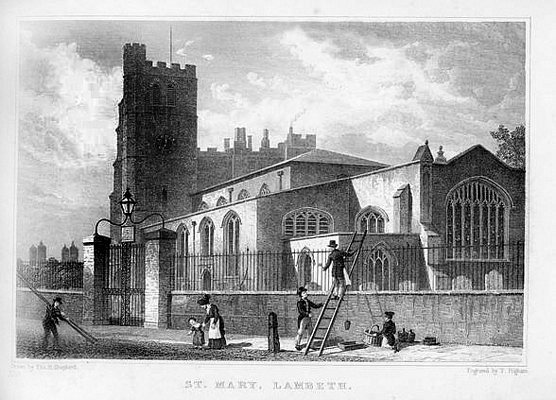
The Sealy Memorial, St Mary-at-Lambeth churchyard


The Coade Artificial Stone Factory was set up in Lambeth in 1769 and ceased to trade in 1840. For much of its life time the company was run by two Eleanor Coades, the elder the widow of the founder and the younger, their daughter. From 1799 to 1813 the company became known as Coade & Sealy when John Sealy, a cousin who started as a clay modeler in the factory, rose to become became Eleanor Coade senior’s business partner. When John Sealy died in 1813 he was buried in the churchyard at St-Mary-at-Lambeth beneath a Coade & Sealy monument (of course) where he was later joined by various members of his large and extended family. 

The memorial is not in as good a state of preservation as the other famous Coade stone memorial in the churchyard belonging to Captain William Bligh and his wife Betsy.


Coade stone is a type of stoneware. Mrs Coade's own name for her products was Lithodipyra, a name constructed from ancient Greek words meaning "stone-twice-fire" (λίθος/δίς/πυρά), or "twice fired stone". Its colours varied from light grey to light yellow (or even beige) and its surface is best described as having a matte finish.

The ease with which the product could be moulded into complex shapes made it ideal for large statues, sculptures and sculptural façades. Moulds were often kept for many years, for repeated use. One-offs were clearly much more expensive to produce, as they had to carry the entire cost of creating the mould.

Contrary to popular belief the recipe for Coade stone still exists, and can be produced. Rather than being based on cement (as concrete articles are), it is a ceramic material.

Its manufacture required special skills: extremely careful control and skill in kiln firing, over a period of days. This skill is even more remarkable when the potential variability of kiln temperatures at that time is considered. Mrs Coade's factory was the only really successful manufacturer.

The formula used was:
 10% of grog
 5-10% of crushed flint
 5-10% fine quartz
 10% crushed soda lime glass.
 60-70% Ball clay from Dorset and Devon.

This mixture was also referred to as "fortified clay" which was then inserted after kneading into a kiln which would fire the material at a temperature of 1,100°C for over four days.


The Ouroboros is an ancient symbol depicting a serpent (or dragon) devouring it's own tail representing eternal return. "The first known appearance of the ouroboros motif is in the Enigmatic Book of the Netherworld, an ancient Egyptian funerary text in KV62, the tomb of Tutankhamun, in the 14th century BC. The text concerns the actions of the god Ra and his union with Osiris in the underworld. In an illustration from this text, two serpents, holding their tails in their mouths, coil around the head and feet of an enormous god, who may represent the unified Ra-Osiris. Both serpents are manifestations of the deity Mehen, who in other funerary texts protects Ra in his underworld journey. The whole divine figure represents the beginning and the end of time........"

Wednesday, 7 October 2015

The affair of the diamond necklace: Jeanne de Valois-Saint-Rémy, Comtesse de la Motte (1756-1791), St Mary-at-Lambeth

Jeanne de la Motte's entry in the St Mary-at-Lambeth burial register
A casual passerby would have seen some odd goings-on at Mount Row in Lambeth on the night of 6 June 1791 when a pair of heavily built men forced their way into one of the lodging houses. A few minutes later a distraught young woman leaves the same house in something of a rush and, despite apparently not being able to speak English, manages to persuade the occupants of a neighbouring house to let her in. She is observed by one of the men from an upstairs window and eventually both of the men follow her into the street and into next door. Noise and confusion follow their entry and then a third storey window of the house opens and the young woman flies out and falls to the pavement, striking a tree on the way down.  It is impossible to say if she fell, jumped, was pushed or even thrown out of the window but it is clear she is badly injured; she seems to have broken more than one limb and she has lost an eye.

In the days that follow the newspapers explain what happened;
 
A female foreigner, who lodged in the neighbourhood of Mount-row, Lambeth, being on Monday night arrested upon an action for a trifling sum of money, was so much affected, that she leaped out of a two pair of stairs window, by which act the broke both her legs, and was otherwise so much bruised, that her life is despaired of. She proves to be the famous Comtesse de !a Mott.  As soon as the Bailiffs arrested her, she asked them to drink a glass of wine,  and, on pretence of getting it, left the room, and immediately locked the door. From the window they saw her go into an adjoining house, and pursued her. She lies terribly mangled; her left eye cut out — one of her arms and both her legs are broken.  Caledonian Mercury 9 June 1791

Jeanne de la Motte
The trifling sum of money was £30 and the young woman was the 35 year old Jeanne de Valois-Saint-Rémy, Comtesse de la Motte. She and her husband, the shadowy Count de la Motte, were fugitives who had earned the undying rancour of the French Royal family and who were terrified of Royalist retribution even though the Revolution was in full throe and Louis XVI and his Queen Marie Antoinette had far more pressing matters to deal with.  Jeanne took two and a half months to die of her injuries, finally expiring on the 21 August, reportedly after over indulging in mulberries for which she had a particular weakness. She was buried five days later at St Mary-at- Lambeth by William Vyse who as well as  being the rector of St Mary’s was also Chaplain to Archbishop Cornwallis, Lambeth Palace being next door to the church.  In the registry the rector recorded the deceased as Jean St Rymer De Valois, Countess De La Motte.  The Count was not at her funeral; he was in Belgium fighting a duel in which he killed William Grey a Bond Street jeweler, no doubt in a dispute over payment for the diamonds that his wife had stolen and that had led to her public flogging and imprisonment in Paris;

An Affair of Honour, which has been attended I with fatal Consequences, took place at Brussels a few Days ago. A Dispute between the famous Count La Motte and Mr. William Gray, of Bond-Street, London, which originated on some trivial Circumstance, had occasioned a Duel, in which the latter fell. A Brace of pistols being fired by each without Effect, they had Recourse to Swords; and Mr. Gray having a Cast in his Eye, and being less versed in the Management of that Weapon than his Antagonist, yielded an easy Victory.  Oxford Journal 27 August 1791

The churchyard at St Mary-at-Lambeth

Jeanne de Valois-Saint-Rémy was born in July 1756 in the Chateau of Fontette near the town of Barbe-sur-Aube in Champagne. Her father Jacque was an illegitimate grandson of Henri II and a near penniless drunkard who had frittered away what was left of the family fortune by gambling. He had fallen so low as to marry a servant with whom he produced six children, supporting them by poaching off the estates he had once owned.  Poverty drove the family to Paris where a broken Jacque died in the workhouse. Jeanne’s mother promptly married a Sardinian guardsman and the family moved to Boulogne. The Guardsman raped the 8 year old Jeanne and made her earn her keep by begging in the streets of the town.  Jeanne stood on the main carriage route with her baby sister strapped to her back, holding a sign which said “Pity the poor orphan of the blood of Valois.”  The Marquise de Boulainvilliers, driving past in her Phaeton, took pity as instructed and became Jeanne’s patron for a decade. Placing the sisters in a convent didn’t stop the Marquise’s husband debauching the adolescent Jeanne. At the age of 20 she ran away from the convent back to her place of birth in Barbe-sur-Aube where she was taken in by a Madame  Surmont, the wife of the local Prefect. The good woman soon regretted her charity when her husband became smitten by the girl; she however reserved her favors for the Bishop of Langres by whom she became pregnant.  Jeanne deftly side stepped the potential scandal by ensnaring Madame Surmont’s beloved nephew, guardsman Nicolas La Motte, into a hasty marriage.  Jeanne had twins, girls, but they died soon after birth.

Cardinal Rohan
   
Jeanne’s much vaunted Valois blood eventually led to her being granted an annual pension by the Crown but it was not enough for a penniless girl with grand ambitions. Her opportunity to further these came when Madame  Boulainvilliers introduced her to Cardinal Rohan, the Bishop of Strasbourg. The Rohans were an important, powerful and vastly wealthy aristocratic family and Cardinal Rohan was a worldly prelate with a taste for politics. He had been one of the political faction opposed to the Austrian marriage of Louis XVI and had been sent on a special mission to Vienna to try and prevent it. He only succeeded in earning the personal enmity of the Empress Maria Teresa and her daughter Marie Antoinette. Once Marie was Queen Rohan’s political career was over and he was barely tolerated at court.  The Cardinal was enchanted by Jeanne and she soon became his mistress and confidante. The only other person Rohan trusted implicitly was Count Cagliostro; placing himself in the unfortunate position of having two of the 18th century’s greatest swindlers as his personal advisers, a situation that would eventually cost him dearly.

Nicole d'Oliva
With Cardinal Rohan’s backing Jeanne took to haunting Versailles, continually calling on officials and courtiers with petitions and requests for the money, property and titles that she felt she was entitled to on account of her Valois blood. When this didn’t work she tried sleeping with court officials and telling outrageous lies about her close personal relationship with the Queen. She became such a pest that officials eventually increased her pension in an effort to get rid of her but it was not enough for the voracious Jeanne. Cardinal Rohan swallowed the story of Jeanne’s new friendship with Marie Antoinette and humbly accepted her advice that he start a campaign to restore himself into Royal favor by writing a letter to the Queen begging her forgiveness for the errors of his past.  Jeanne recruited a friend, a master forger named Rétaux de Villette, to produce a reply that came ostensibly from the Queen herself. Encouraged by the faked response Rohan wrote more letters to the Queen to which Rétaux wrote increasingly warm, even intimate replies.  Flattered by this apparent interest from the Queen Rohan was soon penning treasonous love letters to her majesty. The worldly prelate seems not to have smelled a rat, even when ‘the Queen’ began asking him for substantial donations towards charity. He seemed not to notice that the penurious Jeanne was suddenly affluent, living in better accommodation and dressing in finer clothes. Rohan’s ardor increased to the point where he was desperate to meet the Queen in private.  Jeanne put off the meeting for as long as possible but when she ran out of excuses she arranged a rendezvous on a moonless night in an overgrown arbor in the gardens at Versailles. Another friend Nicole d'Oliva, a prostitute, was recruited as stand in for Marie Antoinette. The private interview was quick, no more than a few minutes, undertaken in conditions of great secrecy – the excited Rohan was barely able to stutter a few endearments to the heavily disguised Queen and had no time to receive any in return. Instead ‘the Queen’ thrust a single red rose into his hand before rushing away to spend the night writing him a long passionate letter.

The famous necklace
It was not only the Cardinal who believed Jeanne’s story of her friendship with Marie Antoinette; the court jewelers Barsenge and Bohmer hearing false rumors of her intimacy with the Queen approached her to intercede with her majesty on their behalf. They were anxious to sell a colossally expensive diamond necklace, a piece which cost so much that only the King could afford to buy it. Unfortunately the King had declined the purchase and the jewelers were left with a necklace into which they had sunk almost all their capital. They hoped that Jeanne could help them solve their liquidity problem by approaching the Queen on their behalf. She immediately saw the potential to make a fortune from the besotted Cardinal Rohan.  On her instructions Rétaux the forger wrote a charming letter to Rohan, ostensibly from the Queen, explaining that she desperately wanted the necklace but that the King was in temporary financial difficulties and had told her she had to make sacrifices. Could her dearest Cardinal please advance her a loan to buy the trinket? The cost was an eye watering 1,600,000 livres, a sum so vast even the lovelorn prelate started to feel uneasy but the jewelers were prepared to accept payment in installments and by the time the first payment had been made the King could probably be relied on to come up with the rest.  Rohan anxiously decided he needed further help in making such a big decision so he asked Count Cagliostro to consult the spirits for him, they surely would know what to do. The Count did as he was asked and was pleased to tell Rohan that the auguries were all good and he should go ahead. Jeanne soon had the necklace, which she passed on immediately to her husband who wasted no time prising the diamonds from their settings before hot footing it off to Brussels and London to sell them.

Marie Antoinette points the finger at Cardinal Rohan

The plot unraveled when the first installment of the money fell due to Barsenge and Bohmer;  Rohan found himself unable to come up with the cash by the appointed date. The two jewellers panicked and approached the Queen directly to politely remind her that the money was due. She of course claimed to know nothing and so the jewelers produced the contract of sale to which Rétaux the forger had obligingly appended her name on behalf of Jeanne. Soon Cardinal Rohan, Jeanne, the unfortunate Cagliostro, Rétaux the forger and Nicole the prostitute all found themselves under arrest. The King decreed that there should be a public trial, a serious misjudgment given the general unpopularity of the Royal family. Both Jeanne and Cagliostro published spirited (and meretricious) defenses which became best sellers in France and newspapers all over Europe took a keen interest in the progress of the trial itself. Public opinion in France believed Rohan to be an innocent victim of Marie Antoinette, the Queen merely using Jeanne and her disreputable friends to discredit and humiliate the Cardinal. The verdict of the Paris Parlement, where the trial was held, reinforced the popular view; Rohan was acquitted of all charges against him, as was Cagliostro, and the full brunt of blame for the affair fell on Jeanne and her two accomplices. Jeanne was ordered to be whipped and branded and sentenced to life imprisonment.

Jeanne is publicly branded in the courtyard of the Palais de Justice

Early in the morning of 21 June 1786 Jeanne was dragged out of her cell in the Palais de Justice wearing only a petticoat and shawl by 8 men who bodily carried her to the main courtyard. She put up a ferocious struggle as her captors tied a halter rope around her neck and attached her to a cart to be whipped. The courtyard had been set up with benches for the public to see the spectacle and despite the earliness of the hour a crowd of several hundred people quickly gathered. The guards seemed almost sorry for her and the lashing across her shoulders and neck was half hearted according to most accounts. One of the guards then stripped her half naked to allow the executioner to brand a V on her shoulder and breast with a red hot iron. As he scorched her breast the swooning Jeanne rallied momentarily and sank her teeth into his hand, biting off a sizeable chunk of flesh before passing out. Whilst she was unconscious her hair was shorn to the scalp. Later she was given the coarse grey uniform of the Salpêtrière before being taken away to that notorious prison for prostitutes. 

Jeanne's flight from the Salpêtrière 
Her sentence was life imprisonment but in the event she served less than six years, somehow escaping and fleeing to London. We only have her own, highly improbable account of how she managed to escape her Parisian jail. She claims well wishers smuggled writing materials to her with which she produced a sketch of the key to her cell (which she merely managed to snatch glimpses of in the hands of the nuns who served as jailers), the sketch was then smuggled out of the prison and used to make a duplicate key which was smuggled back in along with a suit of men’s clothes. When the opportunity arose Jean donned the suit and wig and let herself out of her cell and a further three locked doors and escaped from the prison by mingling amongst a crowd of sightseers on a visit to see the locked up prostitutes. Once free she made her way to Luxembourg and then to London where she was joined by her husband. In London she wrote her bestselling “Memoires Justificatifs de La Comtesse de Valois de La Motte,” but seemed to make very little money from them if she was forced to live in a common lodging house in Lambeth and died being dunned for a mere £30.


Illa Meery as Jeanne de la Motte, in the silent film "Cagliostro" (1929) By Richard Oswald.

Perhaps we have not heard the last of Jeanne; on ‘Find A Grave’s web page about her, an anonymous poster left the following message in January 2012:


  http://www.findagrave.com/icons2/flowers/photoRealRoseSmall.gifIn another lifetime on earth I was Jeanne De Saint-Remy de Valois. To those kind and beautiful souls who have left flowers THANK YOU from the bottom of my heart, it's been very healing. To those few who have left negative comments, believe me, I have paid for my actions in this lifetime by carrying huge amounts of guilt and shame and suffered, which has impacted on every aspect of my life. Her actions were not 'nice' to say the very least, but unless you walk in another's shoes, I would ask you not to judge, think of the poverty and the abuse. I have met Marie-Antoinette again in this life-time and I felt so guilty and ashamed that I could not bear to be in her company and I sobbed for about an hour aterwards. I'm still trying to work through the energy of that life, but I'm grateful for this opportunity to share with whoever comes across this.
-Anonymous
 
Added: Jan. 7, 2012
  

Wednesday, 16 September 2015

His Coffin was a Living Shark! - how Ephraim Thompson's son and Henry Watson's watch ended up in the belly of a fish

Detail from 'Watson and the Shark" by John Singleton Copley showing Lord Mayor Brook Watson losing his leg in Havanna

There is something fishy about this shark tale. Perhaps because it is such a close match to  the classic ‘the fish and the ring’ type of folk tale first written down by Herodotus in his account of the tyrant Polycrates of Samos who was persuaded to give up his most valuable and luxurious possessions otherwise his life would end in tragedy. One of the items he cast into the sea was his favourite emerald ring. Months later a fisherman brought him a fish as a tribute and when it was cut open to be gutted the cast off ring was discovered inside. There are dozens of variants, Jewish, Indian, German, Irish, English amongst others, on the basic motif of the lost or discarded valuable thrown into the sea and emerging at the most opportune moment in the belly of the fish that swallowed it. In the newspaper accounts of the lost son of Ephraim Thompson of Whitechapel the fish not only swallows and eventually gives up the valuable, in this case a watch, but also swallows Ephraim’s son. The accounts below appeared in many newspapers, always with identical wording, so clearly from one original source. Searches of birth, marriage and death records reveal no trace of a Ephraim Thompson in Whitechapel. Nor can I trace any record of a watchmaker called Henry Watson, in Shoreditch or anywhere else in London, or a ship called the Polly and under the command of a Captain Vane. The story may well be an 18th century urban myth but the author of the 1787 version of Dodsley’s ‘Annual Register’ thought it was too good to pass up and his version has caught the fancy of many compilers of miscellanys right up to the present day. And so the story of the Poplar Shark remains in circulation, even if no one can vouch for its reliability.

On Saturday 1 last as some Fishermen were fishing in the Thames, near Poplar, they perceived something more than commonly ponderous in their net, which with much Difficulty they drew into their Boat, when to their great surprise, they found it to be a Shark, yet alive, but evidently in a dying State. It was taken to Shore; the Admeasurement is as follows: From the Tip of the snout to the End of the Tail, 9 Feet 3 Inches—from the Shoulder to the end of the Body, 6 Feet 1 Inch—round the Body in the  thickest Part 6 Feet 9 Inches— the Width of Jaw when extended, 17 Inches. It has five Rows of Teeth, consequently five Years old, having an additional Row every Year until it has arrived to its proper Growth. It has been opened, and what renders this Fish a greater Curiosity, in its Belly were found a Silver Watch, a Metal Chain and Cornelian Seal, together with several small Pieces of Gold Lace, supposed to have belonged to a young; Gentle man, who was unfortunate enough to have fallen overboard and become a Meal to this voracious Fish ; but that the Body and other Parts, had been either been digested, or voided; but the Watch and Gold Lace not being able to pass through it, the Fish thereby became sickly, and would in all Probability very soon have died. This is the largest Fish of the Species ever seen by any Person in, the River Thames. The Watch has the Name of Henry Watson, London, No. 1369, and the Works are very much repaired. It is intended to preserve this extraordinary Fish, as a great natural Curiosity and place it in one the public repositories in this Metropolis. 
Northampton Mercury Sat 08 Dec 1787


Our readers will recollect a paragraph in a former paper, giving an account of a shark taken in the river Thames, near Poplar, by some fishermen, in the body of which was found a watch, with a chain and seal, and also some pieces of gold lace, which was conjectured to have belonged to a young gentleman, who was swallowed by that voracious fish ; the maker’s name and number of the watch, being Henry Watson, London, No. 1369, hath been the means of obtaining the following additional account of that remarkable circumstance :—Mr. Henry Watson, the watchmaker, lives in Shoreditch, who sold the watch two years ago, to a Mr. Ephraim Thompson, of Whitechapel, as a present to his son going out on his first voyage (as what is called a Guinea Pig,) on board the Ship Polly, Capt. Vane, master, bound to Coast and Bay; about three leagues off Falmouth, a sudden heel of the vessel, during the time of a squall. Mailer Thompson fell overboard, and was seen no more. The news of his being lost soon after came to the knowledge of his friends, and no more was expected to be heard of him—but from the above circumstances, it is proved, somewhat similar to the fate of Jonas in the belly of a whale (young Thompson’s coffin was a living shark) he was not so fortunate as to escape. Mr. Ephraim Thompson has purchased the shark, which he calls his son's executor —and the watch, &c. which he considers as his last legacy.
Northampton Mercury 14 December 1787

Monday, 14 September 2015

If it wasn't for bad luck, I wouldn't have no luck at all; Sir John Soane (1753-1837) Old St Pancras churchyard


Sir John portrayed in 1828 by John Jackson
Sir John Soane never had much luck; his reputation has survived better than his buildings. Born in 1753 he was most active at the end of the Georgian period when his neo classical clean lines, careful proportions and decisive detailing were just going out of fashion. The next generation of gothic revivalists demolished many of his buildings and others were finished off by accident or the Luftwaffe. His most famous work was the Bank of England but most of this was peremptorily demolished by Sir Herbert Baker when he rebuilt the bank between the wars, a move described by Nikolaus Pevsner as "the greatest architectural crime, in the City of London, of the twentieth century." Soane’s new infirmary at the Royal Hospital in Chelsea, was destroyed in the blitz in 1940 and his work on the Palace of Westminster was destroyed by fire in 1834. His work on Freemasons Hall in 1821 was demolished to make way for the current building, and his National Debt Redemption Office and Insolvent Debtors Court of 1823 were demolished in 1900 and 1861 respectively.  His design for the new Law Courts at Westminster Hall was completed in 1822 but was so ferociously attacked by author and politician Henry Bankes that Soane was forced to demolish the façade of the building, set the building lines back several feet and redesign it  in a gothic style instead of the original classical. Even this did not save it though – it was demolished in 1883. Enough of Sir John’s work survived to guarantee his reputation though he is still most famous of course for his house at Lincoln’s Inn Fields which became the Sir John Soane museum.

Eliza Soane with her dog Fanny
Sir John's mausoleum in Old St Panras Churchyard was designed and built for his wife Eliza who died in 1815. Elizabeth Smith was the niece and ward of George Wyatt the builder whom Soane knew the from working with him on the rebuilding of Newgate prison. On the 10th January 1784 Soane took her to the theatre and a few weeks later, on the 7th February she took tea with Soane and a group of friends. Soane began to accompany her regularly to plays and concerts and on the 21st August 1784, less than 8 months after that first visit to the theatre, they were married at Christ Church in Southwark.


George and John Soane
They had four children, John born in 1786, George in 1787 (but who died six months later), another George in 1789 and Henry who was born in 1790 but died the following year. Soane was disappointed that neither of his surviving sons showed any interest in becoming architects. John was lazy and suffered from ill health. He was sent to Margate in 1811 to improve his health where he met a woman called Maria Preston. John badgered his father into agreeing to a marriage which Soane eventually did on the stipulation that Maria’s father provided a dowry of £2000. The marriage went ahead on the 6th June but the dowry failed to materialise. Not to be outdone the 20 year old George wrote to his mother a few weeks later to break the news that he had married Agnes Boaden, the daughter of an older acquaintance, on the 4th July. He made no bones about the reason for the marriage telling his mother that he had done it “to spite you and father.”  Sir John tried to keep his wayward offspring in check by tightly controlling their finances. George retaliated by telling his father in 1814 that if he did not settle £350 per annum upon him and Agnes he would be forced to take to the stage for a living and become an actor. Later that year Agnes gave birth to twins, only one of which survived infancy. Two months later George was imprisoned for debt and fraud. Possibly behind her husbands back Eliza Soane settled the debt and repaid the embezzled money to get her son out of prison.

In September  1815 an article was published in the magazine Champion called The Present Low State of the Arts in England and more particularly of Architecture. Sir John Soane was the particular target of an acrimonious attack in the article which, although it had been published anonymously, it soon became clear had actually been written by George. His distraught mother wrote on the 13th October 'those are George's doing. He has given me my death blow. I shall never be able to hold up my head again'. She died on 22 November 1815.  and was buried 1 December. Soane wrote in his diary that he had endured 'the burial of all that is dear to me in this world, and all I wished to live for!'

Cherub & extinguished torch - mausoleum detail 
Soane was never reconciled to George and their feud continued until his death. His son John died in 1823 and was buried with his mother in the family vault. Soane set up a trust fund of £10,000 to support his widow and children.  The following year he found out that George was living in a Ménage à trois with his wife and her sister by whom he had a child called George Manfred. George was scraping a living as an author and his always uncertain temper suffered even further under the stress of always being a step away from poverty. He drank and both the women in his life and his children suffered from domestic violence at his hands. Soane helped the women financially but refused to help his son. It is said that he refused a baronetcy because he did not want george to inherit the title on his death.  When he did die in 1837 he left a considerable bequest for the maintenance and upkeep of his house as museum but left his son a  small annuity of £52 a year explaining in his will that the bequest was so small because of 'his general misconduct and constant opposition to my wishes evinced in the general tenor of his life.' George challenged the will through the courts on the grounds that his father was insane. The challenge was rejected by the courts and George half heartedly attempted an appeal which he eventually let drop. George Sala in his memoirs said “I knew the disinherited George Soane well - a  gaunt, sad man, earning a precarious livelihood as a minor poet and playwright.” George died in 1860 in Portland Place, at the age of seventy. He was not buried in the family mausoleum.

The Mausoleum set in an imaginary landscape, a water colour by George Basevi
Nicolas Pevner's verdict on the Mausoleum: "Outstandingly interesting monument by Sir John Soane to his wife, who died in 1815, extremely Soanesque, with all his originality and all his foibles. A delicate marble monument beneath a heavy Portland stone canopy. Four piers with incised Ionic capitals; a pendentive vault carries a shallow drum encircled by a tail-biting snake (symbol of eternity), with a pineapple-shaped finial. The tomb is surrounded by a low balustrade with distinctive acroteria, which also encloses the steps down to the burial vault. Sir John Summerson suggested that the tomb can be interpreted as civilization (the monument) within eternity (the surrounding canopy)."

Friday, 4 September 2015

The Israelite in whom there was no guile and the boys he saved from the Nazis; Paul Philip Levertoff (1878-1954), Barkingside Cemetery


Schneur Zalman
The intriguing epitaph on this modest grave reads “In loving memory of the Reverend Dr. Paul Phillip Levertoff, Scholar and Saint, who departed this life July 31 1954, aged 75 years. An Israelite in whom there is no guile. Erected by his wife and the boys he saved from the Nazis.” Paul Levertoff was the Vicar of Holy Trinity in Shoreditch who lived at 5 Mansfield Road in Ilford, was married with two daughters, the youngest of which was the poet Denise Levertov and who came from what seems an almost impossibly exotic background for an Anglican clergyman. Paul Phillip had been born Feivel Levertoff, a Russian Jew, in the town of Orsha, Belarus in 1878 to a distinguished family of Hassidim. One of his ancestors was the miracle working Rabbi Schneur Zalman, the Rav of White Russia, who as a child was so precociously clever that at 12 his teachers sent him home from the yeshiva with instructions not to bother returning as there was nothing else they could teach him and who at his Bar-mitzvah address spoke with such passion, prescience and learning that the community immediately pronounced him an 'Iluy', a prodigy of learning.
A young Paul Levertoff in his missionary days with Robert
Feinsilber, who helped hatch the plan to save the boys, at his side
Feivel Levertoff was also an outstanding scholar and in her book of memoirs, “Tesserae”, Denise Levertov recounts an episode when her 8 or 9 year old father picked up a scrap of paper in the snow “about a boy like himself who – it said – was found in the Temple expounding the scriptures to the old, reverent, important rabbis!” Entranced he took the scrap of paper home to show his father, who was furious, tore the paper to shreds and threw it in the fire. It was, of course, the story of Jesus and Feivel’s fascination was prophetic because a few years later, as a student in Germany at a Rabbinical Seminary , he came across a copy of the Gospels translated into Hebrew. These he read clandestinely and as he read he became stirred by a ‘profound and shaking new conviction’ that this man, this renegade Palestinian Jew who had died during the height of the Roman Empire, really was the Messiah. Paul Levertoff became a JBJ, a Jewish Believer in Jesus, had himself baptised as Paul Philip and for fifteen years became a professional missionary visiting Jewish communities in places as far apart as Hungary, Bosnia, Egypt and Palestine.  In 1910 he took a post as Evangelist in Constantinople offered to him by the United Free Church of Scotland where he met Beatrice Spooner-Jones, a teacher at the Scottish mission school.  Beatrice was an orphan from Holywell who had been brought up in the guardianship of her uncle, a Congregationalist minister who consented, when she 19, to her going abroad. Her first hope had been to go to Paris but her horrified uncle rejected the suggestion out of hand, the French capital being a totally unsuitable place for an unattached young woman. He agreed to the more dubious proposition of Constantinople because it was to teach at a church school. So the naïve young Welsh woman who spoke no language other than English and had only previously set foot outside of Wales to visit Liverpool and Chester set off unaccompanied to travel across Europe and take up residence in the Sublime Porte.
The couple were married in 1911 and lived in Warsaw until the outbreak of the first World War when, as a Russian citizen, Paul was placed under house arrest and was technically a prisoner of war for the duration of hostilities.  After the war Beatrice persuaded Paul to leave battle ravaged Europe and return with her to Wales where family contacts helped arrange work for him as a Librarian at St. Deiniol’s Library in Flintshire whilst he prepared for ordination into the Church of England.  From Flintshire the Levertoff’s moved to Ilford, Beatrice already pregnant with Denise and their eldest daughter Olga a toddler. Paul had been made Director of the East London Fund for the Jews and vicar of Holy Trinity in Shoreditch. He began to conduct liturgy in Hebrew and gathered a small but loyal congregation of Jewish converts who were ecstatic to find a spiritual leader who recognised their Jewishness as much as he accepted their Christianity.  The Levertoff’s lived at Mansfield Road for the next 31 years and Paul worked on many of his most influential books in Ilford. He produced a noted translation into English of sections of the Zohar, a key text of the Kabbalah as well as translating St Augustine’s ‘Confessions’ into Hebrew. Amongst his many books were ‘The Son of Man; A Survey of the Life and Deeds of Jesus Christ’, ‘St Paul in Jewish Thought’ and his most renowned work ‘Love and the Messianic Age.’ According to Denise her father was fluent in Russian, German, Hebrew, Aramaic, Greek, Latin, English, Yiddish and Arabic.
Levertoff and the boys - his wife Beatrice is standing in front of him and Denise is being carried.
The boys saved from the Nazis were 10 teenage ‘mischling’ boys, who even though raised as Christians had one Jewish and were therefore ‘crossbreeds’ according to the third Reich. In July 1938 after the Anschluss when Germany had annexed Austria  Levertoff announced to his Stepney congregation his plan to establish a hostel where ten “Jewish Christian refugees of student age and type will be given  hospitality, taught English, shorthand and typing and assisted to complete their studies…”  Levertoff had a friend and colleague in Vienna, Robert Feinsilber, who urged him to help ethnic Jews raised as Christians. The pair recruited a pastor from the Swedish mission in Vienna to help them find suitable candidates and soon identified their ten mischlings. Levertoff had difficulties obtaining visas for the ten boys, his application to the Home Office apparently going nowhere. His eldest daughter Olga, then 8 ½ months pregnant came to the rescue, marching into  the Home Office and demanding an explanation then fainting away in front of the horrified civil servants eyes. Terrified that she was about to go into labour they quickly came up with the required ten visas and then hustled Olga out into the street.  The ten new arrivals were initially billeted at Mansfield Road but then moved into the church hall at Holy Trinity. When Levertoff died in 1954 “the boys” paid for the headstone and also for the maintenance of his grave when Beatrice Levertoff decided to leave England and follow Denise to the United States.