Thursday, 26 October 2023

I am NOT dead! Thank God, I was never in better health; John Ternouth (1796-1848) Kensal Green Cemetery

Sculptor John Ternouth's grave in Kensal Green was probably sculpted by himself

One can only wonder how sculptor John Ternouth came to hear the news about his own death. Did he stumble unsuspectingly on the ghastly fact as he perused the morning newspaper over his breakfast? Was he blithely unaware of his own demise until grieving relatives and stunned friends began to call at the house to express their shock and give their condolences to his wife? Was he out and about conducting the normal business of his Saturday when his attention was drawn to an ashen faced acquaintance, literally rooted to the spot and looking like he had seen a ghost, stuttering the words “but John, I thought you were dead….”? Ternouth was a sculptor who had been commissioned to produce one of the four bronzes that stand on the plinth of Nelson’s column. Although it was reported widely, and in identical words, it seems likely that the original story was printed in The Daily News on Saturday 24 October 1846;  

Nelson Column in Trafalgar-square.—By the death of Mr. J. Ternouth, the sculptor, another delay has occurred in the completion of this long-deferred debt of gratitude to the great hero Trafalgar. Mr. Ternouth, our readers will remember, was one of the four artists entrusted with the modelling of the bronze bas-reliefs for the base of the column. He had made his design, and sent it in to the Woods and Forests for approval, before the retirement of Lord Lincoln from the head of that department; and nothing has been done, we are assured, to further the completion of the monument since Lord Morpeth's appointment, and this not from any dislike or disinclination the part of his Lordship, but simply from the circumstance that his time has been fully employed on matters of greater and more immediate moment. The designs for the four great battles, St. Vincent, the Nile, Copenhagen, and Trafalgar, are yet without official sanction; but this delay, we trust, is only temporary. A new artist should be nominated at once succeed Mr. Ternouth, or to complete his design, if fit for its purpose, and sufficiently advanced to be available. Mr. Ternouth had worked in the studio of Sir Francis Chantrey, was a gentleman of modest and affable manners, and of some talent in his art.

Ternouth's design for the fourth plaque on Nelson's Column

Several other London newspapers took up the story including the Morning Post, The Express, The Globe, The Sun and Lloyd’s Weekly Advertiser. By the following Tuesday retractions of the story were starting to appear in the press, beginning where it had started, with the Daily News;

Fine Arts. The Nelson Column and Mr. Ternouth.— In our paper of Saturday it was stated that another delay had occurred in the completion of the column, in consequence of the death of Mr. Ternouth. We have great satisfaction in contradicting this piece of misinformation on the very best authority. Last evening, we had the pleasure of a visit from Mr. Ternouth, who was, to all appearance, in the best possible health, and certainly—considering the peculiar circumstances of his visit—in best humour.

Mr Ternouth also called upon several other newspapers, including the Morning Post, handing in a letter which they also printed on Tuesday 27 October; Sir, —I am sure I need not to apologise for requesting you to insert in your paper of to-morrow morning a direct contradiction to the paragraph in this day’s paper, headed “Nelson Column," stating that l am dead thank God, I never was in better health. I am, Sir, your obedient servant, JOHN TERNOUTH. 9, Lower Belgrave-place, Pimlico. The editor added that he could “vouch, judging from appearances, that he is, happily, in the enjoyment of most excellent health” and was excusing the error on the grounds that the offending news item had been copied from another paper!  By the following week, apparently forgetting that his paper had also misreported Ternouth’s premature demise, the editor was twitting the Builder, which in that week’s issue “speaks of ‘the death’ of Mr. Ternouth.” Proudly adding, as though it was the fruit of some serious piece of investigative journalism rather than a correction letter received from the aggrieved party, that his own paper “of the 27th instant gave proof under Mr. T.’s own hand (In refutation of the rumour) that “he never was in better health in his life.” The rumour of Mr Ternouth’s death seemed not to be going away, the minute the lie was given in one quarter, it rose again hydra like, in two others.

On the 7th November Mr Ternouth wrote to the most august publication of them all, The Times, complaining that a “report of my death having been most industriously circulated by several of the London daily newspapers.” Would the Times “permit me to contradict the same through your valuable columns and refute the account, which has been circulated to the alarm of my friends, coupled with a feigned regret that the occurrence might tend to retard the completion of the Nelson monument.” A week later the Athenaeum was treating the whole affair as a joke “the long slumber which has fallen on all the proceedings connected with the Nelson Column is lending, not unnaturally, to rumours of the deaths of parties concerned in the works. Mr. Ternouth;, the sculptor, has written to say that he is not dead; and we give him the benefit of his assertion-but yet, we are of the opinion that the inference of his death was a fair one,” they commented caustically.

Like stopped clocks, which continue to register the correct time at least once, sometimes twice, a day, and unlike most other misreported facts, premature reports of a subject’s death inevitably come true.  Mr. Ternouth lived barely two years longer. In December 1848 he caught Typhus and finally died. This time the newspapers did not bother to report his death. His last great work, his Nelson at the battle of Copenhagen was finally fixed in place on Nelson’s column on 26th November 1850 by which point the proud artist had been buried in Kensal Green for over two years. 

Newcastle fans turn their back on Ternouth's Nelson as they pose for the camera's just before losing the FA cup final to Liverpool, 3-0. in 1974


Friday, 20 October 2023

Père Lachaise without the visitors; Zadie Smith on Kensal Green Cemetery and the search for Eliza Touchet


With nothing to do and nowhere to go, I took my regulation walk through the streets like my fellow-Britons, but with the small difference that my eyes always remained above shop level: trained upward to the eaves and the cornices and the chimneys. Toward the nineteenth century, in other words, which is everywhere in North West London, once you start looking. I began haunting the local graveyards. I found William Ainsworth’s grave and Eliza Touchet’s grave, and could point on a map to the unmarked pauper’s grave of the Tichborne Claimant, as well as the corner of King’s Cross where Bogle breathed his last. It was 2020 outside but 1870 in my head.

Zadie Smith: On Killing Charles Dickens  (The New Yorker, July 2023) 

In a writer so tied imaginatively to the area of London she grew up in, and where she still lives, it is inevitable that Kensal Green Cemetery finds its way into Zadie Smith’s fiction. In ‘On Beauty’ the Belsey family attend Carlene Kipps’ funeral at the cemetery but daughter Zora is more interested in carrying out a literary tour of the graves of dead writers (though she is under the misapprehension that she will find Iris Murdoch here) than she is in the interment of a family friend. Kensal Green “is what La Cimetière du Père Lachaise would look like if nobody knew it was there or went to visit it,” Smith says. Her latest book, ‘The Fraud’ features the cemetery even more heavily; based around the Tichbourne Claimant case, of the four principal protagonists two are buried in Kensal Green, the books narrator Eliza Touchet, and her cousin William Harrison Ainsworth, the third, Andrew Bogle, is buried next door in St Marys Catholic Cemetery and the fourth, Arthur Orten, the notorious Tichbourne Claimant himself, is buried in an unmarked grave in Paddington Cemetery, a 15-minute walk away. Other characters are, or were, buried here including W.M. Thackeray and George Cruikshank. During the course of the novel Eliza, who was housekeeper to her cousin and lived with him at the now demolished Kensal Lodge on Harrow Road, takes a walk in the cemetery where she is eventually to be buried herself, and reflects on some of the memorials to past acquaintances.  

I’m spending the morning with Zadie Smith, and she’s taking me to a cemetery. It’s Kensal Green Cemetery, to be exact, the largest one in London. (The interred include Thackeray and a few minor royals which, Smith informs me, is the sign of a “respectable” graveyard.) “Ready to get our legs stung?” she asks, as we veer off the gravel path and plunge into thick undergrowth. I’m more concerned about Smith, who is dressed in denim dungaree shorts, a black tank top – “Walmart,” she says apologetically – and Palmaira sandals that look pretty time-worn. Will the literary establishment forgive me if I let one of its finest living novelists trip over an overgrown tombstone and sprain her ankle?

Zing Tseng in Vogue 23 August 2023


The Fraud is a fascinating book and I was intrigued by Eliza Touchet, who was very real but is now completely forgotten.  Only a biography of Dickens as extensive as Edgar Johnson’s finds space to mention her in passing when discussing Dicken’s friendship with Harrison Ainsworth; “Ainsworth, who was separated from his wife, had taken a pleasant dwelling named Kensal Lodge, on the Harrow Road near the village of Willesden. Here the widow of a cousin, Mrs. Eliza Touchet, a clever, sarcastic, fascinating talker, who was twelve years Ainsworth's senior, acted as his hostess…” Although fantastically successful at the time (his novel ‘Jack Shepherd’ outsold ‘Oliver Twist’) Harrison Ainsworth was a once famous author whose 39 novels are now all out of print and whose reputation is that of a talentless hack. If Ainsworth was a better writer, then Eliza Touchet could be as famous as say, Ellen Ternan. Smith rescues Eliza from anonymity, building her whole fictional edifice around her. Closet taphophile that she is, Smith first attempted to connect with Eliza by seeking out her grave in Kensal Green, where her modest memorial lies just a hundred yards or so away from Ainsworth. In an article written for the New Yorker in July this year Smith says she found Eliza’s grave but when she was interviewed for Vogue by Zing Tseng in August she takes Tseng to Kensal Green where the journalist says “we are valiantly attempting to find the graves of Eliza Touchet and William Harrison Ainsworth.” They don’t find them it seems; close to the end of the article, as an aside, Tsing says “we’ve given up on our cemetery quest and retired to a nearby bench to recover from the heat.” In the postscript to the novel itself Smith says;

Mrs Touchet – a woman always partly phantasmagoric – extends herself far beyond her earthly span here: in reality, she died before her cousin, on the 4th of February 1869… She too is buried in All Souls. Kensal Green, although her grave is entirely obscured by a huge, impassable, spiky thicket of bramble.

The plan for Square 156 showing the position of Eliza's grave

Enthused by the book I was keen to find Eliza Touchet’s grave. The General Cemetery Company’s records say she is buried in grave 10481. Henry Vivian Neal, once head guide at the cemetery and author of several books on it, told me that she was in Square 156 and provided me with a detailed map of the burials to help me locate it. Whilst he was out and about he even checked the plot for me “Went to the cemetery this pm – the Eliza Touchet plot is marked by a substantial dog rose – so, Zadie Smith was right - not much to see,” he told me. Would anyone mind if I pruned the dog rose? I asked. Not at all he told me. And so I lugged a weighty pair of heavy duty loppers to the cemetery, all the way from East London, determined to rescue Eliza, like the prince in Sleeping Beauty hacking his way through the forest of thorns to rescue the somnolent princess. Once I was in front of the dog rose it was immediately obvious that there was no headstone hidden amongst the tangle of thorns and whipcord branches. I was disappointed and rather surprised. Would Ainsworth, a hugely successful novelist, have let is cousin be buried without a memorial? Despite Eliza’s unflattering portrait in the book, I just could not believe that he would be such a miserable bastard. I checked and rechecked the site on the grave plan and eventually realised that Eliza’s grave should be to the right of the dog rose. But that plot carried a memorial for a married couple called Salmon.  On the plan Eliza is to the right of the Salmon’s, not the left – was the plan wrong. I puzzled over this for some time, walking around the grave, checking and rechecking the names on adjacent graves. Eventually the penny dropped; if I pulled away the grass at the side of the Salmon memorial, there was another grave beneath, a ledger stone. Someone has put the Salmon's kerbed headstone on top of Eliza’s grave, completely hiding it. 

Eliza's grave covered by the salmon's headstone and kerb, Eliza's ledger stone just visible at the bottom

The Salmon headstone was inscribed to Albert Charles Salmon ‘who passed away 27th Dec 1939 aged 48 years’ and ‘In loving memory’ of his wife Florence May Salmon ‘who passed away 28th July 1988, aged 92’. To allow Florence to rejoin the husband from whom she had been separated for almost 50 years cemetery staff would have had to lift the kerb and headstone from the grave so that they could dig a new shaft down to just above Albert’s coffin.  The memorial would have been winched out of the way; handily Eliza’s grave had a flat ledger stone and as she had been buried a hundred years earlier there were unlikely to be relatives to object to the cemetery workers putting the Salmon’s memorial on top of it. No doubt after Florence’s funeral the intention would have been to put the headstone and kerb back onto the Salmon’s grave. But for reasons unknown, perhaps they just forgot, it never happened and for the last 35 years the Salmon’s have been smothering Eliza while their own grave was being colonised by the dog rose. Poor Eliza, doubly forgotten in death, even her grave obscured. Cousin William’s much grander memorial, a little further down the path, is unlikely to find itself so easily eclipsed. 

Eliza takes a walk in the cemetery – her she is at the Soyer monument;

On a melancholy whim, she turned back and retraced her steps, passing through the gates of All Souls. The dead stay where they are, at least. More join them, but that is the only change. She took a seat on the first bench that presented itself, and, looking up, grimaced at the twenty-foot monument before her, unchanged, except for a growth of ivy around its preposterous foot-long dedication: TO HER. When she had lived beside this graveyard, and taken her morning constitutionals here, she had liked to pretend that the her in question was Frances. ….. they had known the lady, not well, but they had met her. Emma Soyer the painting prodigy….  Later she had married the head chef at the Reform club – he was the Soyer; before that she was plain Emma Jones – and so, like Mrs Touchet, had found herself in possession of a dubious French name… another one of Samuel Johnson’s dogs, paintbrush in paw… 


And here, her thoughts on the headstone for Dicken’s sister-in-law Mary Hogarth;

She stood up and looked about for a sadder story than her own to cheer her. She did not have to go very far. Only a few hundred yards to the left lay the tragic Hogarth girl. Dead without issue. Dead without making art or books or any kind of name for herself. Dead before womanhood had even come to claim her:

Mary Scott Hogarth
Young beautiful and good
God in His mercy numbered her among
His angels at the early age of seventeen 

Only Dickens, though Mrs Touchet sourly. Only he could imagine those first two adjectives as having any possible relation to the third. Sentimentalist, And never more so than on this subject of his dead sister-in-law. The heaving tears he’d shed at this young woman’s graveside! The animal moan as they lowered the coffin! An inconvenient, revealing grief, unnatural and unmanly. He’d cried more than his wife.

“Thackeray! That pig-nosed moralist!” Eliza rants. When she isn’t reminding us of his porcine snout, she calls him “the worm Thackeray.”    His offense? The sentence “It seems to us that Mr Cruikshank’s illustrations really created the tale, and that Mr Ainsworth, as it were, only put words to it.” Thackeray published ‘An Essay on the Genius of George Cruikshank’ in the Westminster Review in 1840. As well as the one sentence Eliza takes objection to, Thackeray spent 5 pages extolling Cruickshank at Ainsworth’s expense. 

Thackeray's monogram on his grave

The rift between George Cruikshank and Ainsworth was even deeper than that between him and Thackeray. Cruickshank came to genuinely believe that he was not only suggested the plots of Ainsworth’s most successful works but that the reason for the success in the first place was his own illustrations. In 1872 Cruikshank published a pamphlet entitled ‘The Artist and the Author’ in which he claimed to be the true author of not only work by Ainsworth but also by Dickens! Eliza also dislikes Cruickshank for being one of the men who regard her as one of Samuel Johnson’s dogs; “the antipathy was mutual,” she admits. She tells Ainsworth’s daughters that “he drinks too much, and for another, he has a jaundiced view of the world. You should pray for him.”  Cruikshank’s memorial in the cemetery declares that he was ‘for 30 years a total abstainer and ardent pioneer and champion by pencil, word and pen of TOTAL abstinence from INTOXICATING DRINKS.’ But to Eliza “Cruikshank was always a terrible drunk”.

Wednesday, 11 October 2023

The Mysterious Thea Canonero Altieri (1910-2006) Kensal Green Cemetery


What do we know about Thea Canonero Altieri? Not very much. We have her dates of birth (21.06.1910) and death (29.10.2006) and so know that she was 96 when she died. We know her death was registered in Camden. We know she is buried in Kensal Green Cemetery and that she has an unusual memorial with the Italian epitaph, ‘Al di la delle stelle ci sei tu.’  We know the epitaph is almost certainly a quote from the song “Al di la”, Italy’s 1961 Eurovision song contest entry sung by Betty Curtis. Betty’s real name was Roberta Corti and she died in June 2006. Perhaps Italian radio stations played her back catalogue in homage to the dead singer and evoked someone’s dim memory of an old, obscure Eurovision entry? We are probably safe deducing that Thea was Italian and that she was a nonna and that is probably everything we can know with any certainty.  Perhaps she only came to England late in life, to be cared for by her family? Apart from her death I couldn’t find any record of her. Altieri is a reasonably rare surname in London but attempts to trace any possible relatives in North or West London also drew blanks. I found a 1992 article in the now defunct ‘Bedfordshire on Sunday’ free newspaper about a Fiat/Lancia garage in Bedford called Auto Valley Services run by a pair of brothers called Giovanni and Pasquale Toriello and their partner Tony Altieri. The figure on the grave is generally supposed to be based on the Spirit of Ecstasy, the bonnet mascot of the Rolls-Royce. Tony was in the motor trade, has the same surname… it is all a bit tenuous.  I am not alone in my failure to discover anything about Thea; Sheldon from the Cemetery Club couldn’t come up with anything concrete either.

This isn’t the only spectacular modern grave in London where we know nothing about the occupant. One of my favourite graves is the Vassallo memorial in the East London Cemetery in Plaistow. We know very little about the occupant except her name, Angelina Celestina Vassallo, her date of death, the 1st March 1981 and the fact that she was 65 when she died – all information gleaned from the inscription on the grave.  That is a huge amount of information compared to what we know about the occupant of the Amos grave in the City of London cemetery in Manor Park. We have the single name Amos, with no indication if it is a surname or a first name, and that is it. The grave is rather fine with a sculptured lurcher and side panels featuring a hare and a jaunting car and the large headstone a cockerel. There is also an unusual amount of poetry on the reverse of the headstone but no solid information about the deceased, just a series of enigmatic clues. 


The memorial of Angelina Celestina Vassallo in The East London Cemetery in Plaistow

The Amos grave in the City of London Cemetery in Manor Park

Thursday, 5 October 2023

The famous cemetery gates; Lavender Hill Cemetery, Enfield

Anyone alive and watching TV in the early 1970’s witnessed Lavender Hill Cemetery’s brief moment in the national spotlight when it featured in all but one of the 74 episodes of the ITV comedy ‘On the Buses’, as the Cemetery Gates that were the terminus of Stan and Jack’s number 11 bus route. DiamondGeezer, though clearly not a fan of the comedy classic, paid a visit just to see the gates in 2021. His account is worth a read. Members of the ‘On the Buses’ fan club also make pilgrimages to the location. I literally haven’t seen the programme since it came off air 50 years ago in 1973; as a prepubescent I loved it but I strongly suspect that now, even through the soft focus of nostalgia, I would find it unwatchable.

Meller and Parsons in London Cemeteries say “this is a well-maintained cemetery on an undulating site, The planting is now mature and sombre coniferous trees surround the entrance.” They single out a hand full of memorials as being of some interest, failing to mention the one spectacular monument in the cemetery, and can’t find a single notable to list as being buried here. The cemetery clearly failed to inspire them. Their down beat assessment is a little unfair; it is one of the many minor cemeteries in London but there is much of interest to see here and the setting is pretty.  The Enfield Burial Board was formed in 1870 in response to the usual crisis of capacity for burials in the local churchyard, St Andrew’s. The newly formed board acquired land at the top of Lavender Hill, appointed Thomas J. Hill to build the two gothic chapels (one CoE, the other for non-conformists) and opened the new cemetery for business in 1872. Judging from the reports on the meetings of the Burial Board in the Middlesex Gazette, things ran smoothly at the cemetery, with only minor mishaps to enliven Board meetings. In 1901 ‘the Clerk reported that some fencing at Lavender Hill Cemetery had been damaged by a horse and cart belonging to Mr. Walker with whom arrangement been had made for the necessary repair.’  In 1910 ‘it was formally reported by the Clerk that about 14 feet of the metal forming part of the lightning conductor on the Lavender Hill Chapel had been stolen one-night last week. The Board directed that the damage should be made good forthwith.’  In 1908 the Gazette’s reporter stifled a yawn and perked up when there was ‘an application for permission to inter the body of a child with that of a grandparent in an adult space of a nonpurchase grave. After discussion the Board declined to accede to the request, being opposed to the using up of adult spaces for burial of children.’ But that was as exciting as it got. 

Although they mention the Bosanquet chest tomb as being one of the better memorials Meller and Parson’s neglect to mention that James Whatman Bosanquet (1804–1877) was a well to do banker who had a sideline in biblical and Assyrian chronology and wrote several books on the subject. Also buried here is Joy Gardner, the 40-year-old Jamaican who suffered cardiac arrest at her home in Crouch End in July 1993 during an immigration raid by the Metropolitan Police. Gardner was restrained, in front of her 5 year old son, with handcuffs and leather straps and, most notoriously, 13 feet of adhesive tape wrapped around her head.  After suffering cardiac arrest and respiratory failure she was taken to the Whittington Hospital where she died 4 days later. Three police officers stood trial for manslaughter but were acquitted of the charges. The case aroused huge controversy. Benjamin Zephaniah wrote a poem called ‘The death of Joy Gardner’;

They put a leather belt around her
13 feet of tape and bound her
Handcuffs to secure her
And only God knows what else,
She’s illegal, so deport her
Said the Empire that brought her
She died,
Nobody killed her
And she never killed herself.
It is our job to make her
Return to Jamaica
Said the Alien Deporters
Who deports people like me,
It was said she had a warning
That the officers were calling
On that deadly July morning
As her young son watched TV

A war graves headstone commemorates Royal Navy Cook Neil Goodall who died aboard HMS Sheffield on the 4th May 1982 when he was just 21. HMS Sheffield was on her way to the Falklands when she was holed by an Exocet missile fired by the Argentinian Air Force.  A serious fire broke out but as the ship’s fire fighting systems had been damaged by the missile the captain eventually gave the order to abandon ship. Sheffield was towed for several days HMS Yarmouth but high seas and the hole in her hull eventually caused her to sink. The bodies of the 20 crew members who were killed by the attack were still on board and sank with the ship. The wreck is now a designated war grave.   

Another memorial mentioned by Meller and Parson’s is ‘Heinreich Faulenbach’s grave marked by a bronze plaque on a substantial granite vault.’ In 2007 the Edmonton Hundred Historical Society published an occasional paper by Pat Keeble and Robert Musgrove entitled ‘Who was Heinreich Faulenbach?; a case study in family and local history research.’  Copies of the paper are in the university libraries at UCL, Cornell and Stanford but not, unfortunately on-line. I can’t find out anything about Heinrich (or Henry) Faulenbach other than he may have been the owner of a trimming warehouse in the City of London. So the question of who Heinreich (or Heinrich, or Henry) Faulenbach was remains a mystery. 

Lavender Hill’s most impressive monument belongs to the Lucena family. It is not mentioned at all by Meller and Parsons and seems to have been virtually unknown until it featured in Richard Barnes book on sculpture in London cemeteries. Meller and Paron’s missed it I suspect because it probably heavily overgrown for many years. The oldest photos I can find of it date from 2015 and although undergrowth has been cleared away the memorial itself still has Ivy suckers all over it. It must have been some find the council workmen who cleared the site.  The story of the Lucena family is fascinating, particularly that of Anne Maria Lucena, the housemaid who married her employer, became an extremely wealthy woman and was murdered by her son-in-law. I have already dealt with the story at length here, so won’t go into now.  I did however some across this account of Anne Maria’s funeral in the Middlesex Gazette of Saturday 11 January 1908 under the headline ‘The Hampshire Tragedy’ which I think is worth reprinting in full:    

FUNERAL AT LAVENDER HILL. The terrible New Year's Eve tragedy at "Velmead," Fleet, Hampshire, when the late Major Coates Phillips made such a furious attack on the house party, resulted in the death of a lady who was at one time a well-known Enfield resident. Mrs. Lucena, the mother-in-law of the assailant, had, since the divorce decree terminating the marriage of her daughter, lived with Mrs. Phillips either at South Kensington or at the latter’s house at Fleet, near Winchfield. Until after her husband’s death in 1876, she resided in Enfield, and the family were amongst the first to purchase the right of sepulture in Lavender Hill Cemetery. 

It was, therefore, decided, upon a fatal termination of the revolver shot wound, that the remains should be interred here. On the conclusion of the inquest., last Monday, the remains, enclosed in wood and lead shells, with an outer massive casket of polished oak, were given into the care of the undertaker, Mr. James Oakley, of Fleet and Farringdon street, and removed to London. On Wednesday the body was conveyed in an open hearse to Enfield, accompanied by Mr. Field, Mr. Oakley's City manager, the mourners—for the most part nephews and nieces- being met at the G.N. station. The weather was in accord with the sadness of the event. Rain descended copiously, and a gusty westerly wind swept across the cemetery. This notwithstanding, there were about 300 spectators to witness this closing phase of the tragedy. The Vicar of Enfield, the Rev. R. Howel Brown, officiated in the Cemetery chapel and also at the vault, which had been opened by Mr. C. Eaton, mason. Mr. W. J. Matthews, Clerk to the Burial Board, attended; and several police were present to repress any unseemly display, which, however, was altogether absent. On the contrary, the hundreds of on-looker s were evidently animated by feelings of sympathy and commiseration with the mourners, amongst whom were: Mr. T. H. Gardiner (of the firm of Messrs. Jackaman, Gardiner and Smith), family solicitor; Mr. F. Radian, Mr. Stephen Benn and Mrs. Benn of Ealing; Mr. C. Augustus Benn, of Eggars Hill, Aldershot; Mr. E. Purser, Old Windsor; Mr. A. Purser, Slough; Mr. A. W. Perry, and several lady relatives. Mr. and Mrs E. P. Morgan, of Windmill Hill, were also present.

Mrs. Phillips was physically unfit to undertake the long journey, and the ordeal of the funeral; but she sent a very handsome wreath. Floral tributes were also sent by "Bertha," the grand-daughter, Lady and Mrs. Humphreys, the servants at " Velmead" and Cheniston House, Kensington, Mr. Henry Smith (the solicitor who so narrowly escaped being killed at the time of the attack), Miss Ouchterlony ("With best love"), Mr. F. W. Behan, Mrs. W. Lang, Dr. Sunderland (of Cavendish Place), Mr. C. Benn, Mrs. C. A. Breay, "Alfred and Ada," "Edmund and Tot," Mrs. A. L. Martin, Mrs. J. A. Benn and family, Mrs. and the Misses Ouchterlony, and the family solicitors. 

The monument of the mysterious Heinreich Faulenbach

The silver breastplate bore upon it the simple inscription: ANNE MARIA LUCENA, Died 4 Jan., 1908, Aged 65 Years.  Although it is many years ago since the Lucena family resided in Enfield —Mr. Lucena died in 1876—widespread interest was aroused in the locality on the personality of the victim of this terrible tragedy becoming known to local residents. Especially was this so in the case of the older inhabitants of this district who have a vivid recollection of the family when they resided at the house now known as West View, Windmill Hill; and gossip and stories, almost forgotten, have been fully rehearsed here during the past, week. In this connection we might cite one anecdote which is said to be characteristic of Mr. Lucena, who was a solicitor by profession. Back in the 70s there were two very well-known men in commercial circles in the Town—the Brothers Young. Fred. Young was a butcher, and his place of business was at the Pent House, now occupied by Messrs. Stansfeld. The story goes that a dog belonging to Mr. Lucena had carried off a leg of mutton from Mr. Young's premises, and the tradesman hit upon what he conceived to be a shrewd way of presenting the subject of compensation to the owner of the dog.  "Sir," said he to the lawyer one day, “f you were a butcher, and a dog came into your shop and stole a leg of mutton, what would you do?" "Why, I should charge the owner of the dog the value of it, of course," replied Mr. Lucena. Taking the hint, it is said that Mr. Young lost no time in sending in a bill to his "legal adviser" for the value of the joint, accompanied by an intimation that his animal it was that had played the thief. But in lieu of the desired remittance the tradesman received a very different reply —no other than an amount, thus: "To advice on a point of law, 6s. 8d. value of mutton, 5s. 4d.; balance due, 1s. 4d. Please remit at once." We are not aware if there was ever a settlement. 

The Bosanquet chest tomb with the Anglican chapel in the background

The Lucena family grave in Lavender Hill Cemetery is located easily by what is undoubtedly the most handsome monument within those grounds. Mr. Lucena, dying at his house on Windmill Hill in 1876, was buried in a very spacious vault, some 10 ft. in depth and 12 ft. wide, massively constructed and enclosed by substantial ironwork. On a foundation of granite there stands a marble base surmounted by figures said to represent the family at the time of the father's decease. The central figure is that of a woman seated, contemplating a book, while at her knees are the two children, a boy arid a girl. The former holds a dog, which is a memorial of an animal greatly petted by the family in their happier home life at Enfield. Flanking the group is an angel figure on each side. with outspread wings, one grasping a cross, the other an anchor; and above the seated adult figure they hold a wreath. The whole of this statuary is of Italian marble, and it is said that the cost of the memorial was from £2,900 to £3,000. A tragic incident occurred during its erection here. One of the large atones used as a slab suddenly fell, while in an upright position, and killed one of the workmen. 

In the appended copy of the inscription carved on the marble, the reader will not fail to be struck, in the light of the recent tragedy, by the aptness of the Scriptural text. It will be noted, too, that the son's remains have, for some years past, been deposited within the vault. The inscription reads thus: “In Loving Memory of STEPHEN LANCASTER LUCENA, ESQ., Who died 13 June, 1876, In his 72nd Year. This monument is erected by his widow. STEPHIN LANCASTER LUCENA, Son of the above, Who died 4th May, 1900, Aged 34 Years. ‘In the midst of life we are in death.’" Although Mrs. Lucena had ceased to reside in Enfield, she retained considerable property in the locality; and we understand that only a few weeks before the sad at Velmead she was in the Town on business connected with her properties. On that occasion she appeared in good health, and conversed pleasantly with some local residents.

Thursday, 28 September 2023

A fine and private place; Edward Adolphus Seymour, 11th Duke of Somerset (1775-1855) Kensal Green Cemetery


The grave's a fine and private place,
But none, I think, do there embrace

Andrew Marvell – ‘To his coy mistress’

Andrew Marvell was wrong; the graffiti on the interior rear wall of the now bricked up mausoleum of the Duke of Somerset in Kensal Green quite definitely states that someone, possibly with the initials LL, “fucked here July 2000”.  A cold stone floor, in the blackened inhospitable interior of a drafty mausoleum, doesn’t strike me as a fine place to embrace but LL is clearly made of sterner stuff than I am. The late Duke and Duchess almost certainly never imagined that they would be sharing their final resting place with rutting teenagers. Luckily their coffins lie in a vault below the mausoleum, safe from prying eyes and sacrilegious fingers. Most of the recent Duke of Somerset (by recent I mean since the late 17th century) are buried in the parish church of Maiden Bradley in Wiltshire, close to the ancestral home. But Edward Adolphus, the 11th Duke chose to build this relatively modest mausoleum in Kensal Green Cemetery and to be buried away from his relatives. His descendants seem unconcerned with the poor state of repair of their ancestors grave. The door has long gone, the doorway bricked up, and the interior thoroughly vandalised.  The far wall once carried two shield-shaped marble slabs with the names and titles of the 11th Duke and his second wife surmounted by a ducal coronet and family crest; one of the marble slabs is now completely missing.  

Edward Adolphus Seymour was born on 24 February 1775 at Monckton Farley in Wiltshire; he was the third son of the tenth duke but both of his elder brothers predeceased him. He succeeded to the peerage on the death of his father in 1793. His mother was Anna Maria Bonnell, daughter and heir of John Bonnell of Stanton-Harcourt in Oxfordshire. His maternal grandfather had been a successful London merchant and no doubt the marriage between the 10th Duke and the commoner had brought a welcome injection of cash into the ducal family as well as freshening up the stale genetic lineage. Certainly Edward Adolphus developed an intellectual bent that was hitherto unknown in the Seymour family. He was educated at Eton and was created M.A. at Oxford on 2 July 1794. According to Edward Irving Carlyle in the 1927 D.N.B. “from an early age he devoted himself to science and mathematics, displaying genuine aptitude for both studies. He was equally well versed in historical and antiquarian knowledge.” He was a fellow of the Royal Society, the Society of Antiquaries, the Linnean Society, and a member of the Royal Asiatic Society. He was vice-president of the Zoological Society and president of the Royal Institution, the Royal Literary Fund, and the Linnean Society. In 1820 he was elected president of the Astronomical Society but resigned the position after just a few days in post at the request of his friend Sir Joseph Banks who felt that astronomical phenomenon should be in the sole remit of the Royal Society. He was bearer of the orb at the coronation of William IV in 1831 and of Victoria in 1838 and was made a knight of the Garter in 1837. He was the author of two books on Mathematics, ‘The Elementary Properties of the Ellipse deduced from the Properties of the Circle,’ (1842) and ‘Alternate Circles and their Connexion with the Ellipse,’ (1850). 


According to Fisher and Jenkins in The History of Parliament Edward Adolphus was “credited with ‘great amiability of temper and gentleness of manners’, he was reputedly henpecked by his Scottish wife, who carried domestic penny-pinching to ‘a very extraordinary length’.” When he was 25 the Duke fell in love with Lady Susan Hamilton, the daughter of the 9th Duke of Hamilton but Lady Susan’s rather formidable older sister Lady Charlotte took a shine to the diffident Edward and somehow coaxed him into proposing to her instead. Charlotte was three years older than her husband and was perhaps, at the age of 28, starting to worry that she had been left of the shelf. On their marriage in 1800 Charlotte brought cartloads of heirlooms from the Hamilton estate (including several Rembrandts, Rubens and Van Dycks, and much more), not always it seems with the agreement of the family. Thomas Creevy called her “a false devil” who robbed her elder brother of his birthright. She had a reputation of being mean, the artist Joseph Farington records in his diary, her dinner table as being “nothing but a leg of mutton at the top and a dish of potatoes at the bottom”. Charlotte died on 10th June 1827, a fortnight before what would have been their 27th wedding anniversary.  Whatever tensions there were in the marriage did not stop the couple producing children – they had seven. Charlotte died just two weeks shy of what would have been their 27th wedding anniversary in 1827. Edward did eventually marry again, but not until 1836 when he was 61 and his bride, Margaret Shaw-Stewart, was 30 years his junior.  

The burial plot and the mausoleum were acquired and built before the death of the Duke. It was sitting empty when the Duke offered it to the heirs of Lord Raglan, the commander of the British army in the ill-fated Crimean War, in 1855 when the general unexpectedly died of dysentery at Sevastopol. On 21 July 1855 the Longford Journal was confidently reporting;  

THE LATE LORD RAGLAN. Arrangements have been made for the reception of the late Lord Raglan, whose remains are expected to arrive in this country about the 24th instant, from the Crimea. They will be sent from Southampton on a special train of the South Western Railway, to his residence, No 5. Great Stanhope-street, London, and will be finally deposited in the mausoleum of his Grace the Duke of Somerset, All Souls’ Cemetery, Kensal-green, Harrow-road. The funeral will be as private as circumstances will permit.


Edward Adolphus Seymour, 11th Duke of Somerset

Lord Raglan was not buried at Kensal Green but close to the family home at Badminton in Gloucestershire. The Duke himself died at his home. Somerset House in Park Lane on the 15th August 1855 at the age of 80. The Morning Post reported on his funeral on the 24th:

FUNERAL OF THE DUKE OF SOMERSET Yesterday the mortal remains of the Duke of Somerset were consigned to the tomb. The funeral procession left Park-lane at 11 o'clock for the cemetery at Kensal- green, the mournful cortege, preceded by the customary attendants, consisting of a hearse and six horses and six mourning coaches, escorted by pages. The mourners were Lord Seymour, grandson of the late duke, Lord Archibald St. Maur, Lord Algernon St. Maur, and the Rev. Mr. Howarth (rector of St. George's, Hanover-square), be- ing in the first coach; Mr. Blount and Mr. Tollemache, sons-in-law of the deceased; Mr. J. Osborne, Lord Glenelg, Hon. Colonel Bruce, Mr. Stewart Nicholson, Mr. Currie, Mr. J. Festings, &c. The remaining coaches were occupied by the chief members of the late duke's household. In compliance with the wishes of the duke, the funeral was conducted on a very unostentatious scale — the armorial bearings on the hearse and the bearer of the ducal coronet being dispensed with on the occasion. The funeral procession reached the cemetery shortly before 12 o'clock, and the body was borne to the chapel, when the solemn service was commenced by the Rev. Mr. Howarth. After the ordinary prayers, the body was conveyed to the mausoleum, situate at the north- western corner of the grounds, where the burial service was concluded at about half-past 12 o'clock. It may be as well to add that the present duke is on a cruise with Mr. Bentinck, M.P., on board the Dream yacht, in the North Sea, and, it is feared, is still uninformed of his father's death, which will account for his absence at the funeral. His grace's eldest son was consequently the chief mourner.

His widow died at the age of 75 in 1880. This account of her funeral is from the London Daily Chronicle of 23 July 1880;

The remains of the Duchess (Margaret) of Somerset were laid to rest yesterday side by side with these of her husband, the late Duke of Somerset, in Kensal-green Cemetery. The mausoleum, which is situate in that portion of the grounds known as the General Cemetery, was yesterday opened for the first time since the interment of the late duke, now a quarter of a century ago. Facing the iron-grated entrance to the vault there are let into the wall two shield-shaped marble slabs, one of which bears the name and titles of Edward Adolphus St Maur, Duke of ‘Somerset, who died August 15, 1855; and the other the name of Margaret, Duchess of Somerset, his wife with a space left for the date of her death. At the foot of the latter shield is the passage from the Book of Ruth, “Where thou diest I will die, and there will I be buried.” The whole is surmounted by the ducal coronet and family crest. At half-past twelve the funeral cortege which consisted of the hearse, drawn by four horses, five mourning carriages, followed by the family coach and several private carriages, moved away from the residence of the deceased duchess, Somerset House, Park-lane, and took its way along Bayswater-road and Westbourne terrace to Kensal Green, which was reached at the appointed time. Here the coffin, the outer casing of which was of polished oak with brass handles and coronets, and having on its breast a plate bearing the plain inscription, “Margaret, widow of Edward Adolphus, 11th Duke of Somerset, died July 18, 1880," was borne into the chapel, where, as at the grave, the funeral service was read by the chaplain, the Rev. H. C. Johnstone, M.A. From the chapel to the mausoleum a procession was formed, in which the chief mourners were Lord Algernon St Maur, the Lord Chief Baron, Sir Michael Shaw Stewart, Admiral Sir William Houston Stuart, Mr. Tollemache, Mr, Percy St. Maur, Mr. Ernest St. Maur, Sir Herbert Maxwell, Sir John Heron Maxwell, Colonel Alexander, Mr. J. A. Shaw Stewart, Mr. Collyer Bristow, and Mr. Edward Ross. Some flowers were placed upon the coffin as it was lowered into the vault.

Wednesday, 20 September 2023

Dog day afternoon; Paddington Old Cemetery, Willesden Lane, NW6

And there were dogs, more dogs. Devoted dog-tendance—by schoolchildren, by women in fairly high style, by certain homosexuals. One would have said that only the Eskimos had nearly so much to do with dogs as this local branch of mankind. The veterinarians must be sailing in yachts, surely.

Saul Bellow – Mr Sammler’s Planet

There seemed to be more dogs on parade in Paddington Old Cemetery than I have ever seen anywhere in London with the possible exception of Crufts. It was a sunny September afternoon and there were, as far as I could see, no mourners whatsoever in the cemetery. There were dozens of visitors though, large numbers arrive on foot but also a steady stream of them kept arriving by car and parking in front of the fenced off chapels; every single one, pedestrian or driver, was accompanied by at least one canine, often two sometimes three. Bowls of water are scattered throughout the cemetery for the comfort of canine visitors, most of whom were off the leash and roaming at will. It was a very middle-class collection of hounds, certificated pedigrees (french bulldogs, golden retrievers, dachshunds), and designer crossbreeds (cockapoos, labradoodles, schnoodles), predominated. There were no youths from council estates with squat, muscular, short muzzled, bull baiting breeds, shuffling their way along the paths on overdeveloped thighs and frightening the native bourgeoisie. It was all very genteel. There wasn’t even any dog shit on the ground; every single owner was responsibly collecting their pooch’s still warm stools in black plastic bags and disposing of them out of sight. I have never seen so many dogs in a cemetery.    

Even for those without a penchant for dog watching Paddington Old Cemetery is worth a visit. It does not have any really outstanding monuments but there are quite a few interesting ones and the cemetery has more than its fair share of occupants with colourful pasts. Paddington was one of the first municipal cemeteries (as opposed to private ones like nearby Kensal Green or Highgate), opening in 1855 just three years after the 1852 Metropolitan Internment Act began the process of closing London’s churchyards and parish burial grounds to further internments. The Paddington Burial Board acquired 24 acres of land close to what was then the still rural village of Willesden. The cemetery was designed and laid out by Thomas Little, a mainly ecclesiastical architect who designed the gothic chapel at Nunhead (best known today perhaps because George Devey, a much better architect, spent nine years working as his pupil). Little designed the twin chapels with porte cochere and central belltower which luckily still stands at the centre of the cemetery (though it is in the habit of shedding masonry at inopportune moments and so is now completely fenced off to prevent lumps of Kentish ragstone dropping onto the dog walkers). The cemetery still has its two original lodges but both of these have been sold off and are now private residences. 

The cemetery is now immaculately kept but this was not always the case as reported by the Marylebone Mercury on Saturday 03 July 1937;

PADDINGTON CEMETERY Councillor Turner asked whether a letter had recently been received from a relative of persons buried in the Willesden Lane Cemetery, complaining of desecration alleged to be due to wanton neglect, and stating that "the scene beggars description and has to be seen to be believed"; and did the writer complain that, by reason of the overgrowth around it, he and his wife had great difficulty in finding graves of departed relatives, and there were other bereaved persons in similar straits? Were letters of complaint received but not presented to the Committee? Councillor Mrs. Seale M. chairman of the Cemetery Committee, said several letters of complaint had been received. It was impossible to cut all the grass at the cemetery at one time. There were 32,410 graves, and not sixty per cent were looked after by the people themselves. The others had to be cut by the Council. Letters of complaint were placed before the committee, investigated and dealt with.

By the 1980’s the cemetery had become the responsibility of Westminster Council, a responsibility that weighed heavily on the shoulders of the council leader Dame Shirley Porter. Paddington was one the cemeteries that Dame Shirley wished to divest the council of and sold off for a nominal sum (usually a pound) but unlike the other three (Hanwell, East Finchley and Mill Hill) the sale of Paddington never became a scandal for the simple reason that it was bought by a responsible owner, Brent Council. With no intention of milking their asset Brent simply continued to run the cemetery as a cemetery, raising a large section of the ground in the southern part to allow new burials to take place.  


Paddington’s most famous burial is a relatively recent one, Michael Bond, who died at the age of 91 at his home near Paddington and is best known, of course, as the creator of Paddington, the bear from darkest Peru with a liking for marmalade and a penchant for creating chaos. The bear had popular since the early 1960’s (I eagerly read the books as a schoolchild in South Yorkshire, having seen Thord Hird read the stories on Jackanory) but Bond didn’t live to see his creations greatest triumph, taking tea with the Queen at the 2022 Jubilee just before Her Majesty also shuffled off the mortal coil. Bond’s grave is decorated with small Paddington statues left by admirers. There is also a potted plant, perhaps a reference to another of his creations, the BBC TV series The Herbs.  

Other interesting burials include jockey Captain Martin Becher; the identification of his burial site was reported in the Liverpool Echo of 11 November 1996:

GRAND National expert Reg Green has solved a 130-year-old racing mystery. The super sleuth has tracked down the unmarked grave of Aintree legend Captain Becher in a London cemetery. The flamboyant jockey gave his name to Aintree's brook fence after toppling into the water during the 1839 race. For decades his final resting place has baffled race historians. Now race officials are planning to mark Becher's contribution to the famous steeplechase by buying a new headstone. The plot was grassed over in 1963 when officials at Paddington Old Cemetery in Kilburn destroyed several damaged, unsafe and forgotten gravestones. Records show Captain Martin Becher, 67, was buried on October 15, 1864. His wife Susan and son Ernest, five, are buried with him… Aintree marketing manager Joe McNally said: "It is a terrific piece of detective work. We want to get a new headstone but we need permission of living relatives who I want to get in touch with us."

No new headstone was ever put up for Becher (whose party trick was leaping onto a mantelpiece from a standing jump apparently, impressive for a short man) presumably because no living descendants were traced. Becher is famous for not winning the Grand National but another cemetery resident, Danny Maher won the Epsom Derby three times (1903, 1905, 1906) and the Ascot Gold Cup in 1906 and 1909. He was born in 1881 in Hartford, Connecticut and had a successful career in the US before coming to Britain where he won an astonishing 1421 races. He died in 1916. 

The Dundee Courier (and many other newspapers) reported on 08 April 1930 on the funeral at Paddington of actress Anita Foy Tipping;

ACTRESS BURNED TO DEATH WOMEN IN TEARS AT GRAVESIDE. Moving scenes wore witnessed at Paddington Cemetery yesterday, where the funeral took place of Miss Anita Foy Tipping, the young actress and dancer, who was burnt to death at Twickenham Film Studios when her frock caught fire. Scores of women, among them many of Miss Tipping's colleagues from studio, gathered near the grave. When the cortege arrived, and the plain oak coffin was carried to the grave, many of the women were in tears. The brief service the graveside was conducted by Father Herbert Vauglian, of Brondesbury. Scores pf magnificent wreaths had been sent, and these were piled up about neighbouring graves. Among them was enormous wreath of daffodils in the form of cushion three feet square from the "boys and girls of the 'Here Comes the Bride' Company." Nearly all the wreaths were composed of spring flowers, and the senders included Mr and Mrs Julian Wylie, members of ‘Cinders’ company, the Film Artists' Guild, and Twickenham Film Studios.

Nita Foy, as Anita Tipping was professionally known, was a chorus girl in West End theatres and was currently appearing in ‘Here Comes the Bridge’ at the Piccadilly Theatre, at the time of her death. She and five other girls from the chorus line had been given parts in a ballet scene for the fil ‘Spanish Eyes’ by Twickenham Film Studios. The scene was being shot on the last day of the production and could only be filmed when the girls had finished at the theatre. It was well after midnight when the exhausted actress was invited to his dressing room by Donald Calthorp, the star of the film for a brandy and soda. Calthorp told the inquest at Richmond Coroners Court that “she came in, and sat down on the sofa, which is beside an electric radiator, and I pulled out a small bottle of brandy… and poured a little out and said, “Would you like soda, or water, or plain?” Mr Coote, the assistant director, then put his head in the door and said, “All ladies are wanted on the set.” Miss Tipping was then standing and I noticed that her eyelashes were white with powder. I said to her, “Surely you cannot go on. We always darken our eyelashes - it is better for the camera.” She said, “Oh, have you got any wet black?” and I pointed at a little red tin on a shelf over the radiator. I remember turning to the door… There was a flash behind me… I turned round and saw that Miss Tipping was a sheet of flame.” The chorus girls were dressed in crinolines for the ballet scene and it was this that caught fire on the electric radiator. 

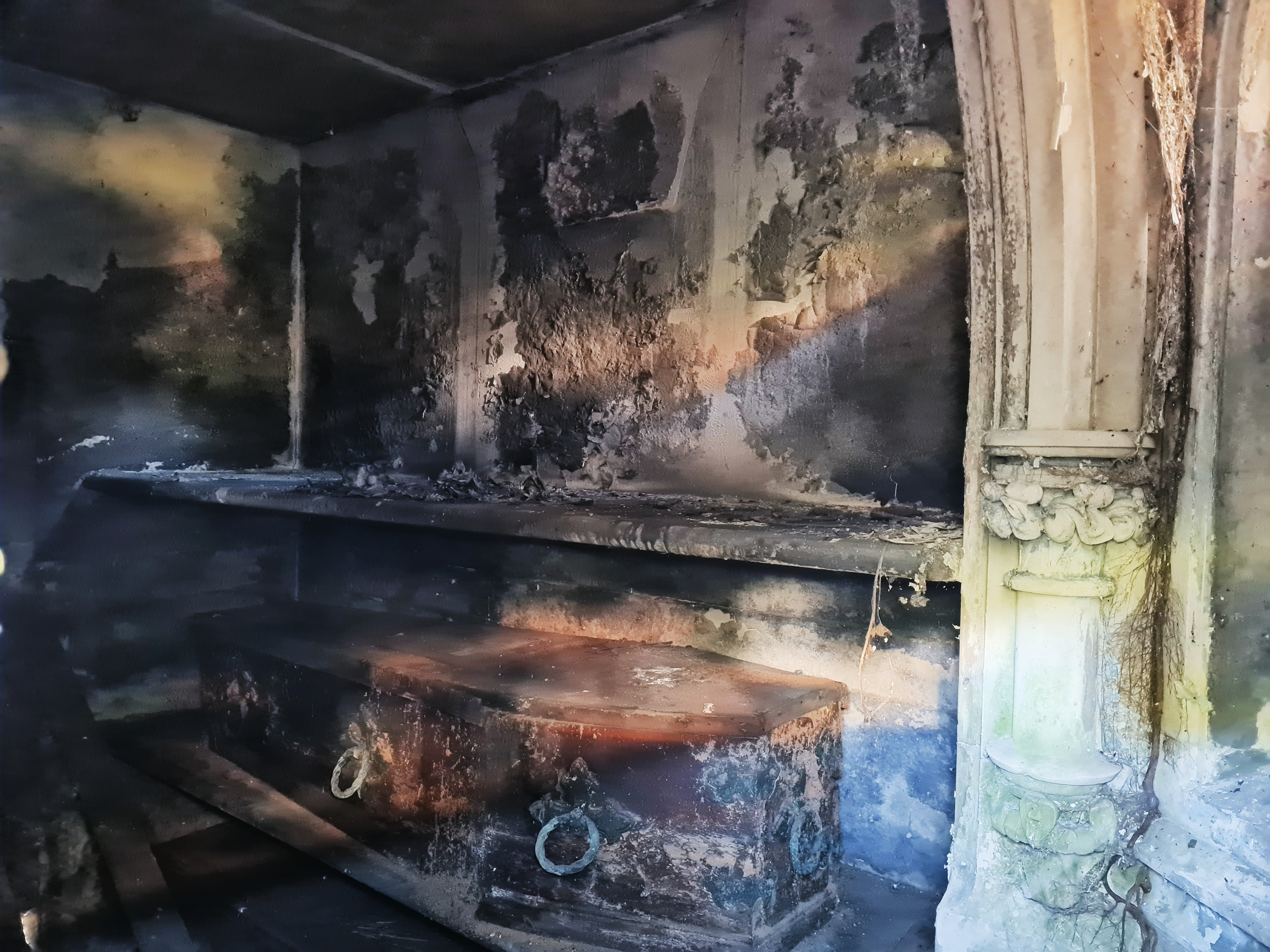
Meller and Parsons (London Cemeteries - An Illustrated Guide and Gazetteer) mention the mausoleum close to the Lidiard memorial; “a lavish exercise in the fourteenth-century Gothic style including a sculpture of the Ascension in the tympanum, fearsome over-sized gargoyles and a three-sided apse with shattered fragments of stained glass in the lancet windows. It is a tragedy that such an extraordinary building has suffered from neglect and vandalism.” The broken windows at least allow you to peer in and see the coffin still sitting on its shelf. Meller and Parsons do not name the occupant of the mausoleum, I presume because, Like me, they could not make out the name inscribed on the step. 

They also mention the ‘early examples of porcelain photographs of the deceased’ such as the ones below;